



Enterprise web scraping has evolved far beyond simple extraction scripts. Modern platforms combine distributed crawling, schema management, data validation, and AI-ready delivery into full data pipelines.
This article explains:
• why enterprise data requirements break DIY scraping systems
• how modern web scraping solutions handle scale and dynamic websites
• the core capabilities enterprises should evaluate in scraping platforms
• how managed solutions deliver structured, analytics-ready web data
Modern enterprises use web scraping solutions for several strategic functions:
Competitive intelligence
Companies track competitor pricing, product launches, assortment changes, and promotions across digital marketplaces. Real-time data helps pricing and strategy teams respond quickly to market shifts.
Market trend analysis
Businesses collect large volumes of product listings, job postings, reviews, and news data to understand emerging demand signals and market movement.
Lead generation and sales intelligence
Sales teams extract company information, job openings, and contact signals from websites and directories to identify potential customers.
Search and digital visibility monitoring
Marketing teams analyze search results, competitor pages, and keyword trends to optimize SEO strategies and digital campaigns.
However, what worked for small-scale scraping projects does not work for enterprises. Simple scripts or browser extensions quickly fail when organizations try to collect data continuously across thousands of websites.
Enterprise environments introduce several new requirements:
- Large-scale crawling infrastructure capable of handling millions of pages
- Structured datasets rather than raw HTML pages
- stable schemas and standardized fields
- integration with analytics platforms and AI pipelines
- reliable monitoring and maintenance
This shift has fundamentally changed how organizations approach web data collection.
Modern web scraping solutions are no longer just scripts that download webpages. They function as full data acquisition platforms, capable of transforming unstructured web content into structured datasets that feed business intelligence systems and machine learning models.
For enterprises operating in fast-moving digital markets, this capability turns web data into a continuous intelligence layer that informs pricing decisions, product strategy, investment analysis, and competitive positioning.
Enterprise Challenges in Scaling Web Scraping Solutions
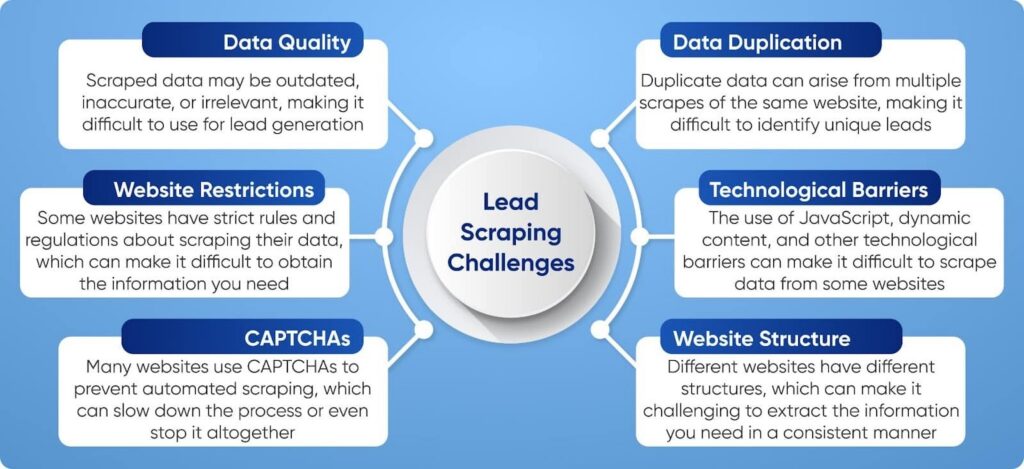
While the value of web data is clear, scaling web scraping solutions to enterprise levels introduces significant technical and operational challenges. Many organizations begin with small scraping scripts, only to discover that maintaining reliable data pipelines at scale requires far more infrastructure, governance, and monitoring.
Below are the key challenges enterprises encounter when implementing large-scale web scraping systems.
Massive Data Volume and Infrastructure Requirements
Enterprise data teams often need to collect information from thousands of websites and millions of pages. For example, e-commerce monitoring systems may track product catalogs across multiple marketplaces, while financial intelligence teams collect signals from corporate websites, news platforms, and regulatory databases.
At this scale, scraping infrastructure must handle:
- distributed crawling across multiple nodes
- high request volumes and concurrency control
- storage and processing of large datasets
- automated scheduling and retry logic
Without proper infrastructure design, scraping pipelines become unstable and data collection becomes inconsistent.
Handling Dynamic and Complex Web Structures
Modern websites are significantly more complex than traditional HTML pages. Many platforms now rely on JavaScript frameworks, dynamic rendering, and asynchronous content loading.
This means data often appears only after browser execution, requiring advanced extraction techniques such as:
- headless browser automation
- DOM rendering
- API interception
- dynamic content parsing
Websites also frequently update their layout or page structure, which can break extraction rules. Enterprise scraping systems therefore require continuous monitoring and rapid adaptation to structural changes.
Data Quality and Consistency
Collecting data is only the first step. For enterprises, the real value lies in clean, structured, and consistent datasets that can power analytics and AI systems.
However, web data is inherently messy. Organizations must address issues such as:
- inconsistent formatting across sources
- missing attributes
- duplicate records
- schema drift over time
Poor data quality can lead to flawed analysis and unreliable machine learning outputs. In fact, data quality issues remain one of the largest obstacles to successful AI deployments, making structured and validated datasets essential.
Data quality challenges are widely recognized across the analytics industry. Research from Gartner estimates that poor data quality costs organizations an average of $12.9 million per year, highlighting why structured and validated datasets are critical for enterprise analytics.
Anti-Scraping Mechanisms and Access Restrictions
Many websites actively attempt to block automated data collection using techniques such as:
- CAPTCHA challenges
- IP rate limiting
- bot detection algorithms
- fingerprinting systems
To operate at scale, enterprise scraping systems must implement countermeasures such as proxy rotation, request throttling, and distributed crawling infrastructure.
Legal and Compliance Considerations
Enterprises must also ensure that their data collection practices comply with applicable laws and ethical standards.
This includes:
- respecting website terms of service
- following data privacy regulations such as GDPR
- collecting only publicly available information
- maintaining proper governance and data lineage records
Enterprise-grade web scraping solutions therefore incorporate auditability, governance controls, and clear data provenance tracking to ensure responsible use of web data.
These challenges explain why enterprises increasingly move away from DIY scraping scripts and toward managed web scraping solutions that provide scalable infrastructure, monitoring, and structured data delivery. The next section will examine how modern web scraping solutions have evolved to solve these enterprise challenges, including AI-driven extraction, schema management, and real-time data pipelines.
How Modern Web Scraping Solutions Are Evolving for Enterprise Needs
To address the operational challenges of large-scale data collection, modern web scraping solutions have evolved far beyond simple extraction tools. Enterprises now require platforms that deliver reliable, structured, and continuously updated datasets rather than raw page downloads.
This evolution has transformed web scraping into a full data pipeline architecture that includes acquisition, structuring, validation, and delivery layers. The following capabilities define how enterprise-grade web scraping solutions operate today.
Scalable Distributed Crawling Infrastructure
One of the most important advancements in enterprise web scraping solutions is the ability to scale across massive data volumes.
Instead of relying on single-machine scripts, modern scraping platforms use distributed crawling systems that process thousands of concurrent requests across multiple nodes. This infrastructure enables organizations to:
- monitor large numbers of websites simultaneously
- collect millions of pages per day
- maintain consistent crawl schedules
- recover quickly from temporary failures
Reliable acquisition infrastructure ensures that enterprises receive consistent data updates without interruptions.
Structured Data Pipelines Instead of Raw Extraction
Earlier scraping tools typically delivered raw HTML or unprocessed datasets. However, enterprise data teams need structured and normalized data that can directly feed analytics systems or machine learning models.
Modern web scraping solutions therefore include transformation layers that:
- extract defined fields from web pages
- standardize data formats across sources
- enrich records with metadata and labels
- validate outputs against predefined schemas
This process converts messy web content into structured datasets suitable for enterprise data workflows. Maintaining consistent schema structures across datasets is essential because schema drift can easily break downstream systems and models if field definitions change unexpectedly.
Built-In Data Quality Monitoring
Enterprises increasingly expect scraping platforms to provide continuous quality monitoring rather than just data collection.
Advanced solutions track several key metrics to ensure data reliability, including:
- freshness of collected records
- completeness of key attributes
- bias across sources and categories
- statistical anomalies or distribution shifts
For example, monitoring dashboards often evaluate whether records are updated within acceptable time windows and whether mandatory fields remain populated across datasets. This type of monitoring prevents silent degradation in data pipelines and ensures that datasets remain reliable for analytics and AI workloads.
AI-Assisted Data Structuring and Enrichment
Another major shift in modern web scraping solutions is the use of machine learning and AI to improve extraction accuracy.
AI-assisted extraction systems can:
- identify patterns in page layouts automatically
- classify entities and attributes in unstructured content
- detect anomalies in scraped datasets
- enrich records with categories, sentiment signals, or metadata
This capability allows enterprises to convert raw web content into high-value datasets that support advanced analytics and AI models.
Enterprise Integration and Data Delivery
Finally, modern web scraping solutions focus heavily on integration with existing enterprise systems.
Instead of delivering static files, data pipelines now support:
- API-based delivery
- direct integration with data warehouses
- real-time streaming pipelines
- automated dataset updates
This ensures that web data becomes part of the organization’s broader data infrastructure, enabling teams to build dashboards, forecasting models, and competitive intelligence systems on top of continuously refreshed datasets.
How PromptCloud Delivers Enterprise-Grade Web Scraping Solutions
Enterprises that depend on external data quickly realize that building and maintaining scraping infrastructure internally is rarely a one-time effort. Website structures change, anti-bot defenses evolve, and data pipelines require constant monitoring to maintain accuracy and uptime.
This is where enterprise web scraping solutions from specialized providers become valuable.
PromptCloud focuses on solving the operational challenges that internal teams often struggle to manage at scale. Instead of delivering raw crawled pages, the platform provides structured, production-ready datasets that integrate directly into enterprise data workflows.
Successful enterprise web data pipelines require reliable extraction, structured datasets, and continuous monitoring. This is the foundation of modern enterprise Data-as-a-Service for web data.
Managed Infrastructure for Large-Scale Data Extraction
PromptCloud operates distributed crawling infrastructure designed to handle enterprise workloads. Organizations can collect data from thousands of sources without needing to manage proxy networks, crawling infrastructure, or monitoring systems internally.
This allows teams to focus on using data rather than maintaining scraping pipelines.
Typical enterprise use cases include:
- e-commerce price monitoring
- competitive product intelligence
- financial market signals
- job market data analysis
- sentiment analysis from reviews and forums
For example, retailers preparing for high-volume events such as seasonal promotions often rely on large-scale scraping to track competitor pricing changes across marketplaces. Monitoring these signals continuously helps pricing teams adjust strategies faster during volatile retail cycles.
PromptCloud provides SLA-backed data delivery and managed crawling infrastructure, allowing enterprises to collect web data without maintaining proxy networks, extraction logic, or monitoring systems internally.
Structured and AI-Ready Data Delivery
One of the biggest barriers in DIY scraping projects is transforming raw web content into datasets that analytics or AI systems can actually use.
PromptCloud focuses heavily on data structuring and normalization, ensuring that collected information is delivered in consistent formats suitable for analytics pipelines and machine learning models.
This includes:
- stable data schemas
- standardized field formats
- deduplication across sources
- labeled attributes and metadata
Structured datasets make it easier for organizations to build AI systems that depend on high-quality input data. Proper labeling and organization of web data is especially important when preparing datasets for large language models and other AI workflows.
Data Quality Monitoring and Governance
Reliable enterprise datasets require more than extraction. They require continuous quality validation and traceability.
PromptCloud’s pipelines emphasize:
- schema stability monitoring
- completeness validation
- freshness tracking
- provenance and lineage metadata
Maintaining lineage and transformation visibility ensures that data teams can trace every record back to its original source, which is essential for compliance, auditing, and debugging data pipelines.
Quality monitoring also helps prevent silent data issues that often appear in large-scale scraping systems. Tracking dataset health metrics allows teams to detect anomalies before they affect downstream analytics or models.
Enterprise Web Scraping Solutions Framework: Key Capabilities to Evaluate
As organizations begin evaluating vendors or building internal systems, one question becomes central:
What actually defines a modern enterprise web scraping solution?
Many tools can extract web data, but very few can deliver stable, structured, continuously updated datasets that integrate into enterprise analytics systems.
Enterprise teams should therefore evaluate web scraping solutions across multiple dimensions, including infrastructure reliability, data quality governance, and integration capabilities.
The framework below summarizes the core capabilities enterprises should assess before adopting a web scraping platform.
| Capability | Why It Matters for Enterprises | What to Evaluate |
| Scalable Crawling Infrastructure | Enterprises often collect data from thousands of sources. Infrastructure must handle large volumes without breaking pipelines. | Distributed crawling systems, concurrency management, proxy handling, failure recovery |
| Structured Data Output | Raw HTML is rarely usable in analytics or AI systems. Structured datasets are required for downstream applications. | Field extraction accuracy, schema standardization, normalization across sources |
| Schema Stability | Changes in website structure can cause schema drift, breaking dashboards or machine learning models. | Automated schema validation, version control, monitoring alerts |
| Data Quality Monitoring | Enterprise data pipelines require continuous validation to prevent silent data failures. | Completeness checks, anomaly detection, freshness monitoring |
| Anti-Bot Resilience | Websites frequently deploy mechanisms to block automated scraping. | Proxy rotation, request throttling, fingerprint management |
| Compliance and Governance | Enterprises must maintain responsible data collection practices and audit trails. | Data lineage tracking, governance policies, access controls |
| Integration with Data Systems | Web data must feed into enterprise analytics environments. | APIs, data warehouse integration, streaming pipelines |
| Operational Maintenance | Websites change frequently, requiring continuous updates to extraction logic. | Automated monitoring, maintenance support, rapid adaptation |
Organizations that treat web scraping as a data infrastructure capability rather than a one-time extraction project typically achieve far better results.
Modern web scraping solutions therefore combine acquisition, structuring, validation, and delivery into a single managed pipeline. This approach allows enterprise data teams to focus on analysis, forecasting, and decision-making, rather than maintaining fragile extraction scripts.
The Strategic Value of Web Scraping Solutions for Enterprise Intelligence
When implemented correctly, web scraping solutions become a foundational component of enterprise intelligence systems.
Companies across industries rely on continuous web data collection to support strategic decisions.
Retail organizations track competitor pricing and product availability across marketplaces. Financial institutions monitor digital signals such as hiring trends, regulatory announcements, and company updates. Travel and hospitality companies track demand signals, reviews, and pricing fluctuations across booking platforms.
In each of these scenarios, web data functions as an early signal layer that reveals market changes before they appear in traditional reports.
Reliable web scraping infrastructure therefore enables organizations to:
- identify emerging market trends faster
- detect competitor movements early
- monitor brand perception across digital channels
- power predictive analytics models with real-time signals
As the volume of digital information continues to grow, enterprises that can systematically capture and structure this data gain a measurable advantage in decision-making speed and market awareness.
The Future of Enterprise Web Scraping
As digital markets expand, the volume of valuable information published online continues to grow. Product listings, pricing updates, hiring signals, and customer sentiment now appear first on the web before they reach traditional reports or databases.
Organizations that can systematically capture and structure this information gain a measurable advantage in decision speed and market awareness.
Modern web scraping solutions therefore operate as full data acquisition platforms rather than simple extraction tools. Distributed crawling infrastructure, structured data pipelines, validation layers, and integration capabilities allow enterprises to transform web content into reliable intelligence systems.
Companies that treat web data as part of their broader data infrastructure will be better positioned to monitor competitors, detect market changes early, and build AI systems powered by continuously updated external data.
If you’re building enterprise web intelligence infrastructure, explore how enterprise Data-as-a-Service for web data handles large-scale data acquisition, structuring, and delivery at scale.
FAQs
What are web scraping solutions?
Web scraping solutions are technologies and platforms used to automatically collect data from websites and convert it into structured datasets. These solutions allow businesses to gather large volumes of web data for analytics, market research, and competitive intelligence.
Why do enterprises use web scraping solutions?
Enterprises use web scraping solutions to monitor competitor pricing, analyze market trends, track product availability, gather customer sentiment, and collect external data signals that support strategic decision-making.
What challenges arise when scaling web scraping solutions?
At enterprise scale, organizations face challenges such as handling massive data volumes, managing dynamic website structures, maintaining data quality, dealing with anti-bot mechanisms, and ensuring compliance with legal and ethical data collection practices.
How do modern web scraping solutions improve data quality?
Modern web scraping solutions include validation layers that check for completeness, consistency, and accuracy of extracted data. They also maintain stable schemas, remove duplicate records, and monitor dataset freshness to ensure reliable analytics.
Can web scraping solutions support AI and machine learning systems?
Yes. Structured datasets generated by web scraping solutions can be used to train machine learning models, monitor market signals, and support predictive analytics. Many organizations use web data to enrich datasets used in AI workflows.