



What are web scraping compliance challenges?
Web scraping compliance failures rarely happen at the start of a pipeline. They happen once the data becomes important. A team builds a reliable crawler. Robots.txt is respected. Rate limits are managed. Data flows cleanly into dashboards, AI pipelines, and reports. Everything works. Then an enterprise client requests a compliance review before contract sign-off. Or a legal team asks for data lineage documentation. Or a GDPR inquiry arrives and someone needs to explain the lawful basis for 18 months of scraped records. That is when the real challenge appears. Not technical. Governance.
In 2026, the question is not whether your scraper works. The question is whether your operation can withstand scrutiny. GDPR enforcement has intensified significantly, with regulators across Europe issuing record fines through 2023 and 2024. CCPA interpretation has broadened under California’s updated enforcement guidance. Over 140 countries now operate some form of data protection legislation. AI training data is under direct regulatory review within the EU AI Act framework. And Reddit’s 2025 lawsuit against Perplexity AI over scraping-related DMCA claims signals how far legal risk has expanded beyond traditional compliance conversations.
None of these issues show up in crawl logs. They show up in audits, partnership due diligence, and product liability reviews. The compliance challenges in this guide are the ten gaps that legal teams, enterprise clients, and data governance officers find first.
1. Treating Robots.txt as a Legal Shield
Many teams still equate robots.txt adherence with legal compliance. Respecting robots.txt matters. It signals technical good faith and, as the European Data Protection Board has noted in its AI guidance, ignoring it can weigh against organizations in fair processing assessments. But robots.txt is a crawl instruction file, not a legal contract.
Data privacy regulations focus on personal data and its lawful processing basis. Copyright restrictions focus on content ownership. Terms of service violations hinge on contractual interpretation. None of these are resolved by reading robots.txt. A scraper can fully comply with robots.txt and still create regulatory exposure by capturing personal data without a documented lawful basis, or by storing copyrighted content without usage rights.
The ICO (UK Information Commissioner’s Office) has published guidance confirming that technical compliance measures do not substitute for lawful processing obligations under data protection law. You can read the ICO guidance on web scraping and data protection for the regulatory baseline your legal team needs to work from. Robots.txt is a necessary starting layer, not a compliance ceiling.
2. Misreading the Scope of GDPR
Most teams understand that GDPR applies to names, emails, and phone numbers. That is the surface. The regulation defines personal data as any information relating to an identifiable person, and that scope extends further than most pipelines account for in their initial design.
Location signals can qualify. Device identifiers can qualify. Combined datasets that enable re-identification qualify even if no single field appears sensitive in isolation. The compliance challenge is not just what you collect. It is what your dataset becomes when fields are joined across sources or time periods.
Consent management adds another layer. Public accessibility does not automatically establish a lawful basis. Just because a profile is visible on a website does not mean the underlying data is freely available for processing under any purpose. GDPR requires a documented lawful basis, processing limited to declared purposes, and functioning deletion workflows. If your scraping pipeline cannot trace source context, processing purpose, and retention schedule per dataset, it cannot demonstrate compliance under examination.
GDPR violations carry fines of up to 20 million euros or 4 percent of global annual revenue. The standard applied by regulators is not whether you had bad intent. It is whether you can demonstrate a documented, defensible process that was active at the time of collection.
3. CCPA Data Usage Rights and the Late-Appearing Risk
CCPA and similar state privacy laws focus on consumer rights: the right to know what data is held, the right to delete it, and the right to opt out of its sale. The definition of sale under CCPA includes data sharing for value exchange, which can apply even when no direct payment changes hands.
This is where compliance issues appear quietly. A scraping pipeline may operate without incident for a long time. Then a partnership forms, data is packaged into a product feature, or an enterprise client requests formal compliance assurances before signing. CCPA implications emerge at that moment, not at ingestion.
The structural problem is that web scraping systems are designed for ingestion, not lifecycle management. Deletion workflows are rarely built in from the start. Opt-out mapping does not exist. If a data subject request arrives and your team cannot trace, locate, and remove associated records within the required timeframe, you face compounding risk with each delay. Legal compliance in web scraping is not just about what you collect. It is about what you can do with it when the rules require action.
Experiencing These Challenges?
If your scraping pipeline was built for scale but not for scrutiny, you are not alone. Our compliant web data and governance solutions help you close the gap before an audit does.
4. Terms of Service Ambiguity and Selective Enforcement
Many websites prohibit automated access in their terms. Others permit it under conditions. Some restrict data reuse without explicitly prohibiting access. Enforcement varies significantly by platform, data volume, and commercial context.
Web scraping compliance challenges in 2026 are increasingly contractual rather than purely technical. The question is not whether scraping is mechanically possible. It is whether it violates agreed terms in ways that create legal exposure when scrutinized by a regulator, partner, or opposing counsel.
High-value sectors carry elevated risk. Competitive intelligence use cases in social platforms regularly intersect with platform terms and content licensing frameworks. For teams building intelligence programs on social signals, understanding where public data ends and platform-restricted data begins is foundational. PromptCloud’s practical breakdown of social media scraping for competitive intelligence outlines how to approach this boundary responsibly.
Without standardized TOS review processes, teams make ad-hoc decisions per domain. Terms of service violations rarely surface at crawl time. They appear during disputes, procurement audits, or escalations when a high-value contract is on the line.
5. Copyright Exposure in Content Reuse
Scraping publicly accessible content does not automatically grant the right to reuse it. Access and rights are different legal questions. Scraping is about reaching data. Copyright is about what you do with what you find.
Displaying excerpts internally for analysis is different from redistributing content. Indexing data for internal search is different from training an AI model on it. Replicating product descriptions or brand copy in commercial systems carries additional exposure beyond simple collection.
In ecommerce scraping, product specifications tend to be factual and less protected under copyright. But product descriptions, marketing copy, and images frequently carry copyright protection. The compliance challenge is reuse classification. Not every field in a scraped dataset carries the same rights profile. PromptCloud’s operational guide to extracting product information from ecommerce sites illustrates how data type determines the compliance profile of downstream use.
AI training data has amplified this challenge significantly. Multiple active court cases in the US and EU are still resolving whether using scraped content for model training constitutes a rights violation. Teams need internal policies defining how scraped content is stored, transformed, indexed, and redistributed. Without that clarity, copyright exposure accumulates quietly across every pipeline that has not been formally reviewed.
Get structured web data built for AI agent pipelines, delivered to your exact schema, across any source, refreshed on your schedule.
• No contracts. • No credit card required. • No scraping infrastructure to maintain.
6. Consent Ambiguity in Publicly Visible Data
Public visibility does not equal informed consent. A user profile visible on a platform was likely created under platform-specific expectations about how that data would be used. That user almost certainly did not anticipate third-party scraping for analytics, profiling, or AI training purposes.
Data privacy frameworks consistently emphasize purpose limitation as a binding principle. Even when personal data is publicly accessible, reprocessing it for unrelated purposes may require a separate lawful basis. Platforms collect consent for their own defined processing, not for external use cases that third parties have not disclosed to the data subject.
The compliance risk emerges when intent is undocumented. Teams need written purpose statements for scraped datasets. They need internal policies governing secondary use cases. They need traceability linking data origin to processing purpose across the full data lifecycle. Without that documentation, compliance becomes reactive, and reactive compliance consistently costs more than proactive architecture.
7. PII Masking and Data Minimization Applied Too Late
Personal data enters scraped datasets more frequently than teams expect, and rarely through the obvious channels. Usernames appear embedded in URLs. Contact details surface inside PDFs. Metadata is hidden inside image EXIF data. Customer reviews contain phone numbers or physical addresses shared casually in review text.
These exposures are incidental, not intentional. The failure mode is sequencing. Many teams apply masking after storage: data is collected, written in raw form, and then redacted downstream. That window creates exposure. Logs, backups, and intermediate pipeline stages may already contain personal data before any masking occurs, and each system that touches unmasked data becomes part of the compliance scope.
In 2026, data minimization must be enforced at ingestion, not as a cleanup task applied later. Mature pipelines run automated PII detection during extraction using pattern scanning for emails, phone numbers, and national identifiers alongside contextual signals in review text and forum threads. They apply redaction or pseudonymization before persistence, tag records containing sensitive attributes, and log masking events as auditable governance actions. In AI training contexts, removal after model ingestion is technically non-trivial. The only reliable protection is preventing unmasked PII from ever entering the training pipeline.
8. Audit Trails Built for Technical Logs, Not Governance
Most web scraping teams believe they are compliant because nothing has gone wrong. Audits do not measure whether scraping worked. They measure whether decisions were documented and whether governance processes were followed at the time of collection.
Scraping systems typically generate strong technical logs: request timestamps, crawl frequency, response codes, error rates. What they rarely capture is governance context. Processing purpose per dataset. Legal review status per domain. Robots.txt assessment records. PII masking confirmation. Consent filtering logs. When regulators, enterprise clients, or procurement teams request documentation, those questions require a different class of evidence than technical logs provide.
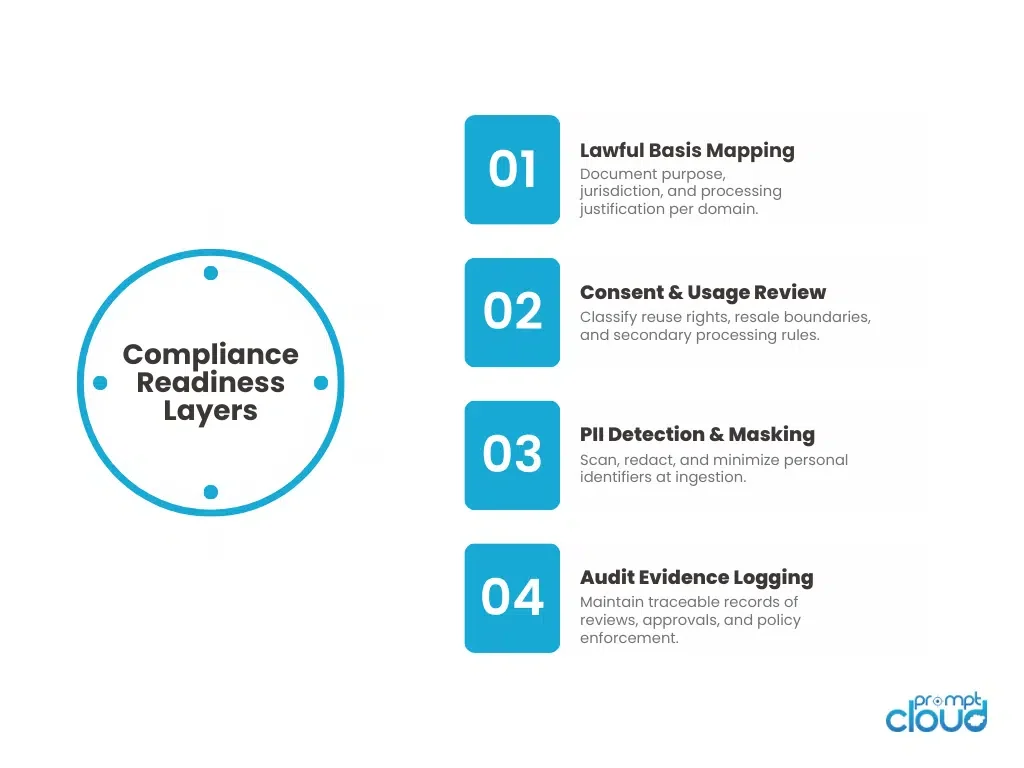
Compliance documentation requests in enterprise sales contexts now arrive significantly earlier in procurement cycles than they did even two years ago. Legal review is no longer a post-deal checkpoint. It is an entry requirement for high-value enterprise contracts. A scraping operation that delivers data reliably but cannot produce compliance evidence on demand has a structural gap that becomes visible at the worst possible moment.
9. Cross-Border Data Transfer Compliance
Web scraping operates across borders by design. Crawl servers may be in one country. Data subjects in another. Storage infrastructure in a third. AI processing pipelines in a fourth. Each jurisdiction may carry different obligations, and most scraping pipelines were not built with jurisdiction mapping as a first-class concern.
GDPR imposes explicit restrictions on cross-border data transfers outside the European Economic Area. Approved transfer mechanisms such as Standard Contractual Clauses or adequacy decisions like the EU-US Data Privacy Framework must be in place when personal data crosses jurisdictions. PDPA variants across Southeast Asia and the EU AI Act add additional layers that vary by destination country and use case.
Most scraping pipelines do not tag data by origin jurisdiction. They aggregate first and classify later. That sequencing creates risk that compounds when operations expand into new markets or when enterprise clients begin asking jurisdiction-specific questions during due diligence. Geographic tagging, region-based processing rules, and data residency controls need to be part of the pipeline architecture, not added retrospectively when a problem forces the issue.
10. Data Governance Frameworks That Cannot Keep Pace With Scale
Web scraping systems typically scale technically much faster than they mature operationally. Crawl volume increases. Domains expand. Data products grow. AI training pipelines integrate. But governance frameworks remain static. Policies exist in documents and slide decks, not in systems with automated enforcement.
Without automated compliance gates, structured review workflows, recurring domain risk assessments, and a centralized data usage registry, legal compliance in web scraping becomes reactive by default. Issues are addressed after escalation. Reviews happen after contracts are signed. Retention policies are implemented after datasets are already stored at scale and have already flowed into downstream systems.
Governance must evolve at the same speed as technical growth. Compliance is not a constraint on scraping operations. It is an architectural layer that determines whether the data your operation produces can be safely used in enterprise, regulated, and AI contexts. If your governance framework cannot keep pace with crawl volume, compliance challenges will consistently surface late. And late compliance is always more expensive than early compliance.
Compliance Risk Map: Web Scraping in 2026
| # | Challenge | Where It Breaks | Why It Surfaces Late | What Mature Teams Do |
|---|---|---|---|---|
| 1 | Overreliance on robots.txt | Crawl directives treated as legal approval | No issues until formal audit | Separate technical access rules from legal assessment |
| 2 | GDPR scope misread | Personal data captured indirectly via field combination | Exposure appears during complaint or audit | Track lawful basis and purpose per dataset |
| 3 | CCPA usage rights gaps | Data resold or shared downstream | Risk emerges during partnerships or productization | Map resale, sharing, and deletion workflows |
| 4 | Terms of service ambiguity | Scraping violates platform contracts | Enforcement triggered selectively | Standardize TOS review and domain risk scoring |
| 5 | Copyright exposure | Scraped content reused in products or AI training | Content ownership disputes surface later | Classify reuse types and restrict redistribution |
| 6 | Consent ambiguity | Public data reused beyond original intent | Questioned during compliance inquiry | Document processing purpose and secondary use policy |
| 7 | PII masking failures | Personal identifiers captured unintentionally | Discovered after internal or external audit | Embed automated PII detection at ingestion |
| 8 | Weak audit trails | No governance documentation of reviews or controls | Audit requests need retroactive reconstruction | Maintain governance logs and review records |
| 9 | Cross-border transfer risk | Data stored across jurisdictions without tagging | Triggered during market expansion or enterprise deals | Tag data by origin and enforce region-based policies |
| 10 | Governance lag at scale | Crawl volume grows without policy updates | Compliance gaps widen quietly | Build governance into pipeline architecture |
When Web Scraping Becomes a Compliance Problem
Most compliance failures in web scraping do not start with bad intent. They start with a pipeline built to collect, not to justify.
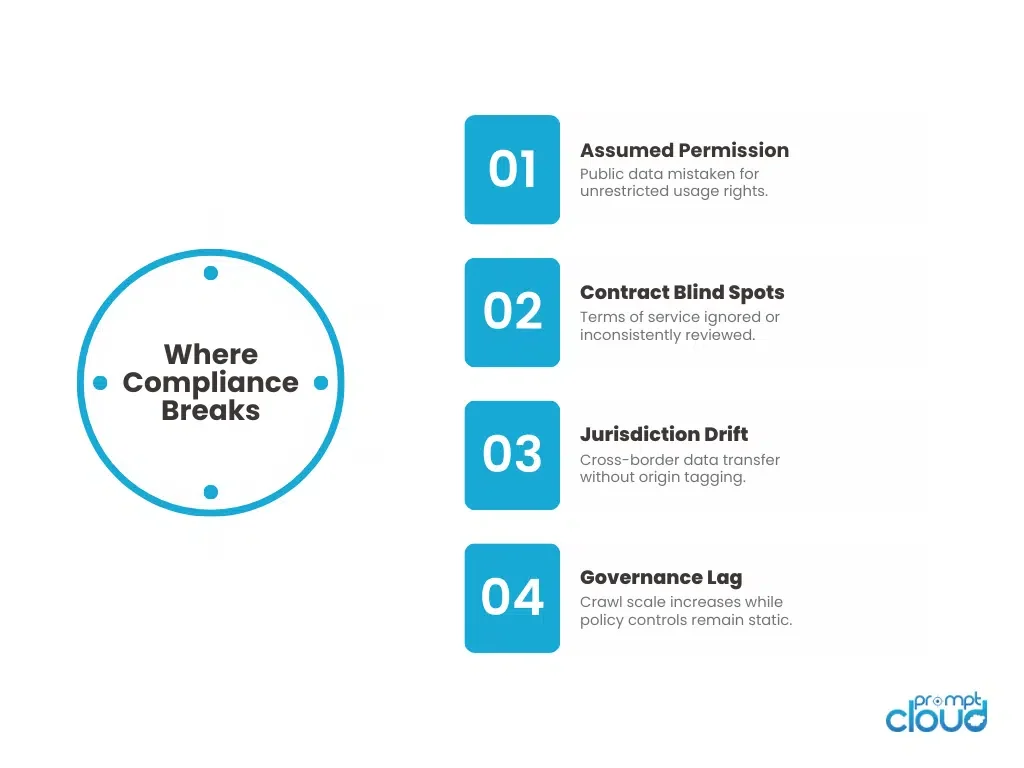
Early on, everything looks fine. Data lands. Dashboards move. Teams ship. Nobody asks difficult questions because the output is described as internal, experimental, or temporary. Then the data becomes commercially important. It gets shared with partners. It powers a product feature. It trains a model. It appears in a board deck during an acquisition review. The standard changes at that moment.
Now you need to answer questions your system was never designed to answer:
- Why was this data collected, and what is it used for today?
- What personal data could be present, even indirectly through field combinations?
- What happens when a record needs to be deleted or excluded from a dataset?
- Which jurisdiction does this dataset fall under, and where is it being processed?
- Can you prove that masking, minimization, and retention controls were active at the time of collection?
This is why compliance issues appear late. Not because teams ignored the law, but because most pipelines treat compliance as documentation rather than as architecture. In 2026, documentation is not enough. Enterprise clients want evidence. Regulators want controls they can inspect. Legal teams want repeatable review processes, not one-off approvals that cannot be reproduced for the next audit cycle.
Compliance is not a blocker to web scraping at scale. It is the quality bar that determines whether your data can be used safely in enterprise, regulated, and AI contexts. If you cannot defend the dataset, the dataset is not production-ready.
How PromptCloud Approaches Compliance-First Web Scraping
PromptCloud builds web data pipelines with compliance architecture embedded from the start, not added after a contract requires it. The approach addresses the structural gaps that create the most risk in enterprise and AI data contexts.
At the pipeline level, PII detection and masking run at ingestion before any record reaches persistent storage. Datasets are tagged with source, processing purpose, and origin jurisdiction at the point of collection, creating the traceability that audit and governance reviews require. Robots.txt rules are assessed alongside legal review, not treated as a substitute for it.
For enterprise clients in financial services, ecommerce, and AI platform contexts, PromptCloud maintains documented lawful basis tracking, retention schedules, and deletion workflows as operational controls rather than policy documents. This is what allows compliance reviews to be procedural rather than disruptive.
The practical result is that scraping pipelines can pass procurement and compliance audits without requiring significant retroactive remediation. For organizations evaluating their current scraping infrastructure against these standards, PromptCloud’s compliant web data and governance solutions provide a structured starting point for assessing and closing governance gaps before they surface in an audit.
If your operation supports enterprise clients, AI systems, or regulated data products and your current governance framework was built for technical scale rather than regulatory defensibility, that is the gap worth addressing first.
Building Defensible Web Scraping Operations
The organizations that navigate web scraping compliance successfully share one structural characteristic: they build traceability, consent logic, and jurisdiction mapping into pipelines from the start rather than retrofitting them after problems emerge.
That means governance controls embedded in pipeline architecture, not layered on top after the fact. Audit logs that capture governance context alongside technical events. PII detection that runs before data reaches storage. Retention and deletion workflows that function as real operational systems. Purpose documentation that can be retrieved and presented on demand without a manual reconstruction effort.
The EDPB, the ICO, and the IAPP have each published guidance emphasizing that lawful basis documentation and data minimization are enforcement priorities, not aspirational standards. Organizations that treat them as optional until challenged will continue to face the same pattern: compliance gaps that surface late, at the worst possible moment, with the highest possible cost.
If your scraping operation supports enterprise clients, AI systems, or regulated data products, the time to assess your compliance architecture is before the next audit request arrives, not after it does.
Get structured web data built for AI agent pipelines, delivered to your exact schema, across any source, refreshed on your schedule.
• No contracts. • No credit card required. • No scraping infrastructure to maintain.
FAQs
1. Is web scraping legal if the data is publicly available?
Public availability does not determine legality on its own. GDPR and CCPA apply to personal data regardless of whether it appears on a public website. Copyright law applies to creative content regardless of how it was accessed. Legality depends on what is collected, what it is used for, and which regulatory frameworks apply to the individuals whose data is involved. Many scraping operations are entirely lawful when formally assessed. The ones that create risk are typically those that have never been reviewed against applicable regulations.
2. Does following robots.txt guarantee compliance with data privacy laws?
No. Robots.txt communicates crawl preferences and respecting it is considered good practice, but it carries no legal authority under GDPR, CCPA, copyright law, or most terms of service frameworks. A scraper can follow robots.txt directives precisely and still violate privacy regulations by collecting personal data without lawful basis, or violate copyright law by reusing protected content commercially. Robots.txt is a starting point for technical compliance, not a legal shield.
3. How does GDPR apply to web scraping teams based outside the EU?
GDPR applies based on the location of data subjects, not where the scraping operation is headquartered or where its servers are located. If a pipeline collects data about EU residents, GDPR obligations apply regardless of where the company is incorporated. This extraterritorial scope includes the requirement to document a lawful basis, implement data minimization, honor data subject rights requests, and maintain records of processing activities. Teams outside the EU consistently underestimate this reach until it surfaces during a formal inquiry or enterprise procurement review.
4. What is the biggest compliance risk when scaling a web scraping operation?
Governance lag. Technical scale consistently outpaces operational maturity in scraping operations. As crawl volume, domain coverage, and downstream data products grow, review processes, deletion workflows, and audit trail practices often remain static or informal. The result is a widening gap between what the operation collects and what it can defend under audit. By the time the gap becomes visible, significant retroactive remediation is typically required, and retroactive remediation is both costly and incomplete.
5. Can scraped data be used to train AI models without a compliance review?
Not without risk. AI training introduces compliance considerations beyond standard scraping. The EU AI Act requires transparency about training data sources for AI systems deployed in the EU. Multiple active court cases in the US and Europe are still resolving whether using scraped content for model training constitutes a copyright violation. Using scraped content for model training without a formal rights assessment and compliance review creates accumulating legal exposure that compounds as the model is deployed and scaled.
6. What lawful basis should a web scraping operation document under GDPR?
Most web scraping operations rely on legitimate interest under Article 6(1)(f) of GDPR when personal data is involved. However, legitimate interest is not automatic or assumed. It requires a documented Legitimate Interest Assessment that weighs the organization’s processing purpose against the reasonable expectations of the data subjects involved. Regulators including the CNIL and ICO have been clear that legitimate interest cannot be applied as a default without this documented balancing test. Organizations that rely on it without documentation are exposed even if the underlying use case would have been defensible.
7. What happens if a scraping operation receives a GDPR deletion request?
The organization must locate, trace, and delete all records associated with that data subject within 30 days in most cases. If the scraping pipeline was not designed with deletion workflows from the start, fulfilling this request becomes technically complex and operationally expensive. It often requires manual tracing across raw storage, intermediate pipeline stages, backups, and any downstream systems that received the data. Deletion workflows and data lineage tracking designed into the pipeline from the beginning are the only reliable way to handle these requests at scale without significant disruption.
8. Are terms of service violations in web scraping a criminal offense?
Terms of service are contracts, not statutes. Violating them is not automatically a criminal offense. It can result in civil claims for breach of contract, account termination, IP blocking, and in some cases it can strengthen a platform’s argument for unauthorized access under computer fraud laws such as the CFAA or equivalent laws in other jurisdictions. Courts in the US have reached different conclusions about TOS enforceability depending on how the terms were presented and whether the user took an affirmative action to agree. Enforcement tends to focus on behavior that causes measurable harm or competitive disruption to the platform.
9. How should enterprise web scraping teams prepare for compliance audits?
Audit readiness requires four documented controls operating together: a lawful basis recorded per dataset with supporting assessment, evidence of PII detection and masking controls active at ingestion, traceable processing purpose for each data source, and functional deletion and retention workflows. Teams should run internal reviews against these criteria before external audits occur. Compliance gaps found internally are significantly less disruptive than those found by regulators or enterprise counterparties. A data lineage record capturing source, purpose, jurisdiction, and processing history per dataset is the most durable foundation for entering any audit with confidence.
10. What is the difference between web scraping compliance and data governance in scraping?
Compliance refers to meeting specific regulatory requirements: GDPR, CCPA, copyright law, terms of service obligations. Data governance is the broader operational framework that makes compliance repeatable and auditable at scale. Compliance tells you what you must do. Governance tells you how your organization will consistently do it, document it, and demonstrate it on demand. Teams that have compliance policies in documents but no governance infrastructure built into their pipelines are typically the ones that fail audits, not because they were non-compliant in intent, but because they cannot produce the evidence that demonstrates compliance in practice.