


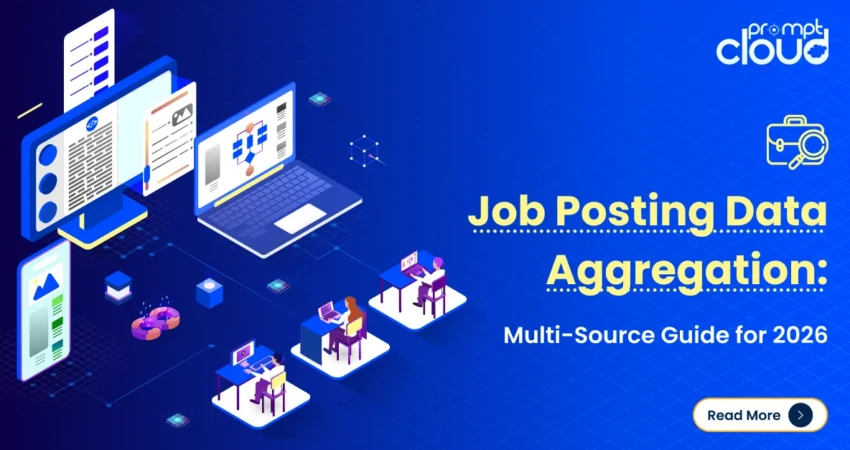

How Job Posting Data Aggregation Works?
If you are building a job board, running labor market analysis, or training a recruitment model, you already know the core problem: job data lives everywhere, and none of it agrees with itself. A single role gets posted on LinkedIn, syndicated to Indeed, picked up by three aggregators, and listed on the employer’s own careers page with a slightly different title each time. By the time your pipeline ingests it, you have four records for one job, inconsistent salary fields, and a posting date that differs by two weeks depending on the source.
Job posting data aggregation is the process of collecting structured job listings from multiple sources, resolving those conflicts, and delivering a clean, deduplicated feed that is actually usable downstream. Done well, it powers everything from competitive intelligence dashboards to AI training datasets. Done poorly, it becomes a daily maintenance problem that quietly corrupts every decision that depends on it.
This guide covers how multi-source job data aggregation works in practice, where the real engineering pain points are, and what separates a pipeline that holds up in production from one that needs constant patching.
What Is Job Posting Data Aggregation and Who Actually Needs It
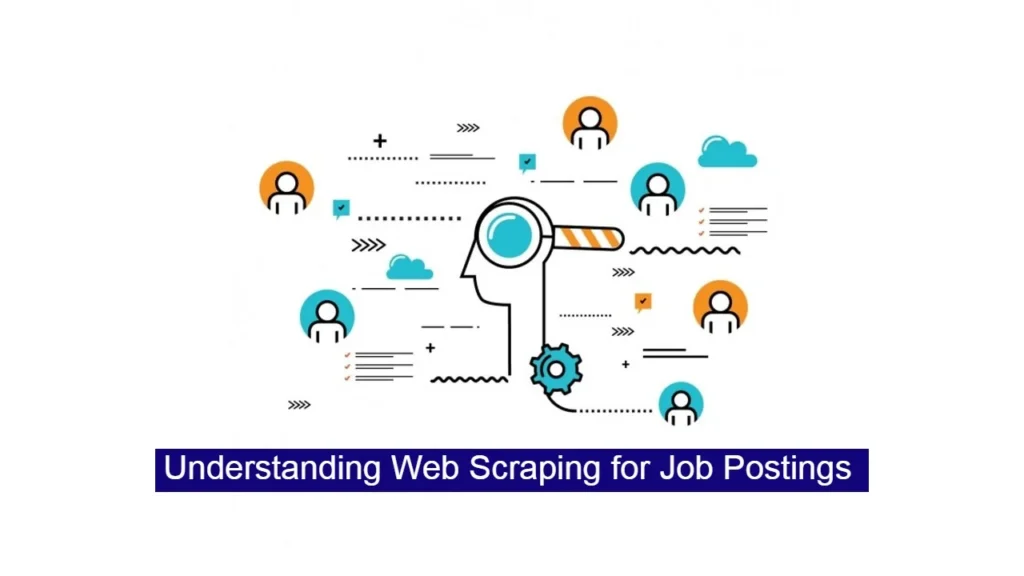
Job posting data aggregation means pulling job listings from multiple distinct sources into a single, structured, normalized dataset. The sources can include major job boards like Indeed or LinkedIn, employer career pages, applicant tracking system feeds, staffing agency listings, niche vertical boards, and government employment portals. The goal is not just collection. It is coherent, consistent data that can support analysis, product features, or machine learning at scale.
The use cases go well beyond building a job board. Workforce analytics firms use aggregated job data to track hiring velocity by sector and geography. Economic researchers treat it as a leading indicator for labor market movement, a function explicitly recognized in the U.S. Bureau of Labor Statistics JOLTS methodology, which measures job openings as a proxy for employer demand before those hires actually appear in payroll data. HR technology vendors use it to benchmark salary ranges and map emerging skill demand. AI teams use it as a training corpus for models that need to understand job titles, skill taxonomies, and compensation patterns at scale.
What all of these use cases share is a requirement for data that is fresh, structured, and trustworthy across sources. The moment a single source introduces schema drift or goes offline for a day, every downstream product feels it. That dependency is precisely why the architecture of the aggregation pipeline matters as much as the volume of data it collects.
Stop rebuilding scrapers every time Indeed redesigns a page.
• No contracts. • No credit card required. • No scraping infrastructure to maintain.
Where the Data Actually Comes From: The Multi-Source Landscape
A robust job data pipeline does not rely on one source type. The landscape spans at least four distinct categories, each with different collection mechanics, freshness characteristics, and reliability profiles.
Successful multi-source job data collection requires more than a scraper that works today. It requires infrastructure that adapts continuously as sources change, without pulling your engineering team off core product work. This is the foundation of modern job data aggregation.
Major Job Boards
Platforms like Indeed, LinkedIn, Glassdoor, and ZipRecruiter collectively hold hundreds of millions of job records. They are the obvious starting point, but they are also the most actively protected. Each platform uses rate limits, bot detection layers, and terms of service that govern programmatic access. Some offer official APIs with restricted coverage. Most require web-based collection for any serious volume, which is where professional web scraping services become the practical solution rather than the fallback option.
Employer Career Pages
Direct collection from employer career sites gives you data that bypasses aggregator delays. A job posted on a company’s own careers page is typically the original record. Everything else downstream is a copy. Providers that index hundreds of thousands of employer career pages daily capture listings before they are syndicated anywhere else. The trade-off is coverage breadth: you need to crawl at enormous scale to match the volume available on major boards, and employer sites change their page structure frequently without warning.
ATS Feeds and XML Sitemaps
Many enterprise employers publish structured job feeds through their applicant tracking systems. Platforms like Greenhouse, Lever, Workday, and iCIMS expose XML or JSON feeds that can be ingested programmatically. These feeds are reliable, well-structured, and often available without scraping. They are, however, limited to employers using those platforms who choose to make feeds public. ATS feeds work best as a supplement to board and career page collection, not as a standalone source.
Niche Boards and Regional Sources
Vertical job boards covering healthcare, legal, engineering, or logistics often hold listings that never appear on general boards. Regional government employment portals, trade association job boards, and staffing agency listing pages add further coverage. These sources are typically lower volume but high signal for specialized use cases. They are also more likely to break silently when their page structure changes, since they receive far less engineering attention than major platforms.
The Real Technical Challenges in Multi-Source Job Data Aggregation
Pulling data from multiple sources is the straightforward part. Making it usable is where the actual engineering work lives. These are the four challenges that trip up most teams building aggregation pipelines from scratch.
Schema Inconsistency Across Sources
No two sources structure job data the same way. One board calls it ‘job_title’, another uses ‘position_name’, a third embeds it as the first line of a freeform description field. Salary might appear as a structured range, a single number, or a phrase buried deep in the body copy. Location can be a city, a metro area, a postal code, or a remote designation with no geography attached. Before any two records can be meaningfully compared, they need to be mapped to a shared schema. That normalization work is continuous because sources change their structure without notice.
Deduplication at Scale
A single job posting routed through multiple distribution channels can produce five or more duplicate records across your pipeline. Exact-match deduplication on job ID is useless here because each platform assigns its own internal ID to the same listing. Real deduplication requires fuzzy matching across title, company name, location, and description, tolerating minor variations while catching genuine duplicates. This becomes computationally expensive as the dataset size grows. Teams evaluating Grepsr alternatives often find that built-in deduplication at the collection layer is one of the most decisive differentiators between providers, since resolving it downstream is an ongoing engineering cost that compounds quickly.
Freshness and Expiry Management
Job data goes stale fast. A listing that was live on Monday may be filled and removed by Wednesday. Aggregators do not always pull down listings promptly, which means datasets can accumulate ghost jobs: records that appear active but have been closed at the source. Managing expiry requires either re-crawling at high frequency or cross-referencing against source APIs where they exist. Neither approach is cost-free. The freshness requirement also varies sharply by use case. Labor market trend analysis can tolerate weekly snapshots. A live job board cannot.
Anti-Bot Infrastructure and Access Reliability
Major job boards invest heavily in detecting and blocking automated access. IP rotation, JavaScript rendering, session management, and browser fingerprint randomization are all part of what a production-grade collection system needs to handle continuously. This is precisely why web scrapers fail in production at a far higher rate than teams initially expect. A scraper that works cleanly against a static test environment will not survive a production board that fingerprints request headers, detects headless browser signals, and rate-limits by subnet.
How a Production-Grade Job Data Pipeline Is Built
A pipeline that holds up over months of operation is not a single scraper pointed at a handful of sources. It is a layered system where each stage has a clear responsibility and defined failure behavior.
Extraction Layer
The extraction layer handles collections from each source type. For web-based sources, this means a browser automation or HTTP client stack capable of handling JavaScript-rendered pages, session tokens, and rotating anti-bot countermeasures. For ATS feeds and sitemaps, it means scheduled ingestion of structured data with validation against expected schemas. Raw data should be captured with full source metadata intact: collection timestamp, source URL, and any available native identifier. Discarding provenance at this stage makes debugging everything downstream significantly harder.
Normalization Layer
Raw data flows into a normalization layer that maps each source’s schema to a shared canonical format. Title standardization, location parsing, salary extraction from freeform text, and employment type classification all happen at this stage. The layer should be configurable per source because the rules for parsing a Glassdoor listing are entirely different from the rules for parsing a regional healthcare board. Teams that hard-code normalization logic end up rewriting it every time a source updates its structure.
Deduplication and Merging
After normalization, records pass through deduplication. The most reliable approach combines exact matching on a composite key of company name, job title, and location with a secondary fuzzy-match pass for records that score above a similarity threshold. Where duplicates are found, the pipeline should merge them into a single canonical record that preserves the highest-quality field values across all matched sources rather than arbitrarily favouring one.
Enrichment and Classification
Clean, deduplicated records can then be enriched with derived fields. Skills extraction from job descriptions, seniority classification from title patterns, and industry tagging from company metadata all add analytic value that the raw source data does not provide. Enrichment is also where company-level data can be joined, linking individual postings to firmographic records for revenue band, employee headcount, or sector classification.
Delivery and Monitoring
The final stage handles delivery in whatever format the downstream consumer requires: API endpoints, flat file exports, database writes, or streaming feeds. Equally important is monitoring. A production pipeline should track collection success rates per source, schema drift alerts, deduplication efficiency, and freshness metrics by source. Without this observability, a source going dark or changing its structure is invisible until a downstream team notices that their data looks wrong.
Build vs. Buy: Where Most Teams Get the Calculation Wrong
Almost every team that decides to build a job data aggregation pipeline in-house underestimates the ongoing operational cost relative to the initial build. The first version, covering two or three sources with basic normalization, is achievable in a few weeks. The reality that follows is far more demanding.
Job boards update their page structure regularly. Anti-bot defenses get upgraded. Sources go down, come back with different schemas, or begin blocking the IP ranges your scraper runs on. Each of these events requires an engineer to diagnose the failure, update the relevant collector, and validate that the fix did not break anything else in the pipeline. Across a system covering dozens of sources, this maintenance load accumulates into a substantial ongoing engineering commitment that was not in the original build estimate.
The full trade-off is explored in depth when comparing web scraping build vs. buy approaches, but for job data specifically, the calculation tilts toward managed infrastructure once source count exceeds ten to fifteen. Below that threshold, the build case is defensible. Above it, the maintenance burden typically exceeds what a small data engineering team can absorb without it dominating their time.
The other underestimated cost is compliance. Terms of service, robots.txt conventions, and regional data regulations all affect what you can collect and how. A managed provider carries years of experience navigating these constraints across hundreds of deployments. A team building from scratch has to develop that expertise entirely on its own.
What Quality Job Data Actually Looks Like at Scale
High-volume job data is not the same as high-quality job data. Understanding the difference matters when evaluating your own pipeline output or assessing any third-party data provider.
Quality in job posting data has four measurable dimensions:
- Completeness: The proportion of records that contain values in expected fields. A dataset where 40 percent of records have no salary data and 25 percent have no location is large in volume but limited in analytical coverage.
- Consistency: Whether equivalent values are represented the same way across records. ‘Software Engineer’, ‘Sr. Software Engineer’, ‘SWE II’, and ‘Software Eng.’ all describe overlapping roles but cannot be compared without normalization.
- Freshness: The lag between a job being posted at the source and appearing in your dataset. For live applications, this needs to be measured in hours, not days.
- Deduplication rate: The percentage of records that represent genuinely unique listings versus copies of the same posting captured from multiple channels.
Evaluating a provider against these four dimensions is more informative than comparing headline record counts. A dataset with 50 million records and a 30 percent duplication rate contains fewer unique signals than a 20 million record dataset that has been properly deduplicated. Teams reviewing Datamam alternatives consistently find that quality metrics separate providers far more decisively than raw volume numbers do.
A dependable normalized dataset also maintains structural stability over time. Titles follow a shared vocabulary. Skills use a unified dictionary rather than inconsistent tokenization from one source to the next. This stability is what allows downstream teams to build reliably on top of the data without constantly adapting to upstream changes that they did not cause and cannot control.
Choosing the Right Infrastructure for Your Job Data Use Case
The right aggregation infrastructure depends on what you are building, how frequently you need fresh data, and how much engineering capacity your team has to operate and maintain it.
For teams building live job boards or real-time recruitment products, freshness is the dominant constraint. You need collection cycles measured in hours, automated expiry management, and enough source coverage to deliver competitive listing volume from day one. This typically requires either a managed data provider with SLA-backed freshness guarantees or significant in-house infrastructure investment.
For labor market analytics and research applications, the freshness requirement relaxes, but historical depth becomes critical. You need consistent schema across multiple years of data, not just the most recent postings. Providers that have been collecting for several years and maintain curated historical archives are a better fit than those optimised purely for real-time delivery.
For AI training datasets, the priority shifts again. You need volume and linguistic diversity across job descriptions, but you also need structurally clean records that do not introduce noise into model training. Deduplication quality matters enormously here because duplicate records in a training set bias model outputs in ways that are difficult to detect after training is complete.
In all three cases, the underlying collection infrastructure needs to be resilient to source changes, monitored continuously, and capable of adapting faster than the sources themselves change. That operational requirement is the central argument for managed web data infrastructure over in-house builds for all but the most resource-rich teams.
How PromptCloud Powers Multi-Source Job Posting Data Aggregation
PromptCloud is a managed web data extraction platform built specifically for teams that need large-scale, structured data from the web without the operational overhead of running their own scraping infrastructure. For job posting data aggregation, this means handling the collection, normalization, and delivery layers end to end while your team focuses on the products and analysis built on top of that data.
Where most generic scraping tools require your team to configure and maintain individual scrapers per source, PromptCloud operates as a fully managed service. Source-specific crawlers are built and maintained by PromptCloud’s engineering team, which means schema changes at the source level are handled on the provider side rather than becoming an emergency for your data engineers at 2 am.
Key capabilities relevant to job data aggregation include:
- Custom crawl schedules per source, allowing high-frequency collection from boards where freshness matters most and less frequent collection from sources with lower churn rates.
- Structured data delivery in JSON, CSV, or directly into data warehouses, so downstream teams receive records that are ready to query rather than raw HTML that needs further processing.
- Compliance-aware collection that respects robots.txt conventions and rate limits, reducing the legal and reputational risk that comes with aggressive in-house scraping.
- Dedicated account management and SLA-backed uptime, meaning your pipeline does not go dark every time a major board updates its anti-bot stack.
- Coverage across niche and regional sources that most generic scraping tools do not support out of the box, giving you a more complete picture of the job market than major-board-only solutions provide.
Teams that have moved job data collection to PromptCloud typically report a significant reduction in the engineering hours spent on scraper maintenance, and a corresponding improvement in data consistency across sources. The platform is particularly well-suited to organizations that need job data at serious scale across dozens of sources and cannot afford the reliability gaps that in-house scraping introduces over time.
If your current job data pipeline is showing signs of strain, whether that is increasing maintenance time, freshness gaps, or growing deduplication problems, it is worth understanding what a managed approach looks like for your specific source mix and delivery requirements.
The Bottom Line on Multi-Source Job Data Aggregation
Job posting data aggregation is not a problem you solve once. Every production pipeline deals with schema drift, deduplication challenges, anti-bot defenses, and freshness constraints on a continuous basis. The teams that do this well are not necessarily the ones who built the most technically sophisticated initial scraper. They are the ones who built the right operational infrastructure around the collection layer and made data quality measurement a first-class concern from the start.
Whether you are building your own pipeline or evaluating a managed provider, the questions that matter most are not how many total records a system can deliver. They are how fresh those records are, how many are genuinely unique after deduplication, how structurally consistent the data is across every source in your mix, and how quickly the system detects and adapts when a source changes its schema or tightens its access controls. Build those four properties into your evaluation criteria from the start, and competitive listing volume will follow as a natural outcome of getting the fundamentals right.
If your team is assessing how to build or scale a job data pipeline, speak to PromptCloud’s data specialists about the infrastructure options that match your use case, source requirements, and freshness targets.
If you are building a job board or labor market intelligence infrastructure, explore how job data aggregation handles multi-source deduplication, schema normalization, and freshness management at scale.
Stop rebuilding scrapers every time Indeed redesigns a page.
• No contracts. • No credit card required. • No scraping infrastructure to maintain.
Frequently Asked Questions
What is job posting data aggregation?
Job posting data aggregation is the automated process of collecting job listings from multiple online sources, such as job boards, employer career pages, ATS platforms, and niche boards, normalizing them into a consistent schema, removing duplicate records, and delivering a unified structured dataset. Organizations use it to power job boards, labor market analytics, salary benchmarking tools, and AI model training.
How does a job data aggregator work technically?
A job data aggregator works in layers. The extraction layer collects raw listings from each source using crawlers, APIs, or structured data feeds. A normalization layer maps inconsistent field names and formats into a shared schema. A deduplication layer removes copies of the same posting collected from multiple sources. Enrichment adds derived fields such as skills tags or seniority classifications. The final layer delivers clean records to the consumer via API, flat files, or direct database integration.
Why is deduplication so difficult in multi-source job data?
Deduplication is difficult because the same job posting is assigned a different internal ID by every platform that carries it. You cannot deduplicate by ID alone. Effective deduplication requires fuzzy matching across multiple fields simultaneously, including job title, company name, location, and posting date, while tolerating minor text variations between copies. This process is computationally intensive and gets harder as the number of sources and records grows.
How often should job posting data be refreshed?
Refresh frequency depends entirely on the use case. Live job boards and real-time recruitment tools need data refreshed every few hours to avoid surfacing filled positions. Labor market analytics platforms can typically work with daily updates. Research and historical analysis applications can often use weekly or monthly snapshots. The risk of infrequent refreshing is ghost job accumulation: listings that appear active in your dataset but have already been closed at the source.
Is scraping job boards legal?
The legality of scraping job boards sits in a nuanced space. Scraping publicly available data is generally permissible in many jurisdictions, including under the hiQ v. LinkedIn precedent in the US. However, job boards’ terms of service commonly prohibit automated access, and violating ToS can carry contractual and reputational consequences even where it is not strictly illegal. The safest approach is to use providers that collect data through compliant methodologies and maintain explicit policies around robots.txt and rate limits.
What is the difference between a job board and a job aggregator?
A job board is a platform where employers post roles directly. A job aggregator collects listings from multiple external sources, including other job boards and employer career pages, and presents them in a single searchable interface. The distinction matters for data collection: aggregators pull from secondary sources, which introduces deduplication and freshness challenges that direct job boards do not face in the same way. Many large platforms, including Indeed, operate as both.
What data fields are typically available in aggregated job posting datasets?
Standard fields in a normalized job posting dataset include job title, company name, location (city, region, country), employment type (full-time, part-time, contract), posting date, expiry or removal date, and job description text. Higher-quality datasets also include structured salary ranges, required skills (extracted from descriptions), seniority level, industry classification, and company firmographic data. The availability and completeness of these fields varies significantly by source and provider.
How do you measure the quality of a job posting dataset?
Quality in job posting datasets is measured across four dimensions: completeness (what percentage of records have values in each expected field), consistency (whether equivalent values are represented the same way across records), freshness (the lag between source posting and dataset availability), and deduplication rate (the proportion of records that represent genuinely unique listings). Evaluating a provider on all four is more meaningful than comparing headline record volumes alone.
What is the difference between job data scraping and job data aggregation?
Job data scraping refers specifically to automated collection from web sources using crawlers or browser automation. Job data aggregation is the broader end-to-end process that encompasses scraping alongside other collection methods (APIs, ATS feeds, partnerships), plus normalization, deduplication, enrichment, and structured delivery. Scraping is one input method within an aggregation pipeline, not the full solution itself.
Can job posting data be used to train AI and machine learning models?
Yes. Aggregated job posting data is a widely used training corpus for models that need to understand job titles, skill taxonomies, compensation patterns, and labor market dynamics. The key requirements for AI training use cases are deduplication quality (to avoid biasing models toward frequently syndicated postings), schema consistency (so models learn from structured rather than noisy inputs), and linguistic diversity across roles, industries, and geographies. Purpose-built managed data providers are typically better suited to AI training use cases than raw scraped feeds.