




What Is Real Time Pricing Intelligence and Monitoring?
Price comparison takes seconds now. A customer opens three tabs, checks your marketplace listing, and lands on a competitor’s product page — all before you’ve finished loading. That’s the environment you’re pricing in.
Most retailers respond by scraping competitor prices and adjusting manually. Some have set up basic automation. But that’s not a price monitoring strategy. That’s a spreadsheet habit dressed up as infrastructure.
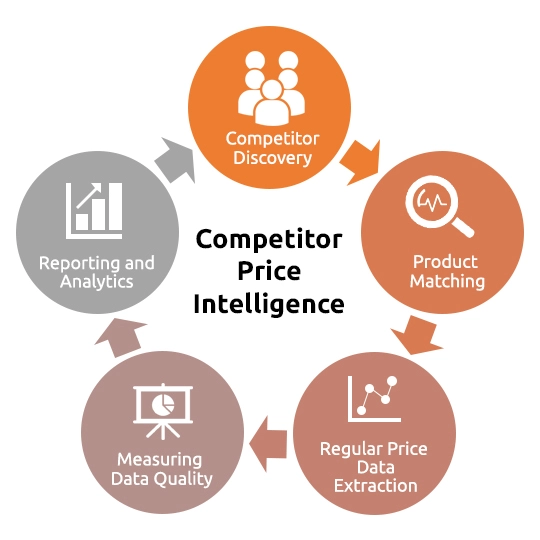
A real price monitoring strategy does three things: it collects competitor pricing reliably, it connects that data to your internal margin and inventory context, and it feeds a decision layer that tells you when and how to respond. Pull any one of those apart and the whole system breaks.
The businesses winning on price in 2026 aren’t necessarily the cheapest. They’re the most informed. They know which competitors actually move the needle on their revenue-driving SKUs. They’ve defined margin floors before a single scraper runs. And they’re not reacting to every flash sale — they’re modeling what comes next.
This guide covers what a modern ecommerce price monitoring strategy actually looks like: competitor prioritization, the data infrastructure that makes it reliable, and the decision logic that turns price signals into margin-aware action.
Step 1: Know Which Competitors Actually Matter
The first instinct is to monitor everyone. That’s the wrong call.
Tracking 50 competitors across thousands of SKUs creates data overload without insight. Before any scraper runs, you need a competitor tier structure based on actual revenue impact — not perceived threat.
Classify competitors by impact tier
Tier 1 — Direct price competitors: Same SKU, same customer, same purchase moment. If they drop 5%, your conversion rate drops too. These warrant daily or near-real-time monitoring.
Tier 2 — Marketplace sellers and aggregators: Third-party sellers on Amazon, Walmart, or Google Shopping who appear in the same search results. They shape perceived price ceilings even if they’re not your primary rivals.
Tier 3 — Substitute competitors: Different product, same job-to-be-done. Their pricing affects category-level demand more than individual SKU decisions. Worth tracking weekly at most.
Stop managing scrapers. Start using the data.
PromptCloud delivers structured, validated competitor price data normalized at the SKU level, timestamped, and ready to feed your pricing engine. No scraper maintenance, no schema breaks, no stale feeds.
Prioritize SKUs by margin and competition intensity
Not every product deserves the same monitoring effort. Focus your infrastructure on:
- Your top 20% of SKUs by revenue contribution
- Products with high search volume and multiple competitor listings
- Items where your price gap versus competitors is already narrow
- SKUs with volatile demand — seasonal, trend-driven, or promotional
This is how you get actionable signal rather than expensive noise. Monitoring everything equally is one of the most common reasons price monitoring programs fail to produce ROI.
Step 2: Connect External Prices to Internal Margin Context
Here’s what most price monitoring setups miss entirely: external price data without internal context is almost useless.
If a competitor drops their price by 8% and your system automatically matches it, you need to know whether that match protects or destroys your margin. Most automated systems don’t know. They just react.
The internal data layer your pricing engine needs
Before feeding competitor prices into any decision workflow, your system should have access to:
- Contribution margin per SKU — not just gross margin, but what’s actually left after fulfilment, returns, and acquisition cost
- Current inventory position — over-stocked SKUs can tolerate aggressive pricing; constrained SKUs should hold firm
- Demand elasticity signals — historical data showing how much your conversion rate actually changes with price movement
- Return rate by SKU — a lower-price competitor with a higher return rate isn’t actually cheaper for the buyer
- Channel-specific conversion data — marketplace buyers and direct site visitors often respond to price changes differently
When these signals are integrated, a competitor’s 5% price drop stops being an automatic trigger. It becomes a question: does matching this improve profitability, or does it just win a race to the bottom?
According to McKinsey’s pricing research, a 1% improvement in price realization generates roughly 8% improvement in operating profit for the average business — significantly more than equivalent gains in volume or cost reduction. The point of price monitoring isn’t to be cheapest. It’s to price with precision.
Step 3: Build a Price Data Pipeline That Doesn’t Lie
Scraping competitor prices is the visible part of a price monitoring strategy. The unglamorous part — data validation, SKU matching, schema management — is where most programs quietly break down.
Reliable data acquisition
Competitor prices come from multiple source types, each with different technical behavior:
- Brand websites — often rendered via JavaScript, requiring headless browser infrastructure rather than simple HTML parsing
- Marketplace listings — Amazon, Walmart, and similar platforms rotate seller positions and use dynamic pricing that changes by region and time of day
- Mobile apps — app-level pricing sometimes differs from web pricing, particularly for flash sales and loyalty members. This channel is frequently missed entirely
- Affiliate and comparison portals — useful for validating your own listings and catching grey-market pricing
Each source type has different anti-bot behavior, refresh cadence, and extraction complexity. A scraping infrastructure that works for static pages will fail on JavaScript-heavy storefronts without additional rendering logic.
SKU matching and normalization
This is where most price monitoring programs produce misleading data. Two product listings can look identical on the surface but differ by variant, bundle inclusion, seller type, or unit measurement. Without explicit normalization rules, your system will compare non-equivalent products and generate false price gaps.
Build canonical SKU identifiers, map variant hierarchies, and standardize unit pricing before any analysis runs downstream.
Data quality validation
Silent data corruption is the biggest risk in automated pricing systems. Scrapers can fail quietly — returning stale prices, misformatted values, or null fields — while your pricing engine continues making decisions on bad inputs. Minimum validation controls for a production-grade setup:
- Mandatory field completeness checks before records are accepted
- Freshness thresholds — if a price record is older than your defined monitoring cadence, flag it rather than use it
- Outlier detection — a sudden 90% price drop is usually a scraping error, not a real promotion
- Duplicate suppression — the same product appearing twice under different IDs will skew your average gap calculations
Step 4: Define Your Monitoring Cadence by Category
How often you collect competitor prices should be a strategic decision, not a default setting. Over-monitoring adds infrastructure cost without adding signal. Under-monitoring creates blind spots at the worst possible moments.
| Category | Recommended Frequency |
|---|---|
| Flash sale / daily deals platforms | Every 1–2 hours |
| Consumer electronics | 2–4x daily |
| Grocery and FMCG | Daily |
| Apparel and footwear | Daily or 2–3x weekly |
| Home and furniture | Weekly |
| Luxury / niche goods | Weekly or bi-weekly |
Beyond baseline cadence, build event-based surge monitoring into your setup. When a major competitor announces a sale, when a holiday promotional period begins, or when you see unusual traffic spikes on certain SKUs — monitoring frequency should escalate automatically, not wait for the next scheduled run.
Step 5: Build Decision Rules That Protect Margin
Data collection without action logic is a reporting exercise, not a pricing strategy. The final layer of a price monitoring system is defining when and how you respond to competitor price changes.
Rule-based automation for most SKUs
For the majority of your catalog, rule-based pricing is the right level of complexity. Rules are transparent, auditable, and easier to govern than black-box dynamic models. Effective rule structures include:
- Price gap threshold rules — if a competitor’s price falls more than X% below yours on a Tier 1 SKU, trigger a review or automatic adjustment
- Margin floor enforcement — no rule can push price below the defined floor, regardless of competitor movement
- Inventory-state overrides — if stock is below a threshold, hold price even if competitors drop
- Promotion classification — rules behave differently for detected flash sales vs. structural repricing
Dynamic pricing for high-velocity categories
In categories where prices move multiple times daily — electronics, travel, high-demand consumer goods — rule-based systems can lag. Dynamic pricing models incorporate demand signals, inventory turnover, time-of-day patterns, and competitor velocity to continuously recalculate optimal price points.
Dynamic pricing only works when the underlying monitoring system guarantees data freshness and SKU accuracy. A dynamic model fed by a leaky data pipeline doesn’t optimize — it amplifies errors at scale.
Governance and audit requirements
Every automated price change should be logged: what system triggered it, what rule fired, and what the before/after price was. In regulated categories and markets with pricing transparency requirements, audit trails are increasingly a legal necessity, not just operational discipline.
Where Ecommerce Price Monitoring Programs Break
Reacting to promotional noise as structural price changes
A competitor’s 40% weekend flash sale is not a pricing signal. It’s a temporary inventory event. If your rules treat it as a real price change and you match, you’ve eroded margin for a competitor’s clearance cycle. Your system needs promotion classification logic: what’s a base price, what’s promotional, and how long does a price need to hold before it’s treated as structural?
Monitoring everything equally
Applying daily monitoring to low-margin, low-competition SKUs wastes scraping capacity and drowns your team in alerts that don’t matter. Roughly 20% of your SKUs drive 80% of revenue risk. Build your monitoring intensity around that 20%.
No feedback loop between price changes and outcomes
If your pricing team can’t see whether an automated adjustment actually improved conversion rate or margin, they have no basis for refining the rules. Every price change should be traceable to a subsequent outcome — even a simple 7-day conversion rate on that SKU.
Advanced: Channel Pricing and Competitor Pattern Detection
Channel-specific pricing
Competitor pricing behavior varies by channel, sometimes significantly. A brand might hold steady on its direct website while running aggressive promotions on marketplace listings. If you’re only monitoring one channel, you’re seeing an incomplete picture.
Track each channel separately — brand site, Amazon or equivalent marketplace, mobile app, affiliate networks — and define whether your pricing response applies at the channel level or globally. Blanket global repricing based on a marketplace signal often over-corrects on your direct channel where margin is higher.
Detecting competitor behavior patterns
Over time, historical price monitoring data reveals competitor rhythms: end-of-month discount spikes, regular weekend promotions, end-of-season clearance windows. Once you can predict when a competitor is likely to drop price, you stop being reactive entirely.
This is where price monitoring matures from a reporting function into genuine competitive intelligence. You’re no longer chasing changes — you’re anticipating them and positioning ahead of the cycle.
Need This at Enterprise Scale?
While manual monitoring works for a small competitor set, enterprise ecommerce introduces catalog complexity and multi-channel freshness requirements that in-house scrapers can’t sustainably handle. Most enterprise teams evaluate total cost of ownership before assuming in-house is cheaper.
The Price Monitoring Maturity Model
Most businesses think they’re further along than they are. Here’s an honest benchmark:
| Stage | Description | Signal |
|---|---|---|
| Stage 1 — Manual Tracking | Spreadsheets, periodic checks. No consistency. | Starting point |
| Stage 2 — Automated Scraping | Scheduled collection, but no validation or SKU normalization. | Common default |
| Stage 3 — Structured Monitoring | Schema control, defined frequency tiers, duplicate suppression. | Where you want to be |
| Stage 4 — Integrated Intelligence | Internal margin + inventory data merged with competitor feeds. | Competitive edge |
| Stage 5 — Predictive Optimization | Elasticity modeling, channel segmentation, competitor pattern detection. | Durable moat |
Stage 2 is where most mid-market ecommerce teams plateau. They have scrapers running, but no validation discipline, no SKU normalization, and no margin context. The output feels like intelligence but produces reactive decisions.
Stage 3 is the first point where monitoring actually protects margin. Everything after that is compounding advantage.
Measuring the ROI of Your Price Monitoring Strategy
If you can’t measure it, you can’t justify the infrastructure investment or improve it over time. Track these metrics directly tied to your monitoring program:
- Margin per SKU before and after automated adjustments
- Competitive price gap — how often are your Tier 1 SKUs within your defined threshold of key competitors?
- Conversion rate on price-adjusted SKUs
- Monitoring coverage rate — what percentage of your priority SKUs have fresh, validated price data at any given time?
- Time-to-response — how quickly does a competitor price change trigger a review or adjustment?
If the only metric you’re tracking is raw price parity, you’re measuring activity rather than impact. The goal isn’t the cheapest price. It’s the most profitable price that still wins the customer.
From Price Monitoring to Competitive Moat
The businesses that treat price monitoring as structured intelligence — rather than reactive scraping — build something competitors can’t easily replicate: the ability to move faster, interpret signals more accurately, and hold margin while staying competitive.
That advantage compounds. Better data quality improves automation accuracy. Better automation reduces the manual overhead that slows pricing decisions. Better decisions produce historical data that feeds predictive models. The loop tightens over time.
Before scaling your setup, run through these questions honestly:
- Is your competitor data validated and fresh, or are you automating on stale inputs?
- Are your SKUs correctly matched, or are you comparing non-equivalent products?
- Do your pricing rules enforce margin floors before adjustments run?
- Can you audit every automated price change after the fact?
- Is your monitoring cadence matched to actual price volatility in each category?
If the answers are unclear, the fix isn’t more scraping capacity. It’s better architecture.
PromptCloud delivers structured, validated ecommerce price data at the SKU level — normalized, timestamped, and ready to feed pricing engines without the overhead of managing scraping infrastructure yourself.
Explore More
If you are expanding into structured data-driven decision systems, these resources provide deeper context:
- Netflix’s big data approach to personalization.
- Guide to mobile app scraping.
- Building structured extraction logic in Python.
- Big data engineering lessons from cybersecurity.
For a strategic perspective on how pricing directly impacts margin and growth, refer to McKinsey’s research on the power of pricing.
Stop managing scrapers. Start using the data.
FAQs
How is a price monitoring strategy different from simply tracking competitor prices?
Competitor price tracking is a data collection activity. A price monitoring strategy connects that data to internal margin context, defines monitoring cadence by SKU priority, enforces automation rules, and measures outcome impact. Without that structure, you have a price feed — not a strategy.
How often should I monitor competitor prices?
It depends on category volatility. Electronics and flash sale platforms warrant multiple checks daily. Apparel is typically daily to a few times weekly. Luxury goods and industrial products can be weekly or less. The right answer is ‘as often as prices actually change in your category’ — not as often as you can technically scrape.
What’s the biggest risk in automated price monitoring?
Silent data corruption. Scrapers that fail quietly return stale or malformed data, and automated pricing engines keep running on those bad inputs. Validation controls — freshness thresholds, outlier detection, completeness checks — are not optional in a production pricing system.
Should every product follow the same pricing rule?
No. High-elasticity products in competitive categories warrant aggressive matching logic. Brand-differentiated or low-elasticity SKUs should hold price more firmly. Loss leaders behave differently from margin protectors. A single pricing rule applied to your whole catalog is almost always suboptimal for at least half of it.
How do you measure whether your price monitoring strategy is working?
Track margin per SKU before and after automated adjustments, conversion rate on price-adjusted products, competitive price gap closure on Tier 1 SKUs, and monitoring coverage rate. If those numbers are moving in the right direction, the strategy is working. If they’re not, the fix is usually upstream — in data quality or rule design, not scraping volume.
Is competitor price scraping legal?
In most jurisdictions, scraping publicly available pricing data is legal — courts in the US and EU have generally held that publicly visible data on a website is not protected in the same way as private or access-controlled data. The landmark hiQ v. LinkedIn ruling reinforced this for publicly accessible pages. That said, there are boundaries: scraping behind a login, violating a site’s Terms of Service in ways that cause demonstrable harm, or using scraped data in ways that facilitate coordinated pricing (which regulators treat as anti-competitive) all carry real risk. The practical answer for most ecommerce businesses is: scraping public competitor prices is legally defensible, but your implementation and how you use the data both matter. Working with a managed data provider adds a layer of compliance discipline that in-house scrapers often skip.
Do I need dedicated software or should I build price monitoring in-house?
It depends on scale and internal capacity. Building in-house gives you control and can work for a small, stable competitor set — but the maintenance burden is higher than most teams expect. Scrapers break when competitor sites update their HTML. Anti-bot measures require ongoing engineering attention. SKU normalization logic needs constant refinement as product catalogs change. Most teams that start in-house end up spending more engineering time on scraper maintenance than on actual pricing analysis. Dedicated software or a managed data provider makes more sense once you’re monitoring more than a handful of competitors, operating across multiple channels, or need data fresh enough to feed automated pricing decisions. The threshold is lower than most people think.