




Why AI Agents Have a Web Data Problem
AI agents run on data. Not last quarter’s exports, not manually curated spreadsheets, and not static training sets refreshed every few months. They need live, structured, continuously updated information drawn directly from the web. And the gap between what most teams expect web scraping to deliver and what actually sustains a production-grade AI pipeline is wider than most realize.
The demand for web data for AI agents has shifted from an edge-case requirement to a core infrastructure priority. According to PromptCloud’s State of Web Scraping 2026 report, AI’s appetite for fresh web data is now one of the primary forces reshaping how scraping infrastructure is designed and operated across the industry. Models do not get trained once and run indefinitely. They require constant flows of current, diverse, and cleaned information to remain accurate. Static datasets go stale faster than teams expect, sometimes within hours for pricing signals, inventory data, or competitive intelligence feeds.
This guide covers what high-quality web data for AI agents actually looks like in practice, where the failure points are, how to make a sound decision between building your own pipeline and using a managed provider, and what questions to ask when evaluating external data vendors. Whether you are building an AI research agent, a real-time pricing tool, a competitive monitoring system, or a RAG-powered assistant, the fundamentals here apply directly.
Most AI agents are built on the assumption that their underlying data is good. It rarely is at the exact point in the pipeline where it matters most. The core challenge is not access to data. It is access to data that is fresh, structured correctly, and reliable enough to act on without a human checking it first.
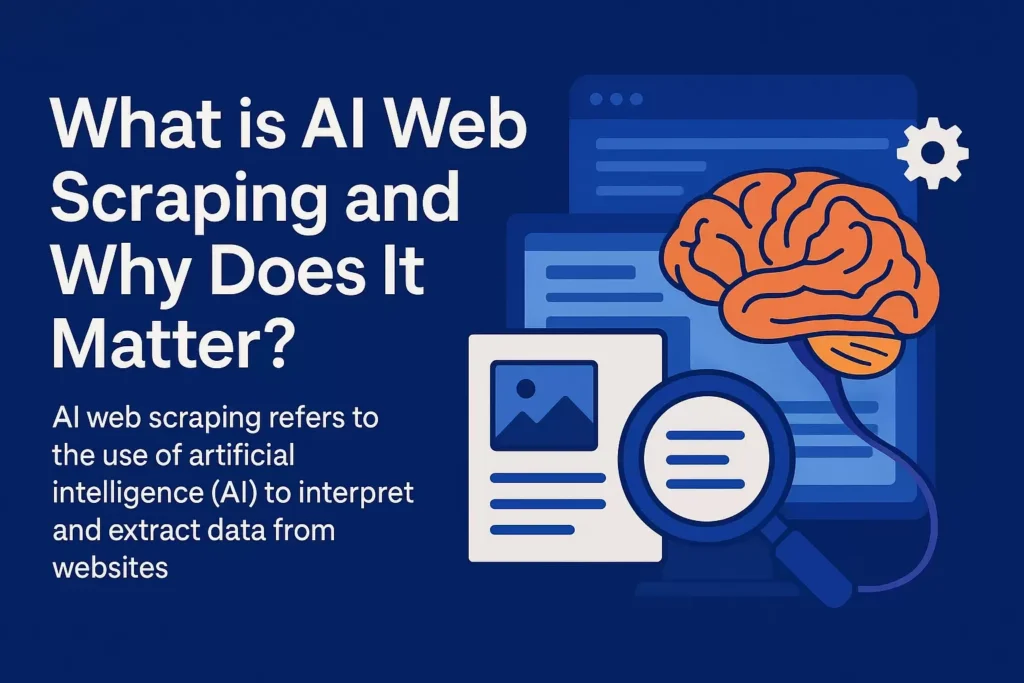
Large language models are trained on datasets that are cut off at a fixed point in time. A model trained on data from twelve months ago does not know about a competitor’s pricing change from last week, a regulatory update from last month, or a product line discontinued last quarter. When AI agents need to make decisions grounded in current reality, that knowledge gap becomes a liability. Research from Firecrawl’s 2026 analysis of AI data pipelines notes that a model with a mid-2024 cutoff will generate confident answers about topics using older patterns, and those answers can sound just as authoritative as correct ones, even when they are not.
The standard architectural solution is retrieval-augmented generation, or RAG, where the agent pulls live external data at query time to supplement what the model already knows. A 2024 NAACL research paper found that RAG reduced hallucination in structured AI outputs by 40 to 71% compared to inference from model weights alone. That is a meaningful reliability improvement, but it depends entirely on the quality of the retrieval layer. And that retrieval layer, more often than not, depends on web scraping.
When an agent retrieves current pricing from a competitor’s site, monitors for new product listings, or ingests fresh reviews to support a recommendation workflow, it is using web scraped data as its source of truth. The scraping layer is not a secondary component in the pipeline. It is the first mile, and failures there propagate into every output the agent produces downstream.
Get structured web data built for AI agent pipelines, delivered to your exact schema, across any source, refreshed on your schedule.
• No contracts. • No credit card required. • No scraping infrastructure to maintain.
What Web Scraping Actually Delivers for AI Pipelines
Understanding what scraping provides to an AI system requires separating the concept from the implementation. Web scraping, in the context of AI agents, is not simply fetching HTML from a webpage. It is the full process of extracting, cleaning, structuring, and delivering web-sourced data in a format that an AI system can reliably consume.
Structured, LLM-Ready Output
Raw HTML returned by a web request contains far more noise than signal. Navigation menus, tracking scripts, cookie banners, advertising elements, and repeated footer content all pollute the payload. For a RAG pipeline, this noise increases token consumption, degrades retrieval accuracy, and introduces inconsistency.
Industry benchmarks on AI scraping tools have found that using clean Markdown output instead of raw HTML can reduce RAG token usage by up to 60% while improving retrieval accuracy. The implication for AI agent design is direct. Better scraping output reduces inference costs and improves the quality of responses generated from retrieved context.
Real-Time and Event-Driven Data
The web is not static, and neither should be the data feeding AI agents. PromptCloud’s State of Web Scraping 2026 report documents the industry-wide shift from scheduled batch scraping to event-driven extraction. Instead of crawling everything on a fixed timer, modern pipelines trigger extraction when something actually changes. A price updates. A new review appears. A product goes out of stock.
For AI agents handling competitive intelligence, inventory decisions, or market monitoring, this shift from scheduled to event-driven data collection is not optional. An agent working from hourly batch data in a market that changes by the minute is structurally disadvantaged from the start.
Scale That Individual Scrapers Cannot Match
Production AI pipelines often need data from hundreds of domains simultaneously, each with different structures, anti-bot protections, and rate limits. A single internal scraper, even a well-maintained one, struggles to handle that surface area reliably. Managed scraping infrastructure handles proxy rotation, JavaScript rendering, browser fingerprinting, CAPTCHA resolution, and retry logic at scale, maintaining success rates that would be impractical to achieve in-house for most teams.
The Real Challenges of Feeding Web Data Into AI Systems
Building a web data pipeline for AI agents involves a different set of problems than building one for a traditional analytics dashboard. The data requirements are stricter, the failure modes are harder to detect, and the consequences of degraded data quality are more severe because the AI system will continue producing outputs confidently even when the inputs are wrong.
Anti-Bot Infrastructure Has Become Significantly More Sophisticated
According to F5 Labs’ 2026 Advanced Persistent Bot Report, 10.2% of all global web traffic comes from scrapers even after bot mitigation systems are applied. In heavily targeted industries such as fashion (53%), hospitality (49%), and healthcare (34%), scraping is no longer occasional noise. It is a constant pressure shaping competitive dynamics. In response, website defense systems have become considerably more capable. Cloudflare’s current infrastructure uses machine learning to distinguish between legitimate crawlers and automated scrapers based on behavioral signals like cursor movement patterns, scroll timing, and browser fingerprint consistency.
Passing these defenses requires infrastructure that can simulate realistic human browsing behavior at scale, not simply rotate IP addresses. For teams building AI agents, this matters because the scraping layer needs to be robust enough to maintain reliable data delivery even as defenses continue to evolve. A scraper that works today may break next month when a target site updates its detection logic, and the AI agent depending on that data will not automatically surface the problem.
This is one of the primary reasons engineering teams evaluate managed alternatives before committing to in-house builds. A detailed breakdown of those tradeoffs is available in PromptCloud’s web scraping build vs. buy guide.
JavaScript-Heavy Pages Require More Than HTTP Requests
A significant proportion of the web’s most valuable data lives on pages built with single-page application frameworks. React, Angular, and Vue-based pages do not return usable content in a simple HTTP response. The data loads asynchronously after the initial page render, sometimes requiring specific user interactions like clicking filters, scrolling to trigger lazy loading, or submitting forms before the target content appears.
For AI agents that need data from these pages, the scraping layer must include headless browser capabilities. This adds complexity, increases infrastructure requirements, and creates new failure surfaces. A selector that works reliably on a static page may behave completely differently when the target page requires waiting for dynamic content to load.
Data Quality Failures Are the Hardest to Detect
PromptCloud’s State of Web Scraping 2026 report identifies a quality triad that every scraping pipeline must maintain: accuracy (the extracted values match the source exactly), freshness (the data reflects current web state, not cached or stale content), and consistency (the schema remains stable so downstream systems do not break unexpectedly).
For AI systems, consistency is particularly critical. When a website changes its page structure and a scraper silently starts returning empty fields or misaligned values, the AI agent consuming that data has no way to know the source has changed. It continues generating outputs based on corrupted input. The failure is invisible until someone audits the end results and notices quality has degraded.
Understanding exactly why scrapers fail in production is essential before deploying any web data pipeline for AI use. PromptCloud’s breakdown of why web scrapers fail in production covers the most common failure modes that teams encounter after initial deployment.
Build vs. Buy: Choosing the Right Web Data Strategy for AI
The build-vs-buy decision looks different when web data feeds AI agents rather than human analysts. The tolerance for failure is lower, the freshness requirements are stricter, and the operational complexity is higher. What works well as an internal scraping project for a quarterly report rarely holds up as the data layer for a production AI system.
What Building In-House Actually Costs
The visible costs of building internal scraping infrastructure are engineering time and compute. The less visible costs grow quickly. A mid-scale scraping operation routinely involves infrastructure expenses, proxy and IP rotation costs, and ongoing human QA time for validation. These costs scale with ambition. Scrapers break on a schedule that has nothing to do with your release cycle, and every maintenance event that goes unresolved means degraded data reaching your AI system.
Research cited in analyses of AI-driven scraping architectures found that in traditional setups, 80% of engineering time is spent on maintenance rather than building new capabilities. For AI pipelines, the maintenance burden compounds. When you scrape ten domains for a dashboard, a broken scraper is a minor incident. When you scrape several hundred domains to feed a production AI agent, even a small failure rate across sources represents a meaningful gap in what your system is working with.
What Managed Providers Actually Deliver
Managed web data providers handle the operational layer so your team can focus on what the data enables rather than how to collect it. This includes proxy infrastructure, anti-bot bypass, JavaScript rendering, schema maintenance, and delivery in structured formats that integrate cleanly into AI pipelines.
The key question when evaluating providers is not whether they can scrape. It is whether they can maintain delivery reliability over time as target sites change, and whether their output quality meets the specificity your AI system requires. Comparing Bright Data alternatives and Zyte alternatives gives you a grounded view of where each provider sits on the reliability-vs-cost spectrum before committing to a contract.
The Hybrid Approach Most Teams Land On
Most mature data teams end up running a hybrid model: small in-house crawlers for niche or highly customized sources, combined with managed infrastructure for high-volume or high-uptime requirements. This is a practical reflection of where the tradeoffs land. Internal scrapers give full control over niche edge cases. Managed providers give reliability guarantees on the sources that matter most to your AI pipeline.
Need This at Enterprise Scale?
While a self-built scraping pipeline works for a few sources, production AI agents introduce schema consistency, anti-bot bypass, and freshness SLAs that compound quickly.
How to Evaluate a Web Data Provider for AI Agent Use Cases
Most web data providers were designed around traditional BI and analytics use cases. Their delivery cadence, output formats, and quality metrics were built for human analysts working with dashboards and reports. Evaluating them for AI agent pipelines requires asking a different set of questions.
Output Format Compatibility
AI pipelines, particularly RAG systems and LLM-based agents, work best with clean, structured output. Raw HTML is almost never appropriate. You need providers that deliver clean Markdown, structured JSON, or pre-normalized text that integrates directly into your ingestion pipeline without a heavy transformation layer in between. Every transformation step added is another place for data quality to degrade.
Freshness SLA and Update Frequency
Define your freshness requirement before evaluating providers. An AI agent monitoring competitor pricing in near-real-time needs fundamentally different data delivery than one doing weekly market trend analysis. Freshness SLAs vary significantly across providers. Some offer daily or weekly batch delivery. Others support continuous or event-triggered extraction. Make sure the provider’s model matches your actual latency requirement.
Schema Stability and Data Consistency
For AI pipelines, schema consistency is non-negotiable. If your extraction schema changes between deliveries because a target site restructured its pages, your AI agent will receive malformed input without warning. Evaluate how providers handle structural changes on source sites. Do they notify you proactively? Do they maintain schema versioning? Do they guarantee a consistent output format even when the underlying source changes?
Compliance and Data Governance
The compliance landscape for web data has changed materially. PromptCloud’s State of Web Scraping 2026 documents the emergence of what it calls the permission economy, where data access is increasingly negotiated rather than assumed. Cloudflare now enforces AI bot restrictions by default. Major publishers are implementing machine-readable access policies. Providers investing in compliance infrastructure now, including identifiable request headers, robots.txt adherence, and documented data access agreements, are better positioned to maintain reliable access as requirements tighten.
Volume and Reliability at Scale
A provider that performs well on a proof-of-concept scrape of fifty URLs may behave differently when your AI pipeline starts pulling from five thousand. Test at the scale you actually intend to operate, and ask specifically about success rates across heavily protected domains. Success rates across top providers on heavily protected sites vary significantly, making real-scale testing essential before committing to a contract.
Preparing Your AI Pipeline to Actually Use Web Data Well
Getting the data in is only half the problem. AI systems that consume web data need to be designed to handle the realities of that data source: variability in content structure, occasional gaps in coverage, and the fact that the web reflects the world as it is rather than as your schema expected it to be.
Build Validation Into Your Ingestion Layer
Every web data feed entering an AI pipeline should pass through a validation step before it reaches the model. This means checking that expected fields are populated, that values fall within reasonable ranges, and that data volume matches what you would expect given the source. Silent failures in scraping infrastructure are common. Without a validation layer, your AI agent will process degraded data and produce degraded outputs with no visible signal that something has gone wrong.
PromptCloud’s report notes that the most advanced data operations combine automated schema validation with human-in-the-loop sampling. Automated checks catch structural failures. Human spot-checks catch the subtler cases where column semantics shift, units change, or content migrates to a new page section without triggering a hard schema error.
Design for Latency That Matches Your Use Case
Not all web data needs to be real-time. An AI agent doing quarterly competitive analysis does not require the same data freshness as one monitoring live auction prices. Over-specifying your freshness requirement drives infrastructure cost without improving outcomes. Under-specifying it means your agent is working from data that no longer reflects reality.
Map your agent’s decision latency, the time window within which a correct answer actually matters, to your data refresh rate. For most AI research and analysis agents, daily or near-daily data is sufficient. For pricing and inventory agents, sub-hourly freshness may be necessary. Getting this alignment right upfront prevents both over-engineering and data quality surprises in production.
Document Your Data Lineage
AI systems that inform business decisions need auditable data sources. When an AI agent recommends a pricing action or flags a competitive threat, someone in the organization will eventually ask where that information came from. Building data lineage documentation into your pipeline from the beginning, recording which sources were scraped, when, and by what method, protects both the system’s credibility and your team’s ability to troubleshoot when outputs look unexpected.
The Compliance Layer You Cannot Skip
Web data collection for AI systems operates in a regulatory environment that has evolved considerably and continues to change. Europe’s AI Act, updated FTC guidance on automated data collection, and GDPR enforcement actions related to scraping have all shifted the compliance baseline upward. This is not a reason to avoid web data. It is a reason to build compliance into your data architecture from the start rather than treating it as an afterthought.
The practical requirements for a compliant web data pipeline are reasonably clear. Scrapers should identify themselves through request headers. Robots.txt instructions should be followed. Data access should be proportionate to the use case. Personal data must be handled under appropriate legal basis. If you are using a managed provider, their compliance posture is part of your compliance posture.
PromptCloud’s 2026 report describes a compliance maturity model that moves from basic adherence, following robots.txt and throttling requests, through progressive compliance with identifiable headers and clear removal policies, to mature compliance with signed data access agreements, interaction logs, and audit trails. For AI systems operating in regulated industries or using data from sensitive domains, reaching that mature tier is a functional requirement, not a best practice.
How PromptCloud Delivers Web Data Built for AI Agent Pipelines
PromptCloud is a managed web data provider built specifically for teams that need reliable, structured, and continuously updated web data feeding production systems. Unlike general-purpose scraping tools that return raw HTML and leave structuring to your team, PromptCloud delivers pre-cleaned, schema-consistent data in formats that integrate directly into AI agent workflows, RAG pipelines, and LLM-based automation without heavy transformation overhead.
What Sets PromptCloud Apart for AI Use Cases
Most web data vendors were built for traditional BI teams running monthly exports. PromptCloud’s infrastructure was designed for the freshness and reliability requirements that AI systems actually impose. That distinction shows up in several ways.
- Structured, AI-ready delivery: Data is delivered in JSON or clean text formats, not raw HTML. This reduces the preprocessing burden on your AI pipeline and lowers token consumption in RAG workflows.
- Event-driven extraction: PromptCloud supports extraction triggered by content changes rather than fixed schedules, which means your AI agent receives data when the web changes, not twelve hours after it changed.
- Schema stability guarantees: When target sites restructure their pages, PromptCloud’s team maintains the extraction schema so your downstream AI system continues receiving consistent output. You do not absorb the maintenance cost of upstream site changes.
- Compliance-first infrastructure: All data collection is conducted with identifiable headers, robots.txt adherence, and documented data access methodology. This matters when your AI system’s outputs inform business decisions that need to be auditable.
- Scale without operational overhead: PromptCloud handles proxy rotation, anti-bot bypass, JavaScript rendering, and retry logic across thousands of domains. Your team focuses on what the data enables rather than how to keep the collection pipeline alive.
PromptCloud works with data teams building:
- Competitive intelligence systems that monitor pricing, product listings, and positioning across hundreds of competitor domains.
- AI research agents that need current, diverse, and citation-ready web content feeding a RAG retrieval layer.
- Market monitoring pipelines that track sentiment, news, and product mentions across the open web in near-real-time.
- LLM fine-tuning datasets that require large-scale, domain-specific web data collected with full lineage documentation.
PromptCloud vs. Building In-House
The question PromptCloud’s customers most often ask before signing is whether they could build the same capability internally. The honest answer is yes, if engineering bandwidth, proxy infrastructure, ongoing maintenance, and compliance documentation are resources your team has available and wants to allocate to data collection rather than to the AI products built on top of it.
For teams that have run that calculation and want a realistic view of the total cost, PromptCloud’s web scraping build vs. buy analysis covers the infrastructure, maintenance, and people costs that rarely appear in initial build estimates.
Getting Web Data Right Is What Separates Working AI Agents From Broken Ones
AI agents that work reliably in production are not defined by the model powering them. They are defined by the quality, consistency, and freshness of the data feeding them. Web scraping is the mechanism that provides that data, but treating it as a solved problem or a commodity input is how pipelines fail quietly over time.
The teams building durable AI data infrastructure are the ones who treat the scraping layer with the same engineering rigor they apply to the model layer. They validate inputs, design for freshness requirements, make deliberate build-vs-buy decisions, and document their data sources in a way that supports both debugging and compliance. The web is not static, and neither are the systems built on top of it.
If you are evaluating how to source web data for an AI agent pipeline, the most important first step is defining what the data needs to do: how fresh it needs to be, what schema it needs to conform to, and what happens to your AI system’s outputs when the data is wrong. Those answers will determine every architectural decision that follows.
Get structured web data built for AI agent pipelines, delivered to your exact schema, across any source, refreshed on your schedule.
• No contracts. • No credit card required. • No scraping infrastructure to maintain.
Frequently Asked Questions
What is web data for AI agents?
Web data for AI agents is structured, continuously updated information extracted from public websites and delivered in a format that AI systems can directly consume. This includes competitor pricing, product listings, news content, reviews, job postings, and any other web-sourced signals an AI agent needs to make decisions, generate outputs, or power a retrieval-augmented generation pipeline. It is distinct from static training data because it reflects the current state of the web rather than a historical snapshot.
Why can’t AI agents just use their training data instead of web scraping?
Large language models have a fixed knowledge cutoff. Anything that happened after that date is outside what the model knows. For business use cases involving current pricing, market conditions, competitor behavior, or recent events, training data is structurally stale from the moment of deployment. Web scraping provides the live retrieval layer that keeps AI agents grounded in present reality. RAG architectures specifically depend on this: the model reasons over retrieved web data rather than its internal weights when the topic requires current information.
How does web scraping feed a RAG pipeline?
In a RAG architecture, the agent retrieves relevant documents at query time and passes them to the language model as context. Web scraping is how those documents are collected and kept current. When a user query triggers the retrieval layer, the system pulls documents that were scraped from target websites, cleaned, chunked, and indexed in a vector database. The quality of those scraped documents directly determines the quality of the model’s answer. Poorly structured or stale scraped data produces poorly grounded AI responses.
What types of web data work best for AI agent pipelines?
The most effective web data for AI agents is domain-specific, consistently structured, and updated at a cadence that matches the agent’s decision latency. Common examples include product and pricing data for e-commerce agents, news and press releases for market intelligence agents, job postings for workforce analytics agents, and review content for sentiment and competitive analysis agents. Data that is publicly accessible, relatively structured in its source format, and changes on a predictable schedule tends to integrate most cleanly into AI pipelines.
What is the difference between web scraping and a web data API for AI agents?
A web data API is a managed interface that abstracts the scraping layer and delivers structured data directly, without your team needing to maintain crawlers, handle anti-bot infrastructure, or manage proxy rotation. Raw web scraping requires your team to build and operate all of that. For AI agent pipelines that need reliable, production-grade data delivery, a managed web data API typically reduces maintenance burden, improves schema consistency, and provides cleaner output than a self-hosted scraping solution. The tradeoff is flexibility: APIs constrain what data can be collected, while self-built scrapers can target any source.
How fresh does web data need to be for AI agents to work effectively?
It depends entirely on the decision latency of the agent. A competitive pricing agent needs data refreshed in near-real-time, potentially every few minutes, because prices can change faster than daily batches can capture. A market research agent doing trend analysis may work well with daily or weekly data. The critical design step is matching your refresh cadence to your agent’s actual decision window, not to what sounds impressive in a vendor pitch. Over-specifying freshness drives unnecessary infrastructure cost. Under-specifying it produces outputs that are confidently wrong.
Can web scraping for AI agents run into legal or compliance issues?
Yes, and the risk is growing as the legal landscape evolves. Scraping publicly accessible data is generally permissible, but it must comply with the target site’s terms of service, applicable data protection regulations such as GDPR and CCPA, robots.txt instructions, and content ownership considerations that increasingly govern AI training use cases. The 2026 regulatory environment is meaningfully stricter than it was two years ago, with Cloudflare enforcing AI bot restrictions by default and publishers implementing machine-readable access policies. Using a managed provider with documented compliance practices significantly reduces exposure.
What makes web scraping for AI different from traditional web scraping?
Traditional web scraping optimized for human-readable outputs: CSV files, database rows, dashboard data. Web scraping for AI agents optimizes for machine-readable, semantically clean output that minimizes noise, preserves document structure, and formats content for LLM token efficiency. AI pipelines also have stricter schema consistency requirements than dashboards. When a scraper silently returns malformed data to a human analyst, the analyst notices. When it returns malformed data to an AI agent, the agent processes it confidently and propagates the error downstream without flagging it.
Should I build my own web scraping infrastructure or use a managed provider for AI data?
Building in-house gives full control over niche sources and custom extraction logic. Managed providers give reliability guarantees, compliance documentation, schema stability, and consistent output formats at scale. The decision depends on your engineering bandwidth, the volume and variety of sources you need, and your tolerance for scraping infrastructure becoming a maintenance burden that competes with product development. Most mature AI data teams run a hybrid: in-house scrapers for specialized or proprietary sources, managed infrastructure for high-volume or high-uptime requirements. Building the entire stack in-house almost always underestimates ongoing maintenance cost.
How do I validate that the web data feeding my AI agent is actually accurate?
Validation should be built into the ingestion layer before data reaches the model. Automated checks should verify that expected fields are populated, values fall within plausible ranges, and data volume matches expected extraction patterns. Schema drift checks should flag when the structure of incoming data changes unexpectedly. Beyond automated validation, human-in-the-loop spot-checking on a sample of records catches the subtler quality issues that automated rules miss: semantic drift in field meanings, unit changes, or content that has migrated to a new page section without triggering a hard schema error. The most reliable AI data pipelines treat quality as an ongoing process, not a one-time setup.