



**TL;DR** Market sentiment is how people feel about a brand, product, or market—right now. It lives in reviews, Reddit threads, social posts, and headlines. Traditional methods (surveys, panels) are slow and thin. Web scraping services collect this public chatter at scale, clean it, and turn it into structured signals your team can actually use. The payoff: faster reads on shifting demand, better product decisions, and fewer “how did we miss that?” moments.
What you’ll get here: a plain-English walkthrough of market sentiment, the sources worth scraping, how data flows into analysis, and where companies are using it today. We’ll also cover compliance, a simple evaluation checklist, a table of sources vs signals, and links to deeper reads from PromptCloud.
What is market sentiment (in simple terms)?
Market sentiment is the overall mood or emotion people express about your brand, product, or industry—across the internet.
It shows up in:
- Reviews
- Reddit comments
- News headlines
- Tweets (or posts on X)
- YouTube videos and their comment sections
- Niche forums and subreddits
- App store feedback
It’s what customers really think—before they fill out a survey, or long after they’ve left your site. Some are raving, some are raging, and others are just casually mentioning you in context. But together? It forms a signal that’s incredibly valuable.
Want a neutral primer? See this overview of sentiment analysis.
Why it matters more than ever
Think of sentiment like early warning radar. Your dashboards show the results—clicks, conversions, returns. Sentiment shows the why behind the results—and it usually shows up sooner.
Example:
A product could be racking up 4-star reviews, but the written comments are saying, “great product, terrible support.” Unless you’re analyzing sentiment, you’ll miss that flaw until churn goes up.
Or a new competitor shows up in Reddit threads, not as a top ad spender, but because early adopters love it. You won’t see it in your ad auctions—yet. But your share of voice is already slipping.
Where market sentiment lives online
| Source | Examples |
| Reviews | Amazon, Walmart, TripAdvisor, G2, Google Play |
| r/SkincareAddiction, r/investing, r/electricvehicles, r/fragrance | |
| News aggregators | Google News, Apple News, niche sites |
| X/Twitter | Brand mentions, hashtags, threads, replies |
| YouTube | Unboxings, reactions, tutorials, product comparisons |
| Niche forums | EV forums, finance communities, parenting boards, gaming hubs |
These are the places where people say what they really mean, not what they think you want to hear.
Where Web Scraping Comes In
Most companies know that market sentiment matters. Where they struggle is: how to track it at scale, across platforms, in real time.
- Surveys? Too slow.
- APIs? Limited access or missing context.
- Manual tracking? Not even close to scalable.
That’s where web scraping services step in.
What web scraping does
A scraping service automates the process of collecting public-facing content from websites—think product reviews, Reddit posts, news articles, or forum threads.
It does four things really well:
- Crawls the content you care about — based on your list of sources or keywords
- Extracts the relevant text and metadata — comments, ratings, timestamps, etc.
- Cleans and structures it — removes duplicates, formats it into JSON or CSV
- Delivers it on your terms — daily, hourly, weekly, via API or S3
That’s it. No brittle scripts to maintain. No missed updates. Just raw public opinion, delivered as clean data.
While DIY screen scraping works for small datasets and short-term extraction, enterprise-grade data requirements introduce challenges like anti-bot defenses, schema drift, and continuous data reliability. Most enterprise teams evaluate build vs buy data pipeline models to determine total cost of ownership.
Let’s talk
Why this matters for sentiment
Because once you have the data structured, you can run it through any NLP model to extract real-time emotion, opinions, complaints, love letters, or rants. And instead of relying on someone clicking a button on a survey, you’re watching how they really talk when no one’s asking.
For example:
- “I love the new update but battery life sucks.” → Mixed tone
- “It broke after two uses. Never buying again.” → Strong negative
- “It’s fine. Gets the job done.” → Neutral
Without scraping, that’s just noise floating on the internet. With it, it becomes a live signal that tells you what people think, at scale.
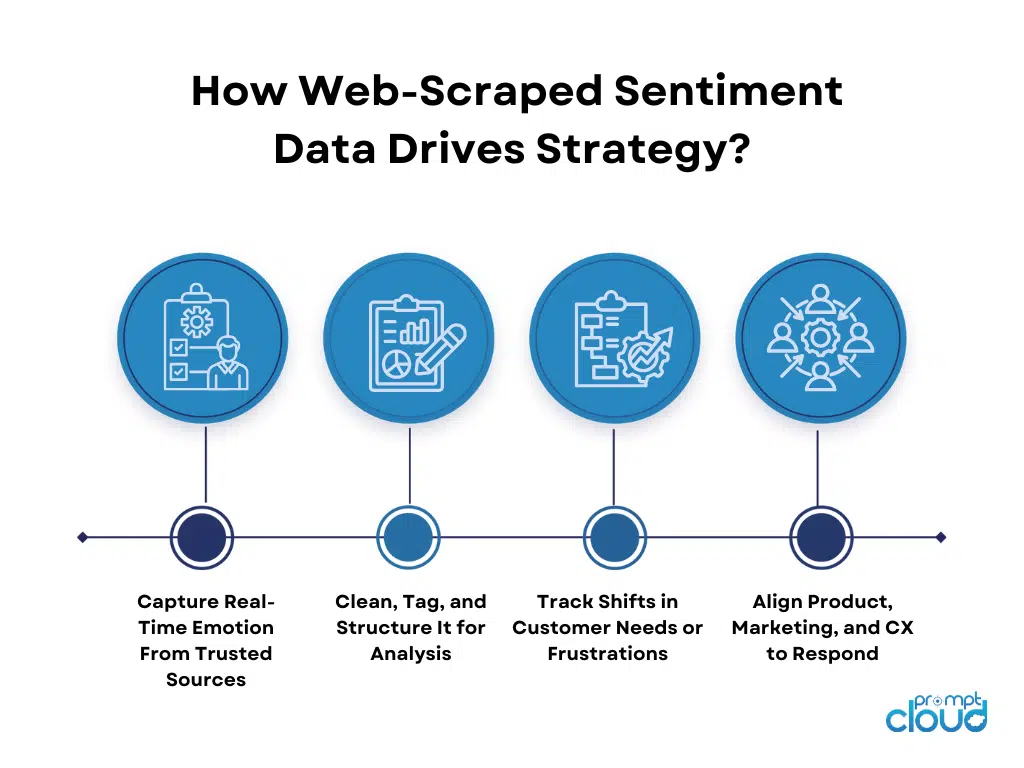
How the Sentiment Data Pipeline Works
Web scraping is just the start. What really makes the data useful is what happens after it’s collected. Here’s a look at how raw internet chatter turns into structured, decision-ready sentiment insights:
Step-by-step breakdown
1. Pick your sources
Choose the platforms that matter most to your business. For an eCom brand, that might be:
- Amazon reviews
- Reddit product mentions
- YouTube comments
- X posts on your brand hashtag
For a travel platform, it could be:
- TripAdvisor reviews
- Google Reviews
- Regional news articles
- Customer forums
Don’t try to track everything. Start focused.
2. Crawl the pages
Your scraping partner sets up crawlers that visit those pages at a frequency you choose—daily, hourly, etc.—and pulls the data. This includes:
- Full text
- Ratings or reactions (likes/upvotes)
- Author info (when public)
- Timestamps
- Metadata like categories or tags
3. Clean the mess
This is where the magic starts:
- Remove duplicate entries
- Normalize formats (e.g., dates, prices, ratings)
- Handle special characters, emojis, punctuation
- Organize comments and replies (especially for Reddit/forums)
Now you’ve got data that’s usable—not just raw HTML or scraped chaos.
4. Analyze the tone
Use sentiment analysis models (NLP tools) to tag each entry:
- Positive / Negative / Neutral
- Optionally: Emotional tone (anger, joy, confusion, etc.)
- Add themes: is it about price, UX, delivery, sizing, performance?
This is where the signal emerges from the noise.
5. Turn it into action
Once structured and scored, the data can feed:
- Dashboards (for execs or ops teams)
- Alerts (e.g. “battery complaints up 47% this week”)
- Reports for product, marketing, CX, or leadership
- Triggers for real-time responses (PR, crisis control)
Example Output (for a weekly sentiment summary):
| Source | Theme | Volume | Sentiment | Action Triggered |
| Pricing | 132 | Mostly negative | Flag for strategy review | |
| Amazon | Packaging | 96 | Mixed | Raised to product team |
| TripAdvisor | Cleanliness | 204 | Positive | Used in marketing copy |
| App crashes | 71 | Negative | Bug ticket filed |
What to Scrape — and Why It Matters
When people talk online, they don’t follow your templates.
Some leave five-star reviews with zero comments.
Others write five-paragraph essays on Reddit explaining why your product is “mid.”
And plenty just say “meh” and bounce.
So what exactly should you scrape? Start with this:
What you’re trying to capture
- The platform (where it was said)
- The topic (what it’s about)
- The tone (how they feel about it)
- The volume (how many people are saying the same thing)
- The change over time (is it increasing or fading?)
When scraped and structured properly, this is what turns into actionable sentiment insight.
Market Sentiment Signals — Source vs Use Case
| Source | What You Get | What to Extract | Business Value |
| Product Reviews | Honest feedback from buyers | Text, rating, SKU, variant, country, timestamp | Identify recurring product issues or praise |
| Reddit Threads | Early adopter chatter, complaints | Post title, comments, upvotes, subreddit, date | Spot trends before they go mainstream |
| News Aggregators | Public/media tone | Headline, source, category, body, publish date | Track narrative shifts around brand/industry |
| Twitter (X) | Real-time emotional reactions | Post text, user handle, hashtags, date | Monitor campaign sentiment and virality |
| YouTube Comments | Unfiltered product reactions | Comment text, video title/channel, likes, date | Understand usage context and first impressions |
| Forums | Feature-level pain/gain insight | Thread title, comment body, post time | Feed roadmap with direct quotes from core users |
Example:
Someone posts a Reddit thread titled “The new iPhone overheats like crazy.”
That’s not a product return yet. But if 100 people upvote it, 10 comment “same here,” and it shows up in related forums—you now have a sentiment trend.
Need help structuring a crawler for this kind of sentiment extraction? Check out: Using a Content Crawler to Automate Website Monitoring.
Real-World Industry Use Cases
Let’s bring this to life with real business scenarios. Here’s how different industries are using market sentiment scraped from reviews, forums, Reddit, and news — and turning it into strategic advantage.
eCommerce: Find the “why” behind returns and reviews
Use Case:
A home appliance brand saw rising return rates on a product with strong ratings. Scraping reviews revealed the issue: people liked the product, but found the setup instructions confusing. That detail never showed up in their NPS.
How sentiment scraping helps:
- Identify what customers actually say in reviews (not just the stars)
- Cluster complaints by product variant or feature
- Flag praise for copywriting and SEO teams to amplify
Related read: Beginner’s Guide to Review Sentiment Analysis for eCommerce.
Automotive: Forums don’t lie — your dashboard might
Use Case:
An EV maker scraped Reddit, EV forums, and YouTube comments. They found that winter battery complaints were always highest in the Northeast — despite internal performance data saying otherwise.
How it helped:
- Prioritized firmware updates for cold regions
- Created localized content to manage expectations
- Avoided PR blowback by owning the issue first
Media & Publishing: Headlines that hit — or miss
Use Case:
A digital publisher noticed certain push notifications underperforming despite high topic interest. Scraped comments and Twitter replies showed the issue: the headlines were seen as “clickbait” and “misleading.”
How scraping helped:
- Tracked perception across Twitter, Reddit, and aggregator replies
- Adjusted tone and framing in future headlines
- Built a sentiment feedback loop into A/B tests
Related read: The Advantages of Automated News Aggregation.
Finance: Sentiment before the market moves
Use Case:
A fintech team monitored Reddit and X (formerly Twitter) chatter about a competitor’s new pricing model. Sentiment flipped negative over 3 days — before official complaints or churn data came in.
What they did:
- Accelerated their own pricing announcement
- Targeted ad campaigns at “switchers”
- Used sentiment spikes as early warning signals
Related read: Scrape Reddit Like a Pro.
Travel & Hospitality: Complaints cluster around details
Use Case:
A hotel chain scraped TripAdvisor and Google reviews weekly. They didn’t just look at scores — they tracked themes (cleanliness, service, location, noise). One city had a spike in “slow check-in” sentiment. The issue? A software update had broken the kiosk.
Impact:
- Rolled back buggy kiosk software
- Preempted a wave of low-star reviews
- Added sentiment data to monthly ops reports
All of these use cases feed the same goal: Move from guessing what people feel → to acting on it, while there’s still time to fix or win.
What Good Sentiment Modeling Looks Like
Once your scraped data is clean and structured, the next step is to make sense of what people are actually saying — and how they’re saying it.
This is where sentiment modeling comes in.
You don’t need a fancy LLM to get started
Yes, GPT-style models can help. But most teams get great results with simpler NLP pipelines that are faster, easier to audit, and cheaper to run.
Here’s a good baseline framework:
The 6-Step Sentiment Modeling Process
1. Preprocess the text
- Lowercase everything
- Remove junk: HTML tags, emojis (or convert to tags), special characters
- Standardize punctuation and spacing
Good text in = better model out.
2. Tag themes (a.k.a. topics)
Use keyword-based tagging or train a model to assign themes like:
- Shipping
- Sizing
- Battery life
- Customer service
- Pricing
- Delivery time
- Packaging
This gives context to the sentiment.
3. Score sentiment
- Start simple: Positive / Negative / Neutral
- Upgrade to: Joy / Anger / Trust / Disgust / Fear / Surprise (if needed)
- Add a score (e.g. -1 to +1) to track intensity
Some comments are quietly unhappy. Others are furious.
4. Track volume and change
- How many mentions per theme this week vs. last week?
- Did negative mentions of “checkout flow” double after your redesign?
Don’t just look at sentiment — look at shifts.
5. Layer in severity
Use:
- Comment length
- Upvotes or likes
- Verified vs. anonymous users
- Engagement rate
1 negative post with 200 upvotes matters more than 10 bland ones.
6. Create alert thresholds
Example rules:
- “50+ negative mentions of delivery in past 3 days”
- “Sudden drop in 4- and 5-star reviews for SKU X”
- “Competitor brand name shows up in positive context 20+ times in a week”
These turn insights into action, automatically.
Pro Tip: If your team wants summaries, use a language model to answer:
“What were the top 3 complaints about this product last week?” Or “Summarize positive sentiment for our latest campaign.”
LLMs work best when fed pre-cleaned, structured data from your scraping + tagging pipeline.
Compliance, Ethics & Responsible Scraping
Let’s address the elephant in the room.
Is web scraping legal? Yes — when it’s done ethically and responsibly.
But not all scraping is created equal. And how you collect and use data matters just as much as what you collect.
The golden rule of ethical scraping: public, respectful, transparent
At PromptCloud, here’s how we make sure every sentiment data pipeline stays clean — legally and ethically.
1. We only scrape public-facing content
No login walls, no password-protected pages, no private APIs.
If it’s freely visible to any user on the web, it’s generally fair game for read-only access — provided it’s collected the right way.
2. We follow robots.txt and site rules
Many sites offer clear rules about what bots can and can’t do.
Our crawlers:
- Respect robots.txt
- Use polite crawl rates
- Rotate user agents and IPs to avoid overloading servers
- Stop immediately when terms change or a disallow is detected
3. We don’t hoard or abuse data
All scraped data is delivered for internal analytics and research purposes.
No mass republishing. No unauthorized reselling. No spamming. Just clean, structured, real-time public opinion — used to make better business decisions.
4. We keep clients informed and compliant
We help clients:
- Choose safe, allowed sources
- Document their scraping logic and purpose
- Map scraped fields to intended use cases (e.g., CX, product, research)
And we stay on top of regulations like GDPR, CCPA, and data sovereignty laws to guide best practices.
Want to see how we market sentiment ethically? Check out our full services here: PromptCloud Complete Brief.
Bottom line: If your scraping setup feels sketchy, rushed, or “we’ll deal with it later”… don’t do it. Start with clean methods and you’ll build a sustainable, scalable source of truth you can actually rely on.
Rollout Plan & Choosing the Right Partner
Web scraping for sentiment isn’t something you need to over-engineer or delay. Start focused. Get value early. Expand with confidence.
Here’s how to do it.
Your 4-Week Sentiment Rollout Plan
Week 1: Identify your sources
- Pick 5–10 high-impact sources: reviews, Reddit threads, forums, news, social
- Align with product, marketing, or CX teams on what matters
Outcome: Source list + sample fields
Week 2: Run a sample crawl
- Collect a small batch of data for one product or theme
- Test theme tagging and sentiment scoring
- Review edge cases and false positives
Outcome: Initial sentiment tagging framework + cleanup logic
Week 3: Structure and deliver
- Finalize field mappings (e.g., product ID, theme, score, geo, timestamp)
- Set delivery mode (CSV, JSON, API, S3, etc.)
- Integrate with your BI tool or dashboard
Outcome: Real-time or scheduled feed starts flowing
Week 4: Operationalize insights
- Set alert thresholds for top 3 themes
- Share dashboards with stakeholders
- Plan 2–3 small experiments based on what you learned (copy change, FAQ update, etc.)
Outcome: Insights drive real decisions — fast
How to choose the right web scraping partner
Not all vendors are equipped for sentiment use cases. Here’s your short checklist:
| What to Check | Why It Matters |
| Can they handle dynamic content? | Most sentiment sources use JavaScript heavily |
| Do they normalize and clean data? | Saves you hours of fixing messy formats |
| Are fields schema-aligned and complete? | Structured data = usable data |
| Is the delivery automated and reliable? | No delays, no manual downloads |
| Do they respect site terms and ethics? | Protects your brand from legal headaches |
| Can they scale globally and by language? | Sentiment changes by region and culture |
| Do they help with QA and monitoring? | Sites change all the time — automation breaks |
At PromptCloud, we’ve been powering enterprise-grade sentiment scraping for years — from eCom brands to auto manufacturers to fintech and media teams.
Get started and take the fast lane: Schedule a Demo.
Final Thoughts & Next Steps
Market sentiment isn’t a soft metric.
It’s the earliest, most honest signal you can track. And it’s often hiding in plain sight — on Reddit, in reviews, in rants, in offhand comments on Twitter threads.
If you’re waiting for quarterly reports, NPS surveys, or support tickets to tell you what’s wrong (or what’s working), you’re reacting too late.
With the right web scraping setup:
- You can see the real reasons behind product feedback
- You can catch emerging competitor buzz
- You can track how sentiment changes regionally
- And you can act on signals before they hit your bottom line
And the best part? You don’t have to build it all yourself.
While DIY screen scraping works for small datasets and short-term extraction, enterprise-grade data requirements introduce challenges like anti-bot defenses, schema drift, and continuous data reliability. Most enterprise teams evaluate build vs buy data pipeline models to determine total cost of ownership.
Let’s talk
FAQs
1. Is it legal to scrape reviews and forums?
Yes—when scraping public-facing content responsibly and in line with site terms and robots.txt rules. PromptCloud ensures ethical, compliant data collection.
2. What platforms can I scrape for sentiment?
You can collect data from reviews (Amazon, TripAdvisor), Reddit, news aggregators, Twitter/X, forums, and more—depending on relevance and accessibility.
3. How often can sentiment data be updated?
Most teams go with daily updates. For launch monitoring or high-sensitivity use cases, hourly or real-time scraping can be configured.
4. Do I need my own sentiment model?
Not necessarily. PromptCloud delivers clean, structured data you can feed into your in-house NLP tools—or integrate with off-the-shelf sentiment APIs.
5. Can I start small and scale later?
Yes. You can begin with a single product line, region, or source. Once it’s working, scale to additional categories, platforms, or languages easily.