




**TL;DR**
You scraped a site, cleaned the data, ran analysis, and moved on. Nobody asked many questions as long as the output worked. Somewhere along the way, that changed. Quietly at first. Then all at once. Here is the uncomfortable truth. Most compliance issues do not come from bad intent. They come from assumptions. Assumptions that public data is always safe. Assumptions that anonymization happens automatically. That gap between assumption and reality is where risk lives.
How GDPR and CCPA Reshaped Web Data Compliance
Web data used to feel simple.
GDPR compliance web data obligations changed how personal data is defined and protected. CCPA requirements reframed ownership, giving consumers the right to know, opt out, and delete. Data residency added a physical dimension, forcing teams to think about where data is stored, processed, and backed up.
For teams using web data for analytics, AI training, chatbots, or decision intelligence, this is no longer theoretical. Buyers ask pointed questions. Legal teams want documentation. Procurement wants assurance that data will not cross borders irresponsibly. We will focus on how these rules affect web data collection, processing pipelines, AI use cases, and long term data storage. You will see where teams commonly get it wrong, and what “good” looks like in practice.
What Counts as Personal Data in Web Data Pipelines
This is where most confusion starts. And honestly, it is understandable. When teams hear “personal data,” they picture names, emails, phone numbers. Obvious stuff. The problem is that GDPR compliance web data rules stretch far beyond that mental checklist.
Personal data is broader than you think
Under GDPR, personal data is any information that can directly or indirectly identify a person. Direct is easy. Names, email addresses, profile IDs.
Indirect is where teams get caught.An IP address. A username on a forum. A product review tied to a persistent handle. A location hint buried inside a listing. Even a combination of harmless looking fields can become identifying when stitched together. Now pause for a second.
Most web data pipelines are built to aggregate, enrich, and connect data points. That is their whole job. Which means even if you never scrape a “name” field, you can still end up processing personal data. This is why GDPR compliance web data is less about intent and more about capability.
Public does not mean exempt
Another common assumption is that public data is automatically safe. It is public, after all. GDPR does not agree. Publicly accessible data can still be personal data. A LinkedIn profile. A public comment. A seller page with an individual name attached. Visibility does not cancel protection.
Why this matters early in the pipeline
This is not a legal cleanup step you do later.
What you classify as personal data shapes everything that follows. Storage rules. Retention limits. Access controls. Even how models are trained and evaluated. Teams that get this right early avoid painful retrofits later. Teams that do not usually find out when a buyer’s legal team asks uncomfortable questions.
If your scraping layer is already operating like production infrastructure, the conversation about ownership is worth having.
GDPR Compliance Web Data: What the Regulation Actually Requires in Practice
GDPR sounds intimidating because it is usually introduced through legal language. Articles, clauses, recitals. Most data teams switch off halfway through.
The reality is simpler than it looks, but stricter than many expect.
Lawful basis is not a checkbox
GDPR requires a lawful basis for processing personal data. For web data, teams often lean on two options. Legitimate interest or consent. Consent is rare in web data use cases. You usually do not have a direct relationship with the individual whose data appears on a website. That leaves legitimate interest.
Here is the catch.
Legitimate interest is not automatic. You have to balance your business purpose against the individual’s rights and expectations. If the data subject would reasonably expect their data to be collected and used in that way, you are on safer ground. If not, risk creeps in. Scraping job listings for labor market trends feels reasonable. Scraping personal social media posts to build behavioral profiles does not. GDPR compliance web data hinges on that line.
Purpose limitation forces discipline
GDPR does not like vague intentions.
You must define why you are collecting the data and stick to it. “For analytics” is not specific enough. “For pricing intelligence across ecommerce listings” is. This matters because many web data pipelines evolve over time. Data collected for one use case quietly finds its way into another. Training an AI model. Powering a chatbot. Feeding a sales tool.
Data minimization is not about collecting less
This one surprises people. Data minimization does not mean “collect as little as possible.” It means collect only what is necessary for the defined purpose. If a field does not support that purpose, it should not exist in the dataset. That includes personal attributes that sneak in through enrichment or joins.
This is where schema discipline matters. Teams that design clear extraction schemas and validate them consistently reduce risk significantly. If you want a deeper look at how structured schemas support responsible pipelines, this piece on building AI-ready web data schemas is worth reading.
Retention is part of compliance
GDPR cares about how long you keep data.
Web data often gets stored indefinitely because storage is cheap and nobody remembers to clean it up. That is a compliance problem. Retention policies should match purpose. Data should never be archived. Not forgotten in cold storage. This is one of the first things auditors and enterprise buyers ask about.
Accountability is the quiet requirement
Perhaps the most overlooked part of GDPR compliance web data is accountability. You do not just need to comply. You need to show that you comply. That means documentation. Data flow maps. Processing records. Internal guidelines. Vendor assurances. It does not have to be heavy or painful, but it does have to exist.
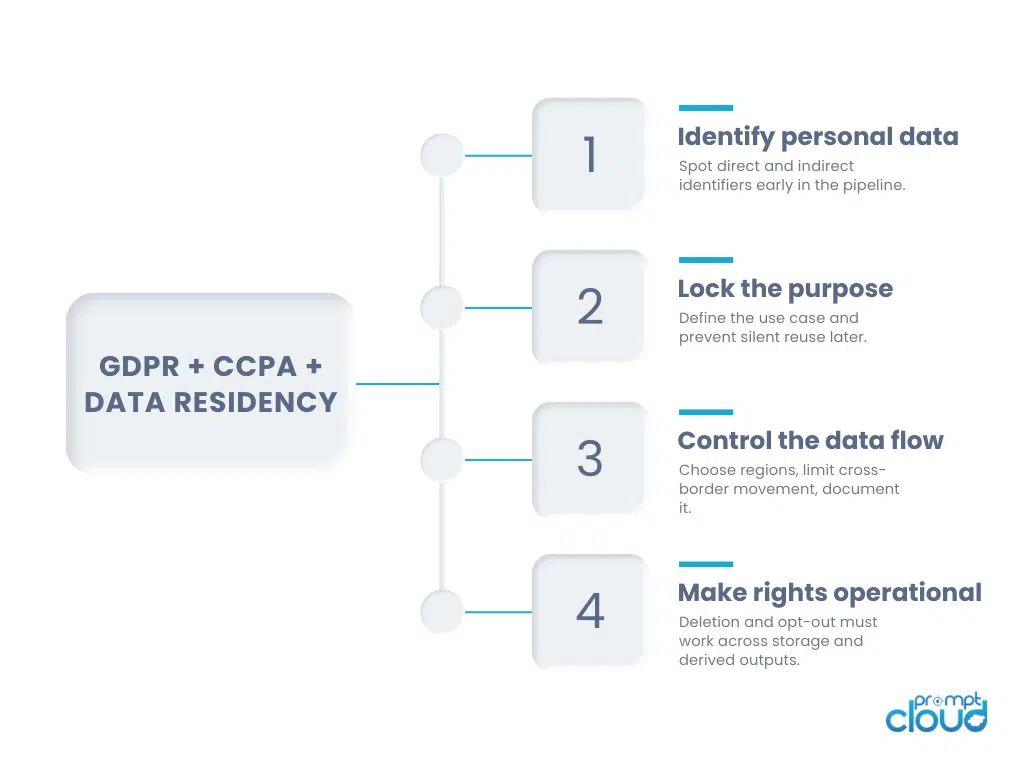
Figure 1: A four-step checklist showing how GDPR compliance web data, CCPA requirements, and data residency map to real pipeline decisions.
CCPA Requirements for Teams Using Web Data
CCPA feels different from GDPR. Not lighter. Just different in where the pressure shows up. If GDPR is about how you process personal data, CCPA is about who controls it.
CCPA reframes ownership
Under CCPA, consumers are given explicit rights over their personal information. The right to know what is collected. The right to opt out of sale or sharing. The right to delete. For teams using web data, this creates a shift in mindset.
You are no longer just a processor thinking about lawful basis. You are a party that may need to respond to consumer requests, even if the data was sourced from public websites. This is where many teams pause and ask, “Does this even apply to us?” Often, yes. If the web data you collect includes identifiers, device data, or any information that can be reasonably linked to a California resident, CCPA requirements enter the picture.
Sale and sharing are broader than expected
One of the most misunderstood parts of CCPA is the definition of “sale.” It does not only mean exchanging data for money. It can also include sharing data for commercial benefit. Data enrichment partnerships. Analytics sharing. AI model training that benefits another party. This matters because web data often flows through multiple systems and stakeholders. Vendors. Clients. Internal teams.
If personal data is involved, you need clarity on whether that flow qualifies as sharing under CCPA.
Opt-out and deletion are operational problems, not legal ones
CCPA compliance breaks down most often at execution.
How do you delete data you collected months ago from distributed pipelines? How do you ensure opt-out requests propagate across backups, derived datasets, and models? This is why CCPA requirements cannot be bolted on later. They have to be designed into data architecture early. Clean lineage. Clear ownership. Controlled downstream usage.
Teams that already think carefully about how web data feeds AI systems usually adapt faster. If you are using web data to power models or decision systems, this article on improving AI model accuracy with ecommerce data shows how quality and governance often move together.
GDPR vs CCPA
| Aspect | GDPR | CCPA |
| Primary focus | Lawful processing and individual rights | Consumer control and transparency |
| Applies to | EU residents’ personal data | California residents’ personal data |
| Key trigger | Processing personal data | Collecting, selling, or sharing personal data |
| Core rights | Access, correction, erasure, restriction | Know, opt out, delete |
| Biggest risk for web data teams | Over-collection and unclear purpose | Inability to honor opt-out or deletion |
This table is not a substitute for legal advice. It is a working mental model. If you understand where each regulation puts pressure, compliance stops feeling abstract and starts feeling manageable.
Data Residency: Why Location Still Matters in a Cloud World
Residency is not the same as sovereignty
These terms are often mixed up, so let’s slow down. Data residency refers to the physical location where data lives. Data sovereignty goes further. It ties that data to the laws of the country where it is stored.
You might be using a global cloud provider, but that does not mean your data floats in a legal vacuum. If your web data pipeline stores information in a specific region, that region’s laws apply. Full stop. For GDPR compliance web data, this matters when personal data of EU residents leaves the EU. For CCPA, it matters when California resident data is processed or shared across systems that lack proper controls.
Cross-border flows are where risk concentrates
Regulators do not expect perfection, but they do expect awareness and safeguards. Standard contractual clauses. Regional processing options. Access controls. Encryption. These are not “enterprise extras.” They are baseline expectations now. Ignoring residency does not usually break things immediately. It breaks trust during audits, procurement reviews, or compliance checks. And that is often worse.
Residency decisions affect architecture choices
This is where technical teams feel the impact.
If data must stay in-region, your architecture needs to support regional storage, regional processing, and sometimes regional access controls. That influences vendor selection, pipeline design, and even how AI models are trained. For example, training a centralized model on region-restricted data may not be allowed. Teams either segment models or anonymize data more aggressively before training.
If you are using web data to power conversational systems or chatbots, this question becomes very real. This article on web data extraction for chatbots touches on how downstream use cases amplify compliance considerations: https://www.promptcloud.com/blog/web-data-extraction-for-chat-bots
Residency is a buyer trust signal
At this stage, data residency questions are rarely academic. Teams that can answer clearly move faster. Teams that cannot often stall deals.
How Privacy Compliance Breaks Down in Real Web Data Workflows
It starts with scope creep
A web data pipeline is built for one purpose. Competitive analysis. Market trends. Content monitoring. Then someone asks for a perfectly logical follow-up. “Can we reuse this data for something else?” Maybe it feeds an AI model. Maybe it powers a chatbot. Maybe it enriches customer profiles. Each step feels harmless. Useful, even. The problem is that GDPR compliance web data rules care deeply about original purpose. Once the data drifts into new use cases, the original justification may no longer hold.
And that drift is rarely documented.
Anonymization is assumed, not verified
Another common breakdown happens around anonymization.
Teams often say, “We anonymize the data.” What they usually mean is that obvious identifiers were removed. Names. Emails. IDs. Add behavioral patterns. Join across datasets. Suddenly, identity reappears. This is where privacy compliance quietly collapses. Not in collection, but in enrichment and reuse.
Retention quietly turns into hoarding
Storage is cheap. Deletion is work.
So data stays. Old snapshots. Historical crawls. Archived backups that nobody touches but nobody deletes either. From a compliance perspective, this is a red flag. Retention limits are not optional suggestions. They are part of both GDPR and CCPA expectations. If you cannot explain why data is still stored, you probably should not be storing it.
Access control lags behind growth
Early on, access is simple. A few analysts. A small team. As usage grows, access spreads. More teams. External vendors. Automated systems. Suddenly, nobody has a clear picture of who can see what. This is where internal privacy risk overtakes external risk. Strong access controls and audit trails are boring until they save you. And they save teams more often than most admit.
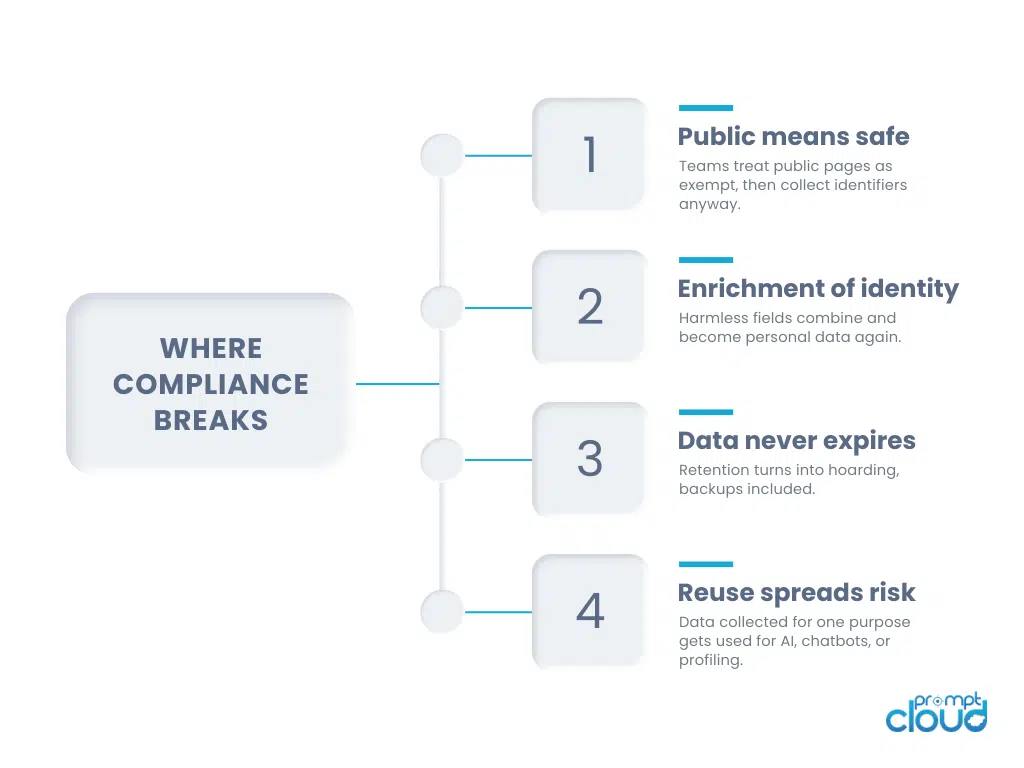
Figure 2: A quick view of the most common points where privacy compliance fails across collection, enrichment, retention, and reuse.
Building Privacy Compliance Into Modern Web Data Pipelines
This is the point where teams usually ask the real question. “Okay, but how do we actually do this without slowing everything down?” The answer is not a single tool or policy. It is a set of design choices that make privacy compliance part of how the pipeline works, not something bolted on later.
Start with intent, not infrastructure
Before writing a line of code, teams should be clear on three things.
Why is this data being collected? Who will use it? How long does it need to exist? When these answers are vague, compliance becomes fragile. When they are clear, decisions downstream get easier. What to store. What to drop. What to restrict. This is where GDPR compliance web data expectations quietly align with good engineering.
Treat schemas as guardrails
Schemas are not just technical artifacts. They are compliance boundaries. A well-defined schema limits accidental collection. It prevents new fields from sneaking in unnoticed. It forces conversations about necessity.
What Buyers and Legal Teams Actually Look For
This is the moment where theory meets reality.
At this stage, conversations stop being abstract. Buyers are interested, but cautious. Legal and security teams step in, and suddenly the questions get sharper. Not hostile. Just precise.
They want clarity, not perfection
One mistake teams make is assuming buyers expect flawless compliance across every edge case.
They do not. What they look for is clarity. Can you explain how GDPR compliance web data is handled in your system? Can you articulate how CCPA requirements are respected? Can you state where data lives and why? Clear answers build trust faster than long policy documents. When teams stumble here, it is usually because compliance lives in someone’s head, not in shared documentation.
Documentation beats reassurance
Buyers hear reassurance all the time. “We take privacy seriously.” “We follow best practices.” Those phrases do not move deals forward. What does move things forward is evidence. Data flow diagrams. Retention policies. Schema definitions. Access control descriptions. Residency options. Not hundreds of pages. Just enough to show that privacy compliance was designed, not improvised.
Residency questions surface early
Data residency often becomes the first filter. Where will our data be stored? Will EU data stay in the EU? Can we choose regions?
If answers are vague, deals slow down. If answers are concrete, legal teams relax. This is especially true for buyers building customer-facing systems, where web data feeds AI assistants, analytics, or automated decisions.
AI use raises the bar
The moment web data touches AI, scrutiny increases. Legal teams ask how training data is sourced. Whether personal data is involved. How bias and traceability are handled. This is where teams that already think about data quality and governance gain an edge. Compliance and accuracy tend to travel together, even if they start as separate concerns.
What buyers quietly evaluate
Buyers rarely say this out loud, but they are assessing maturity.
Do you understand your own data flows?
Do your answers stay consistent across teams?
Do technical and legal explanations align?
When they do, trust builds. When they do not, risk feels higher than it probably is.
Teams that actively validate incoming data against schemas catch problems early, before data spreads across systems. This discipline also improves reliability when web data feeds AI workflows. If you are interested in how responsible data practices support business outcomes, this article on using artificial intelligence for small business success makes that connection clear:
https://www.promptcloud.com/blog/using-artificial-intelligence-for-small-business-success/
Bake deletion into the pipeline
Deletion should not be an afterthought or a manual task. Retention logic belongs in the pipeline itself. Time-based deletion. Purpose-based expiration. Automated cleanup of derived datasets. When deletion is automated, compliance scales. When it is manual, it eventually fails.
Make compliance visible, not hidden
One of the most underrated practices is visibility. Teams should be able to answer basic questions quickly. What data do we have? Where did it come from? Where does it go? Who can access it? This is not about surveillance. It is about confidence.
Compliance by design, compared
To make this practical, here is how ad-hoc pipelines differ from compliance-aware ones.
| Area | Ad-hoc Pipeline | Compliance-Aware Pipeline |
| Data purpose | Loosely defined | Clearly documented |
| Schema control | Flexible, unmanaged | Strict and validated |
| Retention | Indefinite storage | Automated deletion rules |
| Access control | Grows organically | Role-based and audited |
| Audit readiness | Reactive | Built-in |
This shift does not require perfection. It requires intention. Teams that adopt these patterns rarely talk about compliance as a burden. It becomes part of how work gets done.
Common Myths About GDPR, CCPA, and Data Residency in Web Data
As teams move closer to decisions, a few myths tend to resurface. They sound comforting. They are also wrong. Clearing these up is often the final step before confidence replaces hesitation.
Myth 1: Public web data is automatically compliant
This one refuses to die.
Just because data is publicly accessible does not mean it is free from privacy compliance obligations. GDPR compliance web data rules care about identifiability, not visibility. If a dataset can be linked to an individual, protections apply, regardless of where it was found. Public does not mean unprotected. It just means easier to access.
Myth 2: Removing names solves everything
Names are only the surface.
Identifiers can hide in usernames, IDs, locations, timestamps, and behavioral patterns. When datasets are combined or enriched, identity often reappears. This is why anonymization must be tested, not assumed. If re-identification is reasonably possible, privacy compliance still applies.
Myth 3: CCPA only matters if you sell data
CCPA requirements extend beyond traditional data sales.
Sharing data for commercial benefit, enabling downstream use, or supporting partner workflows can all fall under CCPA definitions. Many teams unintentionally cross this line because they think “sale” only means money changing hands.
It does not.
Myth 4: Residency is a cloud provider problem
Cloud providers offer tools. They do not make decisions for you.
Where data is stored, processed, and accessed is an architectural choice. If you do not actively configure regions, controls, and access boundaries, residency requirements can be violated without anyone noticing. Responsibility does not disappear just because infrastructure is outsourced.
Myth 5: Compliance slows innovation
Wrap-up
Poorly designed compliance slows innovation.
Well-designed compliance removes friction. Clear schemas reduce errors. Retention rules reduce clutter. Access controls prevent chaos. Teams that build privacy into pipelines often move faster, not slower, because fewer things break later. At this stage, most readers have already shifted their mindset. Compliance is no longer the blocker they feared. It is the structure they were missing.
Privacy compliance used to feel like something that lived outside the data team. A legal document. A checkbox. A clause buried in contracts.
That era is over.
GDPR compliance web data expectations, CCPA requirements, and data residency rules now sit directly inside modern data workflows. They shape how pipelines are designed, how schemas are defined, how long data lives, and where it is allowed to move. Ignoring them does not make them go away. It just pushes risk downstream, where it becomes harder and more expensive to fix.
What stands out, when you step back, is how practical most of this really is.
Clear purpose definition. Thoughtful schema design. Automated retention. Visibility into data flows. These are not exotic compliance rituals. They are signs of mature data engineering. The same practices that protect privacy also improve data quality, model reliability, and buyer trust.
That is why compliance conversations increasingly show up in the middle of the funnel. Buyers are not looking for perfection. They are looking for motivation. They want to know that web data is collected with care, processed with discipline, and governed with clarity. Teams that can explain their approach calmly tend to move forward faster. Legal reviews feel smoother. Procurement questions feel manageable. Internal teams feel aligned instead of defensive.
Most importantly, this approach scales.
As regulations evolve, as AI use cases expand, as customer expectations rise, pipelines built with privacy compliance in mind adapt more easily. They bend without breaking. They absorb new requirements without rewrites. In the end, responsible web data use is not about fear of regulation. It is about confidence. Confidence that the data you rely on will not become a liability tomorrow. Confidence that growth and compliance do not have to compete.
When privacy compliance becomes part of how data is built, not something bolted on later, everything gets simpler. And calmer. And that is usually a good sign you are doing it right.
See the official definition of personal data under the GDPR at the European Data Protection Board.
https://www.edpb.europa.eu/sme-data-protection-guide/faq-frequently-asked-questions/answer/what-personal-data_en EDPB
This source explains what counts as “personal data” – a key concept for both GDPR and related compliance discussions.
If your scraping layer is already operating like production infrastructure, the conversation about ownership is worth having.
FAQs
Is GDPR compliance required when using only public web data?
Yes. If the data can identify an individual directly or indirectly, GDPR applies regardless of whether the source is public.
Do CCPA requirements apply outside California?
They apply when data relates to California residents, even if the business or infrastructure is located elsewhere.
What is the biggest compliance risk in web data pipelines?
Scope creep. Data collected for one purpose quietly being reused for another without reassessment.
Does anonymized data fall outside privacy regulations?
Only if re-identification is not reasonably possible. Weak anonymization still carries compliance risk.
Why does data residency matter if data is encrypted?
Encryption helps, but residency laws focus on jurisdiction and access, not just security controls.
Can compliance be automated in web data systems?
Parts of it can. Retention, access control, schema validation, and deletion work best when automated into pipelines.