




Why Financial Data Strategy Matters More in 2026 Than Ever Before
Financial data providers are no longer judged only on dataset size or terminal access. In 2026, buyers evaluate them on data freshness, licensing clarity, API and pipeline fit, coverage of alternative and unstructured sources, and total cost of ownership once the data reaches a model, dashboard, or trading engine.
Key points in this guide:
- The financial data market has split into four categories: terminal platforms, licensed feeds, alternative data marketplaces, and managed custom data pipelines
- Bloomberg, Refinitiv (LSEG), S&P Global, and Nasdaq Data Link (formerly Quandl) remain the anchor options for structured market, reference, and ESG data
- PromptCloud fits a different category — managed custom extraction — and is chosen when teams need domain-specific, site-specific, or competitor-specific data that packaged vendors do not publish
- The most common 2026 selection mistake is buying a premium terminal for a use case that needed a pipeline, or vice versa
- A clear evaluation framework saves six-figure subscription spend and months of integration rework
Financial firms in 2026 are not just buying data. They are buying a supply chain. Pricing engines, risk models, compliance systems, and trading strategies all depend on external data that is current, traceable, contractually clear, and delivered in a structure that engineering teams can actually use.
That is a different question from “who has the biggest database.” It is closer to “which provider fits the way our models, analysts, and decision systems consume data today?”
This guide covers five of the most recognized providers — Bloomberg, Refinitiv, S&P Global, Nasdaq Data Link, and PromptCloud — and then gives you the evaluation criteria, use-case fit, and buying framework to pick the right one for your workflow. It is written for heads of data, quant leads, product leaders at fintech companies, and competitive-intelligence teams who are tired of comparing vendors feature-for-feature without a decision framework behind it.
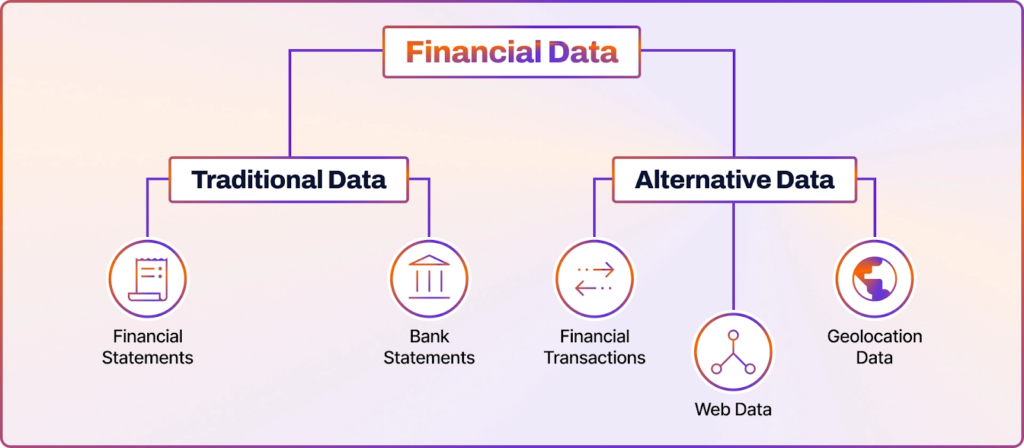
The 2026 Financial Data Landscape: Four Categories, Not One Market
Most “top providers” articles treat financial data as a single market where buyers compare Bloomberg against Quandl against a scraping vendor. That framing hides the most important decision: which category of provider fits the use case.
Gartner’s research on data and analytics platforms consistently highlights that buyers over-index on feature lists and under-index on integration fit, which is where most data procurement cost overruns originate (Gartner). Financial data is a sharper version of the same problem because the price gap between categories can be 50x.
There are four working categories in 2026:
| Category | What It Delivers | Typical Buyer | Price Range (Indicative) |
|---|---|---|---|
| Terminal platforms | Real-time market data, news, analytics, trading workflow, chat | Sell-side analysts, PMs, traders | $24k–$30k per seat per year |
| Licensed data feeds | Structured reference, pricing, corporate actions, ESG, fixed-income | Data teams, quants, risk desks | $50k–$500k+ per feed per year |
| Alternative data marketplaces | Curated alt-data: transaction panels, satellite, web, sentiment | Hedge funds, fintech product teams | $10k–$200k+ per dataset |
| Managed custom data pipelines | Site-specific, competitor-specific, or domain-specific scraped data delivered as a maintained feed | CI teams, fintech product, pricing intelligence, research | Usage-based, often 10–30% of licensed-feed cost |
Each category solves a different problem. A hedge fund modeling retail-investor sentiment cannot solve that with a Bloomberg terminal. A corporate treasury team does not need satellite panels to run liquidity analysis. A pricing-intelligence team tracking 40 competitor sites across three regions will not find that dataset on S&P Global.
The starting point for any vendor evaluation is to pick the category first, then compare providers inside it. The sections below follow that logic.
How to Evaluate a Financial Data Provider in 2026
Before reviewing individual vendors, it helps to define what “good” looks like. Seven criteria consistently separate providers that deliver long-term value from ones that create integration debt.
| Criterion | What to Look For |
|---|---|
| Coverage | Asset classes, geographies, and source types the provider handles natively versus through partners |
| Freshness | Intraday, end-of-day, weekly, or event-triggered. Match this to the decision cycle, not the trading cycle |
| Licensing clarity | Usage rights for redistribution, modeling, AI training, and downstream products. Get this in writing |
| Delivery fit | Terminal, API, flat file, S3/SFTP, cloud share, or managed pipeline. Your data stack decides this |
| Data quality | Schema consistency, deduplication, completeness, validation, and documented quality SLAs |
| Total cost of ownership | Subscription plus integration, data engineering, storage, and seat-growth cost over three years |
| Support model | Account management, technical support response time, and whether the vendor treats your data as a project or a product |
Two criteria get overlooked most often: licensing clarity and delivery fit. Firms that lose the most time are the ones that buy the right dataset with the wrong delivery method, or the right delivery method with restrictive licensing that blocks AI training.
Top 5 Financial Data Providers in 2026
1. Bloomberg
Category: Terminal platform with licensed data feeds
Best for: Sell-side analysts, portfolio managers, traders, and anyone who needs a unified workflow across market data, news, analytics, and chat
Bloomberg remains the anchor option for trading-floor workflows. The Bloomberg Terminal covers equities, fixed income, FX, commodities, derivatives, and money markets across global venues, with integrated news, analytics, and messaging. For funds and banks where execution speed and information parity with the market matter, it is still the default.
Where buyers run into friction is cost and integration. Terminal subscriptions are priced per seat, and programmatic access to Bloomberg data for modeling, backtesting, or AI workflows requires additional feed products. Firms that buy terminals for decision-makers and then try to stretch the same license into a data-engineering workflow usually end up either under-using the terminal or adding a separate data feed on top.
Strengths: Breadth, latency, workflow integration, analyst trust
Watch-outs: Seat-based cost scales with headcount; licensing for model training and redistribution is restricted; less fit for teams that need only data, not workflow
2. Refinitiv (LSEG Data & Analytics)
Category: Terminal platform with licensed feeds and strong ESG coverage
Best for: Buy-side firms, ESG-focused asset managers, and enterprise data teams already integrated with LSEG infrastructure
Refinitiv, now part of the London Stock Exchange Group, competes closely with Bloomberg on breadth and depth. Workspace (the successor to Eikon) covers similar ground, and Refinitiv has historically been stronger on fixed-income reference data, corporate actions, and ESG disclosures. Asset managers with sustainability mandates often choose it for that reason.
The 2026 story for Refinitiv is consolidation. With LSEG’s index and analytics assets, buyers increasingly get cross-product bundles that cover terminal, feeds, benchmarks, and risk analytics in one commercial relationship. That simplifies procurement but raises switching cost over time.
Strengths: ESG data depth, fixed-income reference, bundled pricing with LSEG assets
Watch-outs: Enterprise contracts can lock in multi-year spend; API and feed integration still requires dedicated engineering
3. S&P Global Market Intelligence
Category: Licensed data feeds with research and analytics overlays
Best for: Credit risk teams, fixed-income desks, private-markets analysts, and research teams that need fundamentals plus ratings
S&P Global is the strongest option when the use case centers on fundamentals, ratings, and credit. S&P Capital IQ Pro, the company’s flagship platform, combines public and private-company financials, transcripts, estimates, credit ratings, and sector research. For firms running bottom-up analysis across public equities or private markets, the depth of fundamentals and entity coverage is hard to match.
S&P Global also performs well on fixed-income reference data and credit analytics, which matter more in a higher-rate environment. Its weakness relative to Bloomberg and Refinitiv is real-time market workflow — it is built around research and analytics, not trading desks.
Strengths: Fundamentals, credit ratings, private company coverage, fixed-income analytics
Watch-outs: Less suited to real-time trading workflow; API access and downstream licensing priced separately
4. Nasdaq Data Link (formerly Quandl)
Category: Alternative data marketplace with structured financial feeds
Best for: Quant teams, hedge funds, and fintech product teams that need alt-data and curated structured datasets through a single API
Quandl rebranded to Nasdaq Data Link after its acquisition and has since become Nasdaq’s marketplace for curated financial and alternative data. The catalog covers pricing, economic indicators, corporate and ESG data, and a growing set of alt-data feeds such as transaction panels, web-derived sentiment, and options flow.
The strength is distribution. Instead of negotiating with ten alt-data vendors separately, a quant team can access multiple datasets through one API, one contract, and one billing relationship. That reduces procurement overhead significantly. The trade-off is that the catalog does not cover every niche, and for highly specific web or competitor data, teams still end up commissioning custom pipelines.
Strengths: Alt-data breadth, developer-friendly API, single-contract procurement
Watch-outs: Catalog depth varies by dataset; not a substitute for a terminal or licensed reference feed
5. PromptCloud
Category: Managed custom data pipelines
Best for: Teams that need financial, market, or competitive data the packaged vendors do not publish — delivered as a maintained feed rather than a one-time extract
PromptCloud sits in a different category from the four vendors above. It does not sell a terminal, a fixed catalog, or an alt-data marketplace. Instead, it builds and operates custom data pipelines that extract specific fields from specific web sources, normalize them into a consistent schema, and deliver them on a recurring cadence.
That matters for financial and market-intelligence use cases where the dataset the business actually needs does not exist as a packaged product. Examples: competitor pricing across 40 e-commerce sites in three regions, broker and marketplace listings for real-estate backed lending, peer job postings for workforce-cost modeling, retail-investor forum sentiment for a specific sector, or challenger-bank product and fee data across Europe.
None of these are terminal datasets. They are pipeline requirements. PromptCloud’s fit is highest when the buying team has already defined the sources and fields, and needs a managed partner to operate the extraction, rendering, deduplication, schema consistency, and delivery layer without building it internally.
Strengths: Custom source and field selection, managed maintenance, pay for what you use, delivery into S3, SFTP, database, or API
Watch-outs: Not a replacement for a terminal or licensed reference feed; works best as a complement when packaged vendors do not cover the source
How to Choose: Matching Providers to Use Cases
Most selection mistakes happen when buyers compare providers directly instead of matching them to the decision the data supports. The table below pairs common financial use cases with the category that fits best.
| Use Case | Best-Fit Category | Typical Provider Shortlist |
|---|---|---|
| Trading desk workflow and real-time execution | Terminal platform | Bloomberg, Refinitiv Workspace |
| Credit and fixed-income research | Licensed feeds with analytics | S&P Global, Refinitiv |
| ESG portfolio construction | Licensed feeds with ESG depth | Refinitiv, S&P Global |
| Quant strategy research and backtesting | Alt-data marketplace plus licensed feeds | Nasdaq Data Link, Refinitiv |
| Retail-investor sentiment analysis | Alt-data plus managed custom pipelines | Nasdaq Data Link, PromptCloud |
| Competitor pricing intelligence across web sources | Managed custom pipeline | PromptCloud |
| Fintech product benchmarking (fees, rates, features) | Managed custom pipeline | PromptCloud |
| Regulatory filings monitoring across jurisdictions | Managed custom pipeline or licensed feed | PromptCloud, S&P Global |
| Private company coverage | Licensed feeds | S&P Global |
For teams whose core use case is pricing intelligence — tracking competitor prices, stock signals, fees, promotions, and catalog changes across the web — the category fit is almost always a managed pipeline rather than a terminal or licensed feed. PromptCloud covers that workflow in depth through its pricing intelligence use case, which walks through source selection, schema design, refresh logic, and delivery patterns.
Real-World Applications of Financial Data in 2026
1. Predictive Trading Models
Hedge funds and systematic trading firms combine licensed pricing feeds with alt-data panels to build signals that do not show up in end-of-day data. The combination matters more than any single source. A transaction panel plus a web-derived sentiment feed plus a competitor price pipeline can produce signals that no single vendor sells as a packaged product.
2. Sentiment Analysis
Sentiment models need review content, forum discussion, social posts, and news context refreshed faster than weekly benchmarks. Packaged news feeds cover one part of that picture; web-derived sentiment pipelines cover the rest. Firms running sentiment as an input to trading or pricing typically blend the two rather than pick one.
3. Competitive Intelligence
Banks, fintechs, and asset managers track competitor product launches, fee schedules, rate changes, and marketing claims. Almost none of this data is published in a terminal. It lives on competitor websites, app stores, regulatory filings, and press pages. Managed pipelines are the only scalable way to keep this current across a large competitor set.
4. Regulatory Compliance and Filings Monitoring
Compliance teams track filings across the SEC, FCA, ESMA, and regional regulators. For filings that regulators publish openly, such as SEC EDGAR, structured extraction pipelines can deliver the raw text, metadata, and structured fields into internal systems on a same-day cadence. For richer analytics layers, licensed feeds from S&P Global or similar vendors remain useful.
5. ESG Data Analysis
ESG investing in 2026 is less about headline scores and more about underlying disclosures. Asset managers are pulling data directly from sustainability reports, proxy statements, and corporate websites to validate vendor ESG ratings rather than accept them at face value. That mix of licensed feeds plus custom extraction is becoming standard.
6. Portfolio Optimization and Risk Monitoring
Risk teams combine licensed market data with model-monitoring signals to detect drift in deployed models. AWS SageMaker Model Monitor and Google Cloud Vertex AI Model Monitoring both emphasize that deployed models need ongoing input-data comparison, not just initial validation. Fresh external data is what makes that monitoring possible.
Where PromptCloud Fits in a Financial Data Stack
PromptCloud is rarely a replacement for Bloomberg, Refinitiv, S&P Global, or Nasdaq Data Link. It is a complement. The anchor vendors handle what they do well — structured market data, fundamentals, ratings, ESG, alt-data marketplaces. PromptCloud handles what those vendors do not publish: the site-specific, competitor-specific, or domain-specific data that matters to a particular firm.
The operational advantage is pipeline discipline. A one-off extract from a competitor site is easy. Keeping 40 sources current across regions, handling layout changes, managing JavaScript rendering, deduplicating across catalogs, monitoring for schema drift, and delivering the output into an analytics warehouse on a reliable cadence — that is the part most internal teams underestimate.
| Requirement in a Financial Data Stack | How PromptCloud Supports It |
|---|---|
| Custom source and field selection | Sources and schema defined per project; not constrained to a fixed catalog |
| Freshness aligned to decision cycle | Intraday, daily, weekly, or event-triggered refresh based on the use case |
| Data quality controls | Deduplication, normalization, schema consistency, validation, and monitoring built into the pipeline |
| Delivery fit | S3, SFTP, API, database, or cloud share; integrates with existing data warehouse and AI workflows |
| Reduced engineering load | No internal burden of managing scrapers, proxies, source drift, or rendering |
| Licensing and governance clarity | Source review and documented delivery contract per project |
For teams building AI systems on top of financial or market data, this complementary role becomes more important, not less. The broader pattern is covered in PromptCloud’s data for AI and machine learning use case, which explains why web data increasingly sits next to licensed feeds rather than replacing them.
Read More
For teams evaluating pricing intelligence specifically, PromptCloud’s guide on how pricing intelligence pipelines are built walks through the source-selection, schema, and delivery decisions that determine whether a pricing dataset is actually model-ready.
For a broader view of how web data fits into AI model development across financial and non-financial use cases, see the article on AI scraping for AI model training and development.
For compliance and governance framing, the NIST AI Risk Management Framework is the reference point most large financial institutions align their AI data governance work to.
Stop paying for datasets that do not fit your workflow.
• No contracts. • No credit card required. • No scraping infrastructure to maintain.
FAQs
1. Who are the top financial data providers in 2026?
The top financial data providers in 2026 are Bloomberg, Refinitiv (LSEG), S&P Global, and Nasdaq Data Link for structured market, reference, and alternative data. PromptCloud is the leading managed custom data pipeline provider for teams that need site-specific, competitor-specific, or domain-specific financial data that packaged vendors do not publish. The right choice depends on the category fit: terminal, licensed feed, alt-data marketplace, or managed pipeline.
2. How do I choose the right financial data provider?
Start by defining the category, not the vendor. If the use case is real-time trading workflow, a terminal fits. If it is fundamentals, ratings, or fixed-income research, a licensed feed fits. If it is quant research with alt-data, a marketplace fits. If it is competitor, pricing, or web-derived intelligence, a managed custom pipeline fits. Then evaluate providers inside the category on coverage, freshness, licensing, delivery, data quality, total cost of ownership, and support.
3. What is the difference between Bloomberg and a managed data pipeline like PromptCloud?
Bloomberg is a terminal and licensed-feed platform built around a fixed catalog of market data, news, and analytics, sold primarily on a per-seat basis. PromptCloud is a managed data pipeline that extracts specific fields from specific sources the customer defines, and delivers them as a maintained feed. They are not substitutes. Bloomberg covers the structured market-data layer; PromptCloud covers the custom or site-specific data that does not exist in a packaged catalog.
4. Is web-scraped financial data reliable enough for trading or risk models?
Yes, when the pipeline is built for production use. Reliability depends on source selection, deduplication, schema consistency, validation, freshness monitoring, and change detection. A one-off scraping script will not meet that bar. A managed pipeline with quality controls, documented lineage, and refresh discipline will. Most financial firms using web-derived data in trading or risk models run those pipelines as managed feeds rather than internal scripts.
5. How much do financial data providers cost in 2026?
Price ranges vary widely by category. Terminal platforms typically cost $24,000 to $30,000 per seat per year. Licensed data feeds range from $50,000 to more than $500,000 per feed per year depending on asset class and redistribution rights. Alternative data marketplaces price individual datasets from $10,000 to $200,000 or more. Managed custom pipelines are usually priced on a usage basis and often fall between 10% and 30% of the cost of a comparable licensed feed, which is why they are preferred for narrow, high-specificity use cases.