




What Is an Ethical Data Extraction Framework?
Most data ethics problems do not start with a bad decision. They start with no decision at all. A scraper gets built. The data looks useful. The pipeline runs quietly for months. New teams pull from it. New models train on it. By the time someone asks whether this is the right thing to do, the data has already shaped a product, a model, or a market report that hundreds of downstream users rely on. This is the real challenge with ethical web data governance: not malice, but drift. Intent gets diluted by scale. Early assumptions harden into invisible defaults. Compliance gets mistaken for permission.
This guide is for engineering leads, data governance owners, and AI teams who need more than a policy document. It explains what an ethical data extraction framework actually contains, how to operationalize it across a live pipeline, and where most organizations go wrong without realizing it. If your team is building data infrastructure that feeds AI systems, training datasets, or commercial data products, the decisions made at extraction time shape everything downstream. Getting that foundation right is worth the structured thinking.
An ethical data extraction framework is a structured set of principles, decision checkpoints, and accountability mechanisms that govern how automated data collection is designed, approved, and maintained over time.
It is not a legal checklist. Legality defines what you are permitted to do under current law. Ethics asks a harder question: should you?
A framework answers that systematically rather than leaving it to individual judgment. It defines who approves a new data source and on what basis. It sets rules for what gets collected versus filtered. It creates review triggers when scope changes. It attaches accountability to decisions so those decisions survive team turnover and system evolution.
The distinction matters because compliance and ethics frequently diverge. Scraping a public webpage may be technically permissible under current regulations. It may still violate the reasonable expectations of the site’s users, damage a platform relationship, introduce bias into a downstream AI model, or create reputational exposure that no legal review would catch. An ethical framework is where those considerations live.
Organizations building responsible AI systems have learned this lesson repeatedly. Models inherit the ethical quality of their training data. If data was collected without structure, clarity of purpose, or sensitivity to context, the model reflects that. Fixing outputs downstream is harder and more expensive than fixing inputs upstream. Ethical web data is upstream work, and the sooner it is treated as infrastructure rather than an afterthought, the less firefighting happens later.
Get structured web data built for AI agent pipelines. Delivered to your exact schema, across any source, refreshed on your schedule.
• No contracts. • No credit card required. • No scraping infrastructure to maintain.
Why Intent Alone Fails at Scale
Every team that has drifted into an ethical gray area believed, at the time, that it was acting reasonably. Intent is not the problem. The problem is that intent does not scale.
Decisions become invisible. In early-stage projects, someone makes an informal judgment: this source seems fine, this scraper is proportional, this use case is legitimate. That judgment never gets documented. It becomes the unchallenged default. New engineers, new teams, and new use cases inherit it without knowing it exists.
Scale changes the meaning of harm. Collecting a few pages manually is categorically different from crawling an entire domain on a daily schedule. Volume, frequency, and downstream distribution each change the ethical weight of an extraction decision. A framework forces reassessment when scale shifts rather than assuming yesterday’s logic still holds.
Reuse breaks the purpose link. A dataset built for competitive pricing analysis gets quietly reused in a customer-facing recommendation engine. The extraction was approved for one context; the reuse creates a completely different one. Without a formal reuse review step, this happens without anyone raising a flag.
Responsible AI initiatives cannot compensate. Bias mitigation, explainability tools, and model audits all operate downstream of data collection. They cannot retroactively fix a training set built on ethically unexamined inputs. Compliance and data governance infrastructure has to be built upstream, not layered on as remediation.
Frameworks exist to make all of this visible before it becomes a problem, not after it already has.
Core Principles of an Ethical Web Data Governance Framework
These principles do not predict every edge case. They define the questions teams must answer when edge cases appear. Think of them as guardrails, not guarantees.
| Principle | What it means in practice | Red flag when absent |
|---|---|---|
| Purpose clarity | Every extraction has a declared, approved reason for existence | “We might use it later” as the justification |
| Proportionality | Collection is right-sized to the stated purpose | Pulling full sites to answer narrow questions |
| Context respect | Teams evaluate whether automated reuse fits the source’s intent | Treating public access as blanket permission |
| Minimization | Sensitive or unnecessary data is filtered at ingestion, not stored for later | Accumulating everything and cleaning up later |
| Accountability | Named owners, documented decisions, traceable approvals | No one can explain why a dataset exists |
| Continuous reassessment | Review is triggered by scale changes, new uses, and regulatory shifts | One approval at inception, never revisited |
Each principle generates a concrete question. Purpose clarity asks: what decision does this data support, and for how long? Proportionality asks: is the volume and frequency genuinely required? Context respect asks: would the source find this use surprising? Minimization asks: what can be filtered without losing utility? Accountability asks: who approved this and when?
None of these questions are difficult to answer. They are simply easy to skip when no structure forces them to be asked.
From Principles to Practice: Making Ethical Governance Operational
Principles stall on paper unless they attach to real pipeline decisions. This is where most governance efforts break down. A policy gets written, a values statement gets published, and the sprint backlog runs exactly as it did before.
Operationalizing ethical web data governance means embedding decisions into the work, not alongside it.
Need This at Enterprise Scale?
While a framework works for contained pipelines, enforcing it across dozens of sources at speed introduces complexity most teams underestimate.
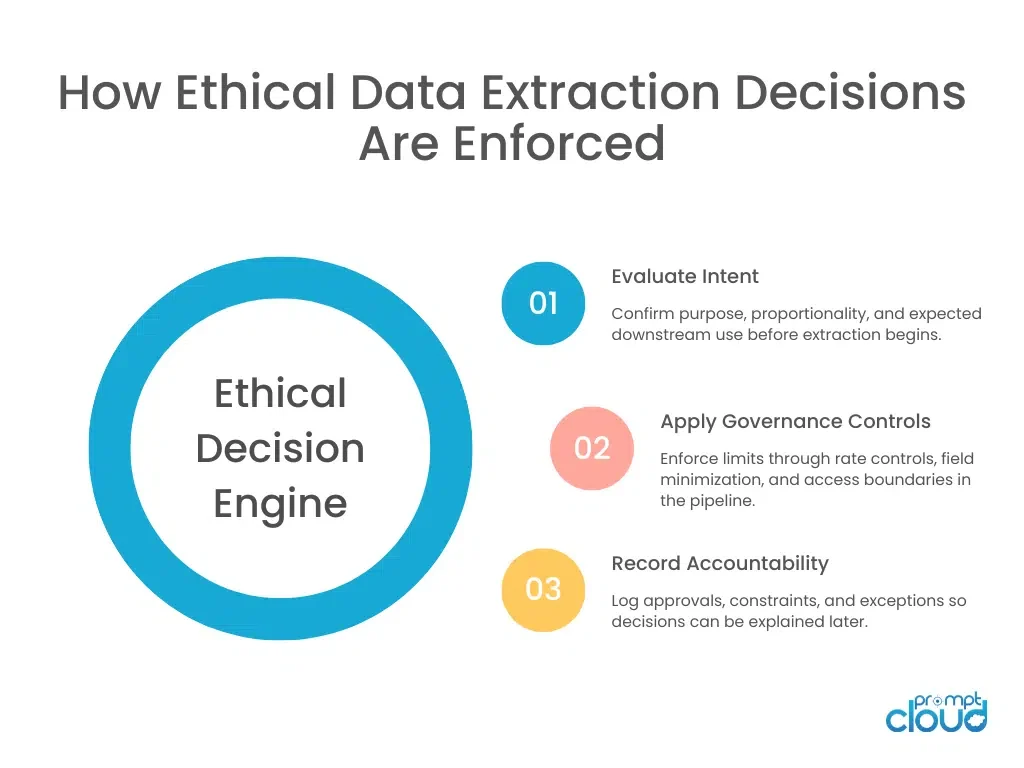
Build checkpoints into the pipeline, not before it. Ethical review should not only happen when a project is proposed. It should recur at defined moments: when a new source is added, when collection frequency increases, when data is reused for a purpose different from its original approval, and when it flows into a new downstream system. Each checkpoint asks the same core questions. That repetition is the point.
Separate capability from approval. Engineers can build a scraper. That does not mean the scraper should run. Approval to collect should sit with a governance function, a risk team, or a cross-functional review group separate from the team with technical capability. This separation catches scope creep before it becomes standard practice. Web scraping is applied broadly across industries, and the governance gap between technically possible and ethically approved widens quickly as use cases multiply.
Encode constraints in systems, not documents. Rate limits, field-level filters, purpose tags, access controls, and retention expiry dates need to live in code and configuration. Controls that live only in policy documents get applied selectively. Controls that live in systems get applied consistently. This is where governance frameworks stop being theoretical.
Make trade-offs visible. Some data is genuinely valuable but contextually sensitive. Some proportionality decisions are legitimately subjective. A good framework does not pretend otherwise. It creates a record: what risk was identified, what alternatives were considered, and what decision was made and by whom. That visibility matters for responsible AI teams who need to explain training data decisions years after collection.
Measure behavior, not just outcomes. Are review checkpoints actually running? Are exceptions documented and time-limited? Are controls technically enforced? Outcomes matter, but behavior tells you whether the system is functioning. Ethical data extraction becomes durable when following the process is easier than bypassing it.
Where Ethical Data Extraction Commonly Breaks Down
Most failures are procedural, not intentional. A shortcut becomes a standard. A one-time exception multiplies. A change in scale slips past without triggering review. Understanding specific failure patterns is more useful than general warnings about ethics.
| Breakdown point | What teams tell themselves | What actually happens | Framework fix |
|---|---|---|---|
| Purpose creep | “Same data, new use case” | Unapproved workflows accumulate on approved data | Reuse approval gates tied to purpose tags |
| Over-collection | “We can filter later” | Sensitive fields spread into storage, logs, and exports | Minimization rules enforced at ingestion |
| Context blindness | “It’s public, so it’s fine” | Extraction violates platform or user expectations | Context review step for every new source |
| Scale drift | “We just increased frequency a bit” | Proportionality changes; impact exceeds original intent | Scale thresholds that trigger reassessment |
| Weak accountability | “Everyone owns it” | No one can explain who approved a dataset or why | Named owners and documented review roles |
| Exception normalization | “This one case is special” | Exceptions accumulate into the de facto standard | Exception register with defined expiry dates |
| Downstream opacity | “The AI team will handle bias” | Responsible AI efforts inherit ethically weak inputs | Ethics review required before model ingestion |
Failures cluster around change. New sources. New markets. New automation capabilities. New team members who inherit pipelines without inheriting the context behind them. Ethical drift is rarely detected from the inside. It surfaces when something external triggers review: a platform block, a regulatory inquiry, a public complaint. A framework exists so that review is internal and proactive, not reactive.
A Practical Ethical Data Extraction Framework
The following seven steps are designed for teams operating automated collection at scale. Each step forces an explicit decision before drift has a chance to set in.
Step 1: Source and Context Validation
Before extraction starts, evaluate the source itself. Not just whether data is technically accessible, but whether automated reuse fits the context in which it was published. Consider the intended audience, publishing intent, and any signals about expectations around automation. Ambiguity here should slow the process down, not be quietly absorbed.
Step 2: Purpose Locking
Every dataset requires a declared and approved purpose before collection begins. That purpose limits what the data can be used for. A new use case triggers a new review, not an automatic extension of existing approval. This single step prevents more ethical drift than any other control in the framework.
Step 3: Proportionality Assessment
Define scope deliberately. How frequently is collection necessary? Which fields are genuinely required versus marginally useful? What volume fulfills the stated purpose without exceeding it? Proportionality should be determined at design time, not discovered retroactively when someone asks why the pipeline is far larger than the use case requires.
Step 4: Technical Control Enforcement
Rate limits, field-level filters, access controls, retention timers, and purpose tags need to live in configuration and code. If a constraint only exists in a document, it does not function as a control. This is the step where governance frameworks become infrastructure rather than aspiration.
Step 5: Downstream Use Approval
Before data flows into a new team, tool, or model, it is reviewed again. Does this reuse introduce new ethical considerations? Does it expand exposure, inference risk, or impact on individuals or platforms? Using a structured review checklist at this stage makes the process concrete rather than open-ended and prevents the silent reuse that creates most downstream problems.
Step 6: Accountability and Documentation
Every dataset has a named owner. Every review decision has a record. Not for bureaucratic compliance, but because teams change and systems outlast the people who built them. Ethical intent without documentation does not survive the first wave of attrition. The Data Lineage Evidence Kit is one practical tool for teams that need to trace collection decisions across the full data lifecycle.
Step 7: Scheduled Reassessment
Define triggers for mandatory review: scale increases, new downstream uses, new source categories, regulatory changes. If no review is ever triggered, the framework is decorative. Ethical systems stay aligned not by accident but because reassessment is built into how they operate.
Ethical Data Extraction and Responsible AI
Responsible AI is frequently treated as a modeling problem. Bias mitigation. Model cards. Fairness metrics. These matter. But they operate downstream of a more foundational issue: the ethical quality of the data the model was trained on.
Upstream extraction choices determine what enters the system long before any model sees it. If the purpose was vague, the model inherits ambiguity. If proportionality was skipped, the model trains on more than it should. If context was ignored, the model learns patterns from data that was never intended for the use it now serves.
Reuse is where this gets problematic in practice. A dataset built for search analysis ends up in a customer-facing recommendation system. A monitoring feed becomes part of a training pipeline. Each reuse feels incremental. Collectively, it moves the system far from the ethical conditions under which the original data was approved.
Context loss amplifies the problem. Engineers see fields and schemas, not publishing intent. Analysts see trends, not collection boundaries. Models see patterns, not people. Ethical frameworks address this by attaching context to data: purpose tags, known limitations, and sensitivity flags that travel with the dataset so downstream consumers understand what they are working with. This matters especially when teams explore niche alternatives to large user-generated platforms, where ethical trade-offs differ significantly from mainstream sources and need case-by-case consideration.
The OECD Principles on Artificial Intelligence and the EU AI Act both treat upstream data quality and ethical provenance as foundational requirements for responsible AI systems, not optional additions. Organizations subject to these frameworks cannot treat data governance as an afterthought.
The practical payoff is measurable. Teams that invest in upstream governance spend less time defending their AI systems later. Fewer questions about data origin before a product launch. Fewer model reviews triggered by training data that was never cleared for the use it ended up serving. Responsible AI does not start at the model. It starts at the source.
Ethical Data Governance in Commercial and Monetized Use Cases
Ethics gets tested most seriously when revenue enters the picture. Commercial data use is not inherently unethical. But monetization changes the pressure dynamics in ways that governance frameworks have to account for explicitly.
Scale increases as commercial success grows. Incentives shift toward collecting more, faster, and from more sources. Proportionality checks that felt straightforward at low volume become harder to enforce when a data product is generating meaningful revenue. A framework applied only to initial setup but not to growth will fail eventually.
Purpose drift is a particular risk. A dataset performs well. New opportunities appear. Teams stretch the original approved purpose to accommodate them rather than triggering formal reassessment. Over time, data supports use cases that were never evaluated ethically. Frameworks prevent this by separating extraction approval from commercial performance: revenue does not automatically extend permission.
Fairness and context still matter regardless of the business model. Extracting data that supports affiliate marketing programs or pricing intelligence workflows is legitimate. The method and scale of collection should still align with reasonable expectations of the source. Web scraping in advertising is one clear example where the line between competitive intelligence and overreach depends entirely on the governance infrastructure surrounding it.
The long-term commercial argument for ethical restraint is stronger than it typically gets credit for. Systems that respect collection boundaries encounter fewer platform disruptions. Data products built on ethically sound foundations are more defensible to enterprise buyers, legal reviewers, and regulators. Sustainable data businesses are built with restraint, not despite it.
How PromptCloud Supports Ethical Web Data Governance
Building and maintaining an ethical data extraction framework is operationally demanding. Most organizations understand the principles but underestimate the infrastructure required to apply them consistently at scale.
PromptCloud is a managed web data platform built for enterprises that need structured, compliant, and continuously refreshed data without the engineering overhead of running their own extraction infrastructure. The platform is designed around the same principles covered in this guide: purpose-defined collection, proportional scope, access-controlled pipelines, and documented data lineage.
For teams feeding AI systems, building competitive intelligence programs, or powering pricing and market analytics, PromptCloud handles the extraction layer with governance built in rather than bolted on. That includes rate-limit compliance, field-level filtering, structured delivery formats, and the source-level controls that make downstream use defensible.
The compliance and data governance solutions at PromptCloud are specifically designed for organizations that need to demonstrate ethical data provenance to internal stakeholders, regulators, and enterprise buyers. Rather than scrambling to reconstruct a paper trail after the fact, teams working with PromptCloud have the audit documentation ready because it is generated as part of the collection process.
Building Governance That Holds
Ethical web data governance is not a compliance exercise that gets completed once and filed away. It is an operational discipline that runs alongside the systems it governs, continuously.
The teams that get this right treat extraction decisions as the first ethical decision in a chain, not a technical detail before the important work begins. They build review into pipelines rather than layering it on top after the fact. They document decisions so accountability survives team changes. They treat commercial growth as a trigger for reassessment, not a reason to suspend scrutiny.
The data extracted today trains the models that make decisions tomorrow. Building that foundation with the same rigor applied to model development is not overhead. It is how responsible AI systems actually get built.
Get structured web data built for AI agent pipelines. Delivered to your exact schema, across any source, refreshed on your schedule.
• No contracts. • No credit card required. • No scraping infrastructure to maintain.
Frequently Asked Questions
What is an ethical data extraction framework?
An ethical data extraction framework is a structured system of principles, decision checkpoints, and accountability controls that governs how automated data collection is designed, approved, and maintained. It goes beyond legal compliance by asking whether collection is appropriate given the context, purpose, and potential downstream impact, not just whether it is technically permitted.
What is the difference between ethical web scraping and legal web scraping?
Legal scraping means you are not violating current law. Ethical scraping means the collection aligns with the reasonable expectations of the source, respects the context in which data was published, and avoids harm to users or platforms even when no law explicitly prohibits the activity. Many legally permissible scraping operations are ethically questionable at scale, particularly when the purpose is vague or the data feeds AI systems that affect real people.
How does ethical data extraction affect AI model quality?
AI models inherit the ethical quality of their training data. If data was collected without clear purpose, proportionality, or context awareness, those gaps show up in model behavior through bias, blind spots, and outputs misaligned with user expectations. Establishing ethical collection standards upstream is more reliable than attempting to fix model behavior after the fact through bias mitigation alone.
What regulations govern ethical web data collection in 2026?
Several frameworks apply depending on jurisdiction and use case. The EU AI Act requires organizations training AI on web data to document data provenance and demonstrate lawful collection. GDPR governs any data involving EU residents, including web-scraped personal data. The CCPA applies to California residents. The OECD AI Principles set voluntary international standards for responsible data use. Teams operating across markets need to account for all applicable frameworks simultaneously.
What is data minimization and why does it matter in web data governance?
Data minimization is the principle of collecting only what is necessary to fulfill the stated purpose, and filtering out sensitive or irrelevant data at ingestion rather than storing it speculatively. It matters because accumulated data that was never needed for the original purpose creates compliance exposure, increases inference risk in downstream AI systems, and makes it harder to maintain clear data lineage. Minimization is a design constraint, not a clean-up task.
How should organizations handle data reuse in an ethical governance framework?
Data reuse should be treated as a new extraction decision, not a free extension of the original approval. Before data flows into a new team, tool, or model, teams should evaluate whether the new use changes the impact, audience, or risk profile. The original purpose tag should be reviewed. If the new use falls outside the approved scope, it requires its own ethical assessment. This reuse review step prevents the silent purpose drift that causes most downstream problems.
What is the role of robots.txt and terms of service in ethical web data collection?
Robots.txt and terms of service are signals about a platform’s expectations around automated access. Respecting robots.txt directives is now treated as a factor in regulatory assessments in some jurisdictions, including by France’s CNIL in legitimate interest evaluations under GDPR. Terms of service often include explicit restrictions on scraping. Ignoring both is not only a legal risk but signals a disregard for source context that sits at the core of ethical extraction principles.
Can ethical web data governance frameworks support commercial data products?
Yes. Commercial use is not inherently in conflict with ethical extraction. The key is ensuring that commercial growth does not silently expand collection beyond its original ethical approval. Frameworks that build in reuse review gates, scale reassessment triggers, purpose locking, and accountability documentation can support monetized data operations without eroding ethical standards. Restraint in collection often produces more durable commercial outcomes than aggressive extraction.
How often should an ethical data extraction framework be reviewed?
Review should be event-triggered rather than calendar-only. Key triggers include: adding new data sources, increasing collection frequency or volume, reusing data for a new purpose, changes in team ownership, and regulatory or platform policy changes. For stable pipelines with no changes, an annual review is a reasonable minimum. The goal is to prevent the assumption of stability from silently eroding governance that was set up under different conditions.
What documentation should an ethical data governance framework produce?
At minimum: a source approval record for each data origin, a purpose declaration for each dataset, a proportionality assessment at the time of setup, a change log when scope or frequency is modified, a downstream use approval record for each new consumer, and a named owner for each active dataset. This documentation serves both internal accountability and external defensibility in the event of a regulatory review, audit, or partner inquiry.