




Why do you need images in bulk?
An image downloader is useful for quick, small-scale tasks. But in 2026, many teams need more than browser extensions. From ecommerce monitoring to AI training pipelines, bulk image extraction now requires scalability, automation, and reliability. This guide compares the top 5 image downloader tools and explains when you need to move to a production-grade web scraping solution.
An image downloader is useful for quick, small-scale tasks. But in 2026, many teams need more than browser extensions. From ecommerce monitoring to AI training pipelines, bulk image extraction now requires scalability, automation, and reliability. This guide compares the top 5 image downloader tools and explains when you need to move to a production-grade web scraping solution.
In 2026, images are no longer just visual assets. They are structured data inputs.
According to the 2025 HTTP Archive Web Almanac, the average homepage contained 20 image requests, while inner pages averaged 14 image requests. Homepages also used 239% more image bytes than comparable inner pages, showing how image-heavy modern websites have become. For businesses collecting product visuals, campaign creatives, listings, or AI training images, this volume turns image downloading from a manual task into a data extraction problem.
Ecommerce platforms analyze competitor product images. AI teams collect millions of labeled visuals for model training. Marketing teams track campaign creatives across channels. Retail intelligence platforms monitor catalog changes through image updates.
All of this requires bulk image extraction.
For small tasks, a simple image downloader works fine. You open a page, click a button, and download everything. Fast and convenient. But the moment your use case expands, cracks appear.
What happens when:
- You need images from 10,000 URLs instead of one?
- The website uses heavy JavaScript rendering?
- Images load lazily through dynamic calls?
- Do you need structured metadata alongside images?
- Does the site layout change every month?
Most traditional image downloader tools are not built for that scale. This guide walks through the top 5 image downloader tools available in 2026. More importantly, it clarifies the difference between casual downloaders and scalable image extraction pipelines so you can choose the right approach for your needs.
What Is an Image Downloader?
An image downloader is a tool that automatically detects and saves images from a webpage without requiring you to manually right-click and download each file.
At its simplest, it scans the page’s HTML, identifies image file URLs, and downloads them in bulk. Most tools allow filtering by file type, resolution, or size. Some work as browser extensions. Others are standalone desktop apps or web-based utilities.
For individuals, this is convenient. For businesses, it can be operationally useful when:
- Collecting product images from a limited set of URLs
- Archiving blog visuals
- Building small datasets for experimentation
- Saving reference material for creative teams
However, not all image downloader tools are built the same. Some are meant for casual use. Others aim to support more advanced bulk extraction.
Before we compare tools, it’s important to understand how they actually work.
How Image Downloader Tools Work
Most image downloader tools follow a similar process:
- Load the webpage
- Parse the DOM (Document Object Model)
- Identify <img> tags and background-image references
- Extract image URLs
- Download files to local storage
This approach works well for static pages. But in 2026, many websites use:
- Lazy loading
- JavaScript rendering
- API-driven image delivery
- Dynamic galleries
- CDN-based image transformations
Basic tools may fail to detect images that load only after scrolling or user interaction. They may also capture thumbnails instead of full-resolution files.
Advanced image downloaders attempt to:
- Detect high-resolution source files
- Follow embedded API calls
- Extract metadata alongside images
- Batch-process multiple pages
The difference between tools lies in how well they handle modern website complexity.
Image Downloader vs Web Scraping Services
For small-scale use, an image downloader is sufficient. But there is a clear dividing line.
An image downloader works best when:
- You are extracting from a single page or small batch
- The site is not JavaScript-heavy
- You do not need structured metadata
- You are not dealing with frequent layout changes
A web scraping service becomes necessary when:
- You need images from thousands of URLs
- Images update frequently
- You require associated metadata like titles, prices, or categories
- The site uses dynamic rendering
- You need API-based delivery
- Compliance and governance matter
For example:
An ecommerce intelligence team tracking competitor catalogs needs not just images, but:
- SKU identifiers
- Price tags
- Product names
- Availability
- Timestamps
A browser-based image downloader cannot structure and deliver that reliably at scale. This distinction becomes clearer when we examine the top 5 tools available in 2026.
For teams requiring recurring, high-volume image extraction with metadata, rendering support, and quality checks, managed web scraping services provide structured image datasets without the operational burden of maintaining scrapers, proxies, retries, and changing page logic.
Stop relying on manual image downloads that break when volume, metadata, or website complexity increases.
• No contracts. • No credit card required. • No scraping infrastructure to maintain.
Top 10 Bulk Image Downloader Tools in 2026
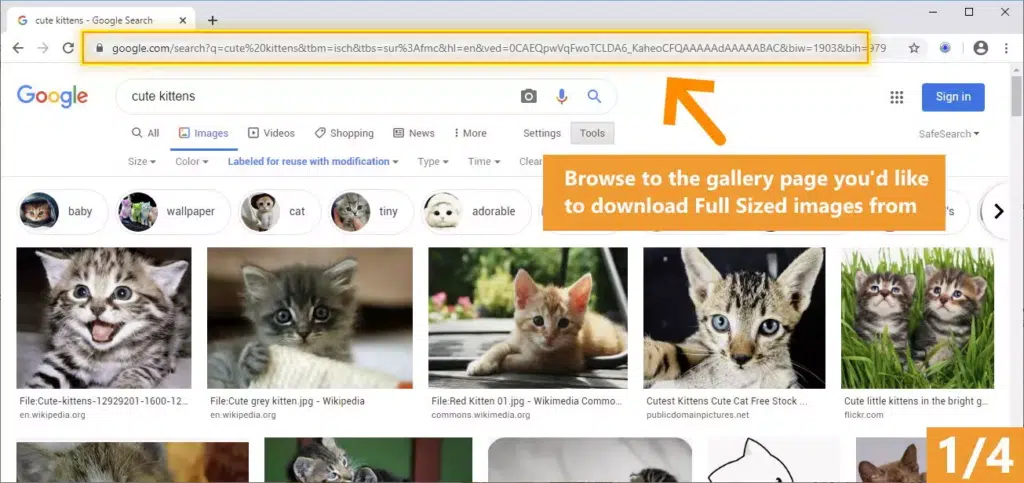
Link: Bulk Image Downloader
1. Bulk Image Downloader
Link: Bulk Image Downloader
Description:
Bulk Image Downloader, often called BID, is a Windows desktop tool built to download full-sized images from web galleries with minimal setup. The official site describes it as a tool to download full-sized images from almost any web gallery, and its 2026 site still shows active browser-extension support for Chrome, Firefox, Edge, and Opera.
| Strengths | Limitations | Best Suited For |
| Strong full-size gallery downloads, mature desktop workflow, browser extension support, preview before downloading, useful for image-heavy galleries | Windows-focused, paid tool after trial, not ideal for scripted automation or recurring enterprise pipelines | Users who need to download full-resolution images from web galleries without building a scraper |
2026 relevance: Still active. The official site shows 2026 copyright and a maintained “What’s new” section, while Softpedia lists a 2026 update and describes BID as a fast way to download full-size image galleries with minimum configuration.
Verdict: Bulk Image Downloader is one of the strongest dedicated desktop options for non-technical users who want full-size gallery downloads. It is not the best fit for developer automation, but for manual gallery-based image collection, it remains a top 2026 option.
2. WFDownloader App
Link: WFDownloader App
Description:
WFDownloader App is a free cross-platform bulk downloader for images, wallpapers, galleries, videos, documents, URL lists, sequential URLs, and supported websites. It supports Windows, Mac, Linux, and a cross-platform version, which makes it more flexible than Windows-only bulk image downloaders.
| Strengths | Limitations | Best Suited For |
| Free to use, cross-platform, supports image galleries, search-engine image downloads, sequential URLs, URL lists, and batch downloads from multiple supported sites | Interface is more functional than polished, advanced features can take time to learn, site support may vary depending on source structure | Researchers, marketers, content teams, and power users who need flexible bulk downloads across different sources |
2026 relevance: Still relevant. WFDownloader published 2026 content around bulk image downloading and Linux support, and its official download page still provides Windows, Mac, Linux, and cross-platform builds.
Verdict: WFDownloader App is one of the strongest free options in 2026 for users who need more flexibility than a browser extension. It is especially useful when the workflow involves multiple sources, URL lists, sequential links, or recurring bulk downloads.
3. Extreme Picture Finder
Link: Extreme Picture Finder
Description:
Extreme Picture Finder is a Windows desktop bulk media downloader for saving images, videos, music, and other files from websites. It can download from photo galleries, website categories, video playlists, forum threads, and URL lists, making it more crawler-like than simple browser extensions. The official download page lists Extreme Picture Finder 3.70 as the current version and requires Windows 10 or newer.
| Strengths | Limitations | Best Suited For |
| Strong crawling controls, supports images and mixed media, works with galleries and URL lists, includes templates and tutorial support, useful for large batch jobs | Windows-only, paid/trial model, more setup-heavy than browser extensions, not ideal for non-technical users who only need one-click downloads | Power users who need controlled bulk downloads from image-heavy websites, categories, and media libraries |
2026 relevance: Still relevant. The official site lists version 3.70, and Softpedia shows a January 2026 listing for Extreme Picture Finder, indicating that it remains active and visible in current software directories.
Verdict: Extreme Picture Finder is best when users need more control than browser extensions provide. It is a strong option for recurring or large image collection tasks on Windows, especially when URL lists, templates, and deeper site crawling matter.
4. NeoDownloader
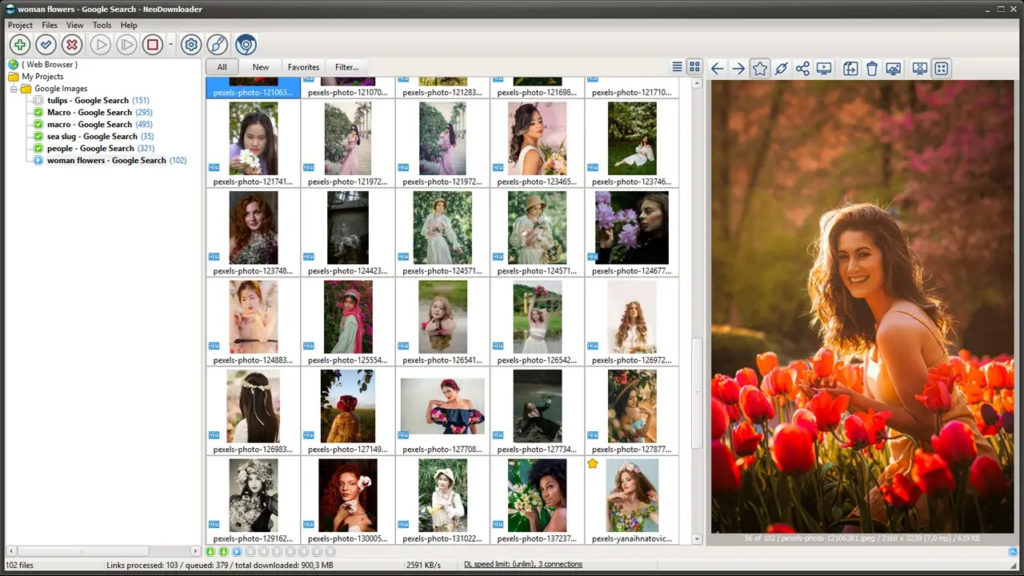
Link: NeoDownloader
Description:
NeoDownloader is a Windows bulk image and media downloader for saving images, videos, and other files from websites. The official download page lists NeoDownloader 5.0.1, released on February 7, 2026, and positions it as a free bulk image and media downloader for Windows 10 and 11 64-bit systems.
| Strengths | Limitations | Best Suited For |
| Supports bulk downloads from URL lists, handles images and mixed media, includes a newer 64-bit Windows version, has a built-in browser in NeoDownloader 5, and supports many website workflows | Windows-only, 64-bit required for the latest version, premium upgrade needed for full power features, not ideal for scripting or automated recurring pipelines | Windows users who need a dedicated desktop downloader for bulk images and media from multiple websites |
2026 relevance: Strong. NeoDownloader is clearly active in 2026, with version 5.0.1 listed on its official download page and third-party software directories also showing February 2026 updates.
Verdict: NeoDownloader is a strong 2026 pick for Windows users who want a modern desktop bulk downloader with URL-list support and mixed media handling. It is better than a browser extension for larger download jobs, but less suitable than developer tools when the workflow needs scripting, scheduled crawling, or repeatable automation.
5. gallery-dl
Link: gallery-dl
Description:
gallery-dl is a free, open-source command-line tool for downloading image galleries and collections from supported websites. The official GitHub page describes it as a cross-platform program with advanced configuration options and powerful file-naming capabilities.
| Strengths | Limitations | Best Suited For |
| Free and open-source, cross-platform, strong automation support, advanced naming rules, configuration files, cookies/authentication support, useful for repeatable downloads | Command-line only, not beginner-friendly, source support can break when websites change, setup takes more effort than browser extensions | Developers, researchers, archivists, and power users who need scriptable bulk image downloads |
2026 relevance: Strong. The GitHub releases page shows v1.31.10 as the latest release in March 2026, and recent GitHub issues from February and March 2026 show active usage and maintenance around supported sites.
Verdict: gallery-dl is one of the best 2026 options for technical users. It is not the right choice for someone who wants a visual one-click downloader, but it is excellent for repeatable, configurable, and automated gallery downloads.
6. JDownloader 2
Link: JDownloader 2
Description:
JDownloader 2 is a free download manager for handling large batches of files, links, albums, playlists, and media downloads. It is not image-specific, but it works well when users need queue control, pause and resume, bandwidth limits, auto-extraction, and browser-to-desktop download handling. The official JDownloader 2 page shows updated installer packages from March 31, 2026, including Windows x64 and ARM64 builds with Java 21.
| Strengths | Limitations | Best Suited For |
| Free, strong queue management, supports pause/resume, bandwidth limits, browser extension workflows, remote access through MyJDownloader, useful for large batches of mixed files | Not built specifically for image scraping, interface can feel heavy, plugin/site support may vary, less precise than image-focused tools for full-size gallery extraction | Users who need a broad download manager for mixed media, large link batches, albums, archives, and recurring download queues |
2026 relevance: Strong. JDownloader’s official optional software offers-free installer page was updated in 2026, and its browser connector extensions remain available for sending download jobs from Chrome or Firefox into JDownloader.
Verdict: JDownloader 2 is best when the task is not limited to images. For pure gallery downloads, Bulk Image Downloader or Extreme Picture Finder is stronger. For mixed download queues, albums, files, and media-heavy workflows, JDownloader 2 remains a reliable 2026 option.
7. DownThemAll!
Link: DownThemAll!
Description:
DownThemAll! is a free, open-source browser extension that adds bulk downloading capabilities to Chrome, Firefox, and other supported browsers. It lets users download links or images from a webpage, refine downloads using filters, queue files, pause and resume downloads, and apply custom renaming masks.
| Strengths | Limitations | Best Suited For |
| Free and open-source, works inside the browser, supports image and link filtering, queue control, pause/resume, and renaming masks | Not built for deep crawling, weaker for JavaScript-heavy pages, limited by browser extension restrictions, less powerful than desktop crawlers | Users who need fast page-level bulk image downloads without installing a full desktop scraper |
2026 relevance: Still relevant, but with a caveat. DownThemAll! remains available on the Chrome Web Store and Firefox Add-ons, with Mozilla showing an update date in late 2025 and third-party directories listing version 4.14.3. However, it is better treated as a browser-based bulk downloader, not a full image scraping or crawling tool.
Verdict: DownThemAll! is best for lightweight, browser-based bulk downloads from pages where images and links are already visible. It is not the best option for complex gallery crawling or recurring automated collection, but it remains useful for quick batch downloads.
8. Imageye
Link: Imageye
Description:
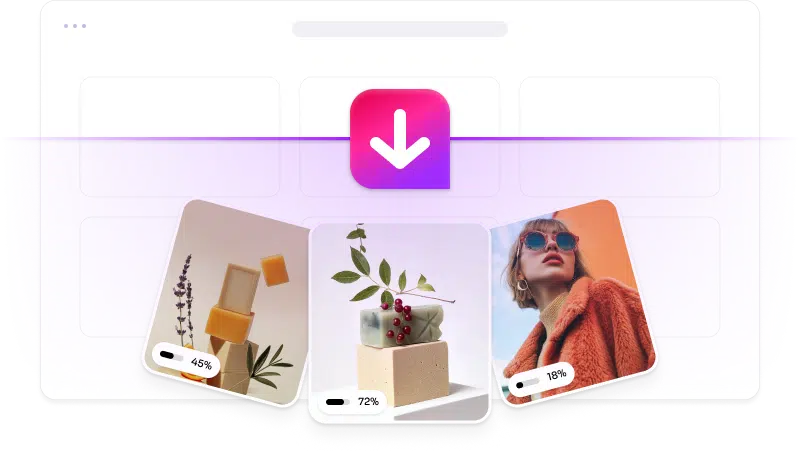
Imageye is a browser-based image downloader that detects images on the active webpage and lets users browse, filter, convert, and download them in bulk. The Chrome Web Store listing says it can filter images by pixel width, height, URL, and file size, bulk download images, copy original image URLs, convert WebP to JPG, and export images in different formats.
| Strengths | Limitations | Best Suited For |
| Easy browser workflow, visual preview grid, filters by size and URL, bulk download, image format conversion, works well for visible page-level images | Browser-extension limits, weaker for deep crawling, may miss images behind interactions, pagination, login walls, or lazy-loaded states | Designers, marketers, researchers, and content teams who need fast image downloads from webpages |
2026 relevance: Still relevant. Imageye remains listed on the Chrome Web Store, and third-party software directories show version 5.30.1 with 2026 update activity. Its official website still positions it as a bulk image downloader for websites including social and visual platforms.
Verdict: Imageye is best for quick browser-based bulk image downloading. It is not a replacement for desktop crawlers or developer automation tools, but it is useful when users need to inspect images visually and download selected assets from a webpage fast.
9. Fatkun Batch Download Image
Link: Fatkun Batch Download Image
Description:
Fatkun Batch Download Image is a Chrome extension for downloading images in batches from webpages. The Chrome Web Store listing says it can automatically group pictures, download high-definition images, support mainstream e-commerce websites, and download images across multiple open pages.
| Strengths | Limitations | Best Suited For |
| Simple Chrome workflow, automatic image grouping, high-definition image download support, useful for e-commerce and multi-page image collection | Browser-extension limits, not ideal for deep crawling, permissions should be reviewed carefully, source/version history can be confusing because multiple similarly named Fatkun/Fitkun extensions exist | E-commerce sellers, marketplace researchers, designers, and content teams who need quick image downloads from product pages or visual-heavy websites |
2026 relevance: Still relevant, but verify the exact extension before installing. The Chrome Web Store listing is live, while related Fatkun-branded pages and similarly named extensions show different versions and update histories, including e-commerce-focused variants updated in 2026.
Verdict: Fatkun is useful for fast browser-based image collection, especially from e-commerce pages. It should not be treated as a production scraping tool, and users should confirm the developer, permissions, reviews, and latest update before installing.
10. Download All Images
Link: Download All Images
Description:
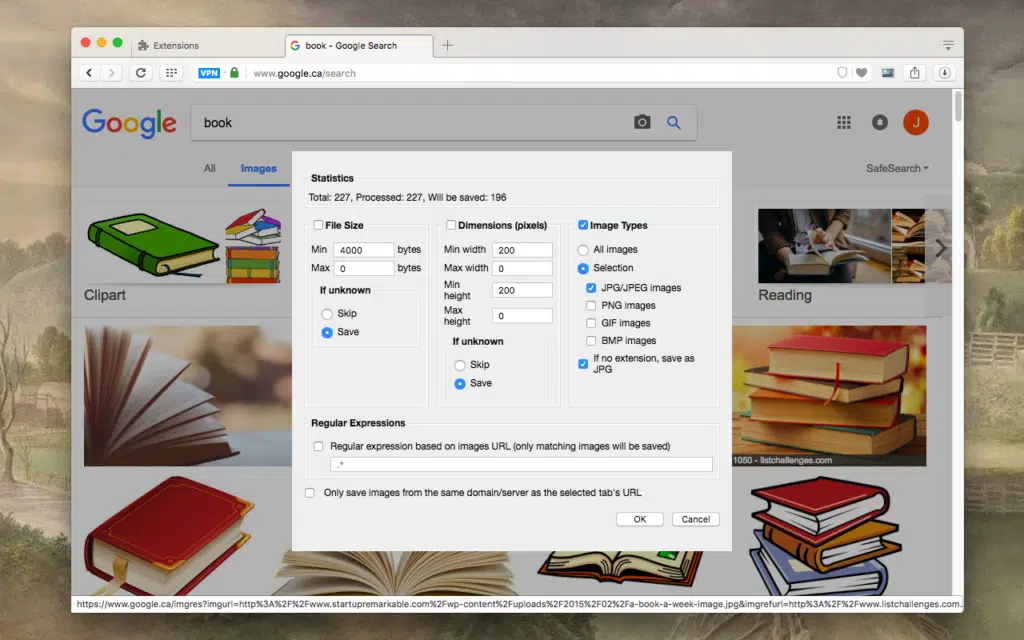
Download All Images is a browser extension that saves images from the current webpage into a ZIP file. The Chrome Web Store listing says it can filter images by file size, dimensions, URL, and image type, making it useful when users want to quickly capture page-level images without setting up desktop software.
| Strengths | Limitations | Best Suited For |
| Simple ZIP export, useful filters, fast browser-based workflow, good for downloading visible images from one page | Page-level only, not built for deep crawling, may miss images hidden behind interactions or pagination, extension permissions should be reviewed | Users who need quick one-page image downloads from websites, blogs, product pages, or visual references |
2026 relevance: Still relevant as a lightweight browser option. It remains available on the Chrome Web Store and is best positioned as a quick page-level downloader, not a full scraping or crawling solution.
Verdict: Download All Images is a good final pick for users who need speed and simplicity. It is not suitable for large recurring image collection, but it works well when the goal is to download filtered images from a single active webpage in one ZIP file.
All ten tools share one characteristic.
They are file downloaders, not data pipelines.
They can:
- Detect images
- Download them
- Save locally
But they typically cannot:
- Crawl thousands of URLs automatically
- Handle heavy JavaScript rendering reliably
- Extract structured metadata alongside images
- Monitor changes over time
- Deliver data via API or S3
- Maintain workflows when layouts change
For individuals, that may not matter.
For businesses building AI systems, ecommerce intelligence dashboards, or visual search engines, it matters significantly.
When an Image Downloader Is Enough
There are still legitimate use cases for lightweight tools.
You might use an image downloader when:
- You are collecting inspiration for a mood board
- You need a quick archive of blog visuals
- You are building a small experimental dataset
- The page structure is static and predictable
- The task is short-term and manual
In these cases, speed matters more than automation depth. Extensions and desktop tools are efficient for one-time extractions.
When You Outgrow Image Downloader Tools
The tipping point usually comes when one of the following happens:
1. Volume Increases
If you move from extracting images from 10 URLs to 10,000 URLs, manual workflows collapse quickly.
Browser tools are not designed for automated, scheduled crawling across domains.
2. Metadata Becomes Critical
For many industries, images alone are not enough.
An ecommerce intelligence team may require:
- Product name
- Price
- SKU
- Category
- Timestamp
- Variant information
An image downloader does not capture this structured context.
3. Websites Become Dynamic
Modern sites load images through:
- JavaScript rendering
- Lazy loading
- API calls
- Infinite scroll
- CDN-based transformations
Basic tools often miss these images or capture thumbnails instead of full-resolution versions.
4. Monitoring Is Required
If you need to detect:
- New product images
- Visual updates
- Seasonal campaign creatives
- Brand compliance violations
You need a recurring extraction system, not a one-time downloader.
Image Downloader vs Scalable Web Extraction Architecture
This is where the conversation shifts.
An image downloader is a user tool.
A scalable web extraction system is infrastructure.
Infrastructure supports:
- Scheduled crawling
- Multi-domain extraction
- Change detection
- Schema standardization
- API delivery
- Quality monitoring
- Legal safeguards
In 2026, organizations collecting images for AI pipelines are increasingly integrating extraction workflows into broader AI data pipeline architectures.
For example:
- Computer vision models need millions of labeled images
- Ecommerce AI requires image + price + description consistency
- Brand monitoring systems require recurring visual scraping
This is no longer a download problem. It is a data engineering problem.
Industry Use Cases Driving Bulk Image Extraction in 2026
To understand where image downloader tools fit, it helps to examine real-world drivers.
Evaluating Managed Solutions?
See how managed web scraping services compare across scale, metadata extraction, JavaScript rendering, image quality validation, delivery formats, and long-term maintenance.
Ecommerce & Retail Intelligence
Retail teams extract competitor product images to:
- Detect catalog updates
- Monitor packaging changes
- Identify counterfeit listings
- Analyze visual merchandising strategies
In high-volume environments like Black Friday, image extraction often pairs with pricing and inventory scraping.
AI & Computer Vision Training
AI teams collect:
- Product images
- Street view imagery
- Satellite images
- Visual annotations
Here, image quality, labeling, and consistency are critical.
Lightweight tools cannot manage large-scale annotation workflows.
Marketing & Brand Monitoring
Marketing teams track:
- Ad creatives
- Banner designs
- Seasonal visuals
- Campaign variations
This often requires scheduled scraping rather than manual downloads.
Travel & Hospitality
Travel platforms extract:
- Property photos
- Amenity visuals
- Room variations
- Seasonal updates
When inventory shifts frequently, recurring extraction becomes essential.
Architecture Matters More Than Tools
In 2026, the conversation is shifting from “Which image downloader should I use?” to “How should my image extraction architecture be designed?”
A mature image extraction workflow includes:
- Crawl scheduling
- JavaScript rendering support
- Full-resolution detection
- Structured metadata mapping
- Storage standardization
- Quality validation
- Compliance review
Without this structure, data quality degrades quickly.
Even small changes in website layout can break extraction logic.
This is why enterprise teams increasingly rely on managed web data services instead of browser-based utilities.
Why PromptCloud Fits Into This Evolution
While standalone image downloader tools serve small tasks well, businesses operating at scale need more.
A professional web data solution supports:
- Multi-domain extraction
- High-volume crawling
- JavaScript-heavy websites
- Structured image + metadata pairing
- Ongoing maintenance
- Compliance frameworks
This ensures images are not just downloaded, but delivered as usable, structured assets ready for analytics or AI training.
Advanced Image Extraction Challenges in 2026
Bulk image downloading has evolved. It is no longer about collecting JPEG files from static pages. Websites have become more complex, image delivery has become more optimized, and anti-automation systems have become more sophisticated.
If you are relying only on basic image downloader tools, you will eventually hit friction.
Here are the major challenges professionals face in 2026.
1. Responsive and Multi-Resolution Images
Modern websites rarely serve a single image file.
Instead, they use:
- srcset attributes
- CDN-based resizing
- Adaptive image rendering
- WebP or AVIF formats
An image downloader might capture the displayed version, which could be a compressed thumbnail instead of the original high-resolution image.
For AI training, ecommerce catalog analysis, or print workflows, that difference matters.
High-quality image extraction requires logic that identifies the highest-resolution available source rather than simply downloading what is visible.
2. Lazy Loading and Infinite Scroll
Most ecommerce and media websites now use lazy loading. Images load only when the user scrolls into view.
If your tool does not simulate full rendering behavior, it may:
- Miss images below the fold
- Capture incomplete galleries
- Download placeholder thumbnails
This is especially common on product listing pages and social feeds.
To handle this correctly, extraction systems must execute JavaScript, scroll programmatically, and wait for dynamic elements to load fully.
Lightweight browser extensions struggle with this at scale.
3. CDN Image Obfuscation
Many large platforms use content delivery networks that dynamically generate image URLs.
These URLs may include:
- Temporary tokens
- Time-sensitive parameters
- Encoded paths
- Expiring access keys
Basic image downloader tools may capture links that expire quickly, making downloaded URLs unusable later.
Professional extraction workflows must resolve the stable, canonical image source.
4. Duplicate Image Management
When collecting large datasets, duplication becomes a silent problem.
If you are scraping thousands of product pages across multiple domains, you may encounter:
- Same product image across different retailers
- Same image under different resolutions
- Reused promotional banners
Without deduplication logic, storage costs increase and datasets become noisy.
Modern image extraction pipelines increasingly integrate:
- Hash-based duplicate detection
- Resolution normalization
- Naming conventions tied to metadata
These are features that standalone image downloader tools typically do not offer.
Image Extraction for AI and LLM Pipelines
In 2026, image collection is often tied to AI use cases.
For example:
- Visual search engines
- Product similarity matching
- Generative AI training
- Image classification systems
- Object detection models
In these scenarios, images must be paired with structured metadata.
For instance, a product image alone is not enough. You need:
- Product name
- Category
- Price
- Brand
- Timestamp
- Variant information
If the image is detached from context, it loses analytical value.
This is where the boundary between an image downloader and a structured web data extraction system becomes clear.
One collects files.
The other builds datasets.
Legal and Compliance Considerations
Another major shift in 2026 is regulatory awareness.
Bulk downloading images without considering compliance can create legal risk.
Professionals must consider:
- Terms of service restrictions
- Copyright protections
- Usage rights
- Attribution requirements
- Jurisdictional data laws
Organizations operating at scale cannot rely on casual extraction methods.
Image downloading should always align with applicable laws and platform policies.
For enterprise use cases, compliance safeguards must be embedded into the workflow itself rather than treated as an afterthought.
Performance and Infrastructure Constraints
When downloading thousands of images, performance becomes critical.
Common bottlenecks include:
- Network throttling
- IP rate limits
- Server blocks
- Bandwidth constraints
- Storage management
Browser-based tools are rarely optimized for high-concurrency extraction.
Enterprise workflows require:
- Distributed crawling
- IP rotation strategies
- Retry logic
- Error handling
- Parallel processing
Without these mechanisms, bulk downloads may fail halfway through large jobs.
Evaluating the Right Image Downloader in 2026
If you are selecting a tool today, evaluate it across these dimensions:
- Does it support JavaScript-heavy websites?
- Can it handle high-resolution extraction reliably?
- Does it allow structured output?
- Can it scale across thousands of URLs?
- Does it offer scheduling capabilities?
- Can it detect layout changes?
- Does it integrate with APIs or cloud storage?
For individual creators, simplicity may outweigh these factors. For organizations, these criteria determine long-term reliability.
Beyond Downloading: Image Intelligence
A new trend in 2026 is moving from downloading images to extracting intelligence from images.
This includes:
- Detecting logos within images
- Identifying packaging changes
- Tracking brand placement
- Monitoring visual compliance
- Running computer vision tagging automatically
In these workflows, image extraction is only the first layer.
The real value lies in integrating image datasets into analytics and AI systems.
This requires:
- Structured storage
- Consistent naming conventions
- Metadata alignment
- Quality checks
- Automation pipelines
An image downloader alone cannot support this full lifecycle.
The Strategic Shift
Image downloading began as a convenience feature.
Today, it has become part of data infrastructure strategy.
The tools covered in this guide serve important roles for small projects and quick extraction needs.
However, once image extraction becomes:
- Continuous
- High-volume
- Multi-domain
- Metadata-dependent
- AI-integrated
The conversation shifts from tools to architecture.
Choosing the right approach in 2026 depends not just on what you want to download, but on what you plan to do with the data afterward.
That distinction determines whether a browser extension is enough or whether you need a scalable web data solution designed for long-term reliability and growth.
If you want to explore more
If image extraction is part of a larger data workflow, these resources will help you think beyond basic downloading:
- Learn how to design scalable systems in AI data pipeline architecture
- Understand seasonal scale challenges with Black Friday web scraping for ecommerce
- Measure extraction reliability using AI data quality metrics
- Structure image and text datasets properly with structuring and labeling web data for LLMs
For a deeper understanding of how modern websites load and structure images, you can refer to the official documentation on responsive images by MDN Web Docs: Responsive Images Guide (MDN). This guide explains how srcset, sizes, and modern image formats work, which is essential when evaluating how image downloader tools extract files from dynamic pages.
Ready to evaluate?
FAQs
1. What is the best way to download images from a website in bulk?
The best way depends on scale. For one page or a small batch, a browser extension or desktop image downloader works well. For thousands of URLs, dynamic pages, metadata requirements, or recurring extraction, a managed web scraping workflow is more reliable.
2. How do I download all images from a webpage at once?
You can download all images from a webpage using a browser extension, desktop downloader, or online image downloader that detects image URLs and saves them in bulk. However, some tools only capture visible images, so lazy-loaded or JavaScript-rendered images may be missed.
3. Why do image downloaders miss some images?
Image downloaders often miss images because modern websites use lazy loading, JavaScript rendering, infinite scroll, background images, CDN transformations, or API-based delivery. If the tool does not render the page fully or simulate user behavior, it may only capture thumbnails or images visible at initial load.
4. Can I download full-resolution images instead of thumbnails?
Yes, but only if the tool can detect the original image source rather than the thumbnail displayed on the page. Full-resolution extraction is harder on websites using responsive images, srcset, WebP or AVIF formats, CDN resizing, or dynamically generated image URLs.
5. What is the difference between an image downloader and an image scraper?
An image downloader usually saves image files from a page or URL list. An image scraper can extract images along with structured metadata such as product name, price, category, SKU, timestamp, page URL, and availability, making it more useful for analytics, AI training, and monitoring workflows.
6. Can bulk image downloaders work on JavaScript-heavy websites?
Some advanced tools can handle parts of JavaScript-heavy websites, but many browser extensions and basic downloaders struggle with dynamic rendering. If images load after scrolling, clicking, or API calls, a scalable scraping setup with rendering support is usually more reliable.
7. Is it legal to download images from websites in bulk?
Bulk image downloading is not automatically legal or illegal. It depends on the website’s terms, copyright status, usage rights, jurisdiction, and how the images will be used. Businesses should review source permissions and compliance requirements before using downloaded images for commercial, AI, or analytics purposes.
8. Can bulk image downloaders be used for AI training datasets?
Yes, bulk image downloaders can help with small experimental AI datasets, but they are usually not enough for production-grade AI training. AI datasets often need image quality checks, deduplication, labels, metadata, source documentation, refresh logic, and compliance review.
9. How do I download images from multiple URLs at once?
You can download images from multiple URLs using tools that support URL lists, batch imports, or sequential URL patterns. For larger workflows, you need automated crawling, retry logic, duplicate handling, structured storage, and quality monitoring to prevent incomplete or messy image datasets.
10. When should a business stop using image downloader tools and move to web scraping services?
A business should move to web scraping services when image extraction becomes high-volume, recurring, multi-domain, metadata-dependent, or tied to AI, ecommerce, brand monitoring, or analytics workflows. At that point, reliability, structure, monitoring, and compliance matter more than simply downloading image files.