





Talabat Data Scraping for Quick Commerce: Why Market Visibility Is Broken Without It
Talabat data scraping allows quick commerce teams to move beyond surface-level competitor tracking and build real-time intelligence across pricing, assortment, delivery speed, and demand patterns. Instead of reacting to market changes, businesses can continuously monitor how competitors price products, adjust delivery windows, and position inventory across locations. The real advantage comes from structuring this data into a system that updates frequently and scales across cities. However, extracting Talabat data reliably introduces challenges around blocking, data consistency, and pipeline maintenance. This is why teams shift from manual tracking or scripts to managed data pipelines that deliver clean, decision-ready datasets.
Quick Commerce Moves Faster Than Traditional Analytics
Quick commerce operates on compressed timelines. Pricing changes, stock availability, and delivery promises can shift multiple times within a single day. Traditional analytics workflows, which rely on periodic reports or delayed dashboards, cannot keep up with this pace.
This creates a structural gap between what is happening in the market and what teams can actually respond to.
The Visibility Problem: Data Exists, But Not as a System
Platforms like Talabat already surface critical signals:
- Product pricing across vendors
- Delivery time estimates
- Availability and assortment changes
- Promotional activity
The issue is not lack of data, but lack of continuous access and structure. Most teams rely on manual checks or fragmented datasets, which makes it impossible to track changes consistently across locations and time.
Where Decisions Start Breaking Down
This lack of structured visibility shows up in operational and pricing inefficiencies:
- Competitor price changes go unnoticed until impact is visible in sales
- Delivery SLA gaps are identified too late
- Assortment gaps are discovered after demand shifts
The result is reactive decision-making instead of proactive strategy.
Why Talabat Data Scraping Becomes a Strategic Layer
Talabat data scraping converts marketplace signals into structured datasets that can be tracked continuously.
Instead of:
- Checking listings manually
- Updating pricing models intermittently
Teams can:
- Monitor competitor pricing in near real time
- Track delivery performance across geographies
- Identify demand patterns through assortment shifts
At this point, Talabat stops being a marketplace interface and becomes a data layer for competitive intelligence and pricing strategy.
Stop unreliable Talabat data pipelines. Start making pricing decisions with confidence
• No contracts. • No credit card required. • No scraping infrastructure to maintain.
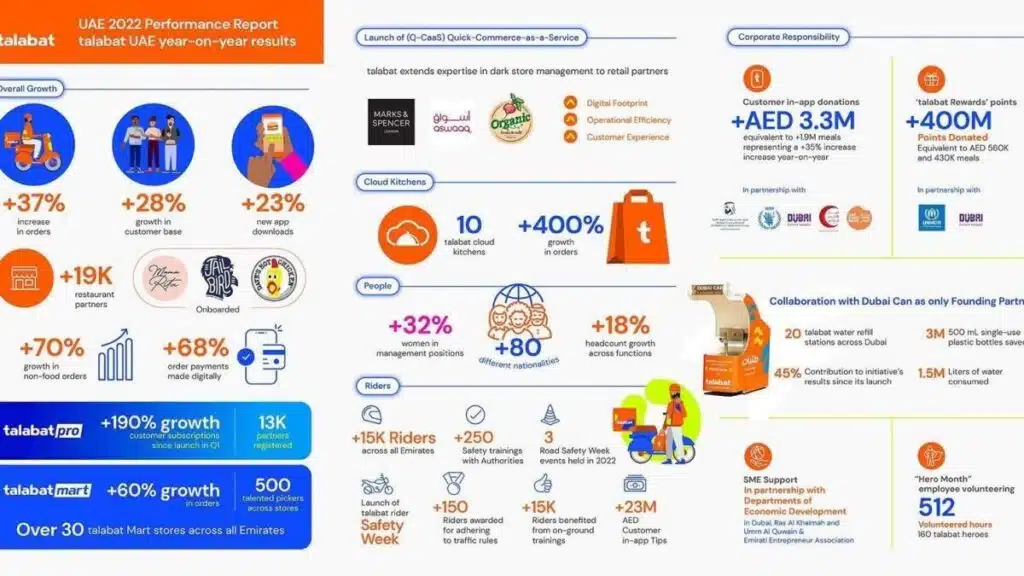
Source: khaleejtimes
What Talabat Data Enables for Quick Commerce Strategy
Real-Time Pricing Intelligence Across Competitors
Quick commerce pricing is highly dynamic. The same SKU can vary in price across vendors, locations, and time windows. Manual tracking cannot capture this variability.
Talabat data scraping allows continuous monitoring of:
- SKU-level pricing across competitors
- Discount patterns and promotional timing
- Price differences across geographies
This enables teams to move from reactive pricing updates to continuous price benchmarking and adjustment.
Assortment Visibility and Demand Signals
In quick commerce, what is listed is as important as what is priced.
Talabat data reveals:
- Which products are consistently available
- Which items go out of stock frequently
- How assortment changes across locations
These signals act as proxies for demand. If certain SKUs disappear quickly or are frequently restocked, it indicates high demand concentration.
This allows teams to:
- Optimize inventory allocation
- Identify high-demand categories
- Reduce missed sales due to stockouts
Delivery Time as a Competitive Lever
Delivery promise is a core differentiator in quick commerce.
Talabat listings provide:
- Estimated delivery times
- Variations across vendors and locations
- Changes based on demand or time of day
Tracking this data at scale helps teams understand:
- Where competitors are outperforming on speed
- Where delivery delays may impact conversion
- How delivery SLAs shift during peak demand
This turns delivery from an operational metric into a pricing and conversion signal.
Promotional and Discount Strategy Tracking
Promotions in quick commerce are frequent and localized.
Talabat data allows teams to monitor:
- Discount depth across categories
- Frequency of promotions
- Vendor-specific campaign patterns
This helps answer:
- Are competitors discounting to gain share?
- Which categories are price-sensitive?
- When do promotions drive demand spikes?
This shifts strategy from static campaigns to data-informed promotional timing.

Source: winklix
Market Comparison: Manual Tracking vs Talabat Data Systems
| Dimension | Manual Tracking | Talabat Data Scraping |
| Pricing Visibility | Limited SKUs | Full catalog coverage |
| Update Frequency | Periodic | Continuous |
| Delivery Insights | Anecdotal | Structured, comparable |
| Assortment Tracking | Incomplete | Comprehensive |
| Decision Speed | Slow | Near real-time |
Explore More
- Learn how AI data pipeline architecture enables continuous marketplace intelligence systems.
- See how seasonal demand tracking and pricing shifts impact ecommerce strategy at scale.
How to Scrape Talabat Data in 2026
What Talabat Data Extraction Involves Today
Talabat operates as a dynamic marketplace where product listings, pricing, and delivery signals are rendered in real time. Extracting this data requires capturing:
- SKU-level pricing and discounts
- Vendor-specific listings and assortment
- Delivery time estimates by location
- Availability changes across time windows
Unlike static websites, this data is often loaded dynamically and varies based on user location, making extraction more complex.
The Shift from Page Scraping to Signal Extraction
Earlier scraping approaches focused on extracting visible page content. In 2026, the challenge is capturing underlying marketplace signals.
This includes:
- Tracking how pricing changes across time intervals
- Monitoring delivery time fluctuations
- Capturing assortment differences across locations
The focus is no longer just data collection, but building a system that reflects market movement continuously.
Where DIY Talabat Scraping Starts to Break
Location-Based Rendering Complexity
Talabat personalizes listings based on delivery location. The same product can appear differently across neighborhoods.
This creates challenges in:
- Standardizing data across geographies
- Maintaining consistent datasets
- Comparing competitors accurately
Without structured location mapping, insights become fragmented.
Anti-Bot and Access Restrictions
Marketplace platforms actively detect automated traffic patterns.
At scale, this leads to:
- Request blocking
- Inconsistent data extraction
- Increased need for traffic distribution strategies
This introduces operational overhead that grows with scale.
High-Frequency Change and Data Drift
Quick commerce data changes rapidly. Prices, availability, and delivery times can shift multiple times a day.
Without continuous extraction:
- Data becomes outdated quickly
- Pricing models rely on stale inputs
- Competitive insights lose relevance
Maintaining freshness becomes a core challenge.
Data Normalization Across Vendors
Different vendors list similar products with variations in naming, packaging, and pricing formats.
This creates issues in:
- SKU matching
- Price comparison
- Category-level analysis
Without normalization, datasets remain inconsistent and difficult to use for decision-making.
Comparison: DIY Scraping vs Managed Data Pipeline
| Dimension | DIY Talabat Scraping | Managed Data Pipeline |
| Setup | Fast initial setup | Structured onboarding |
| Maintenance | Continuous fixes | Managed externally |
| Data Consistency | Variable | Standardized |
| Multi-Location Coverage | Complex | Built-in |
| Reliability | Unpredictable | SLA-backed |
The Core Challenge in 2026
The constraint is no longer access to Talabat data.
The constraint is maintaining reliable, structured, and continuously updated datasets across markets.
This is why most teams start with scraping experiments but transition to systems that can support ongoing data needs without constant intervention.
Explore More
- Understand how data quality metrics impact reliability of marketplace intelligence systems.
- See how structured and labeled web data improves downstream AI and analytics use cases.
Best Practices for Talabat Data Extraction Without Breaking Reliability
Design for Continuous Data Refresh, Not One-Time Extraction
Quick commerce data loses value quickly. Prices, delivery times, and availability shift multiple times a day, especially during peak demand windows.
This means extraction systems must be designed for high-frequency refresh cycles, not periodic pulls. Without this, insights lag behind market reality, and pricing decisions become reactive instead of predictive.
A reliable setup prioritizes consistency in refresh intervals and ensures that datasets reflect current marketplace conditions at all times.
Standardize Location and Vendor Mapping Early
Talabat data varies significantly by location and vendor. The same SKU may appear differently across neighborhoods, stores, or delivery zones.
To make this data usable:
- Location identifiers must be standardized
- Vendor-level data must be consistently mapped
- SKU matching logic must account for naming variations
Without this layer, cross-market comparisons become unreliable and insights remain fragmented.
Build a Strong Data Normalization Layer
Raw marketplace data is not analysis-ready. Differences in naming conventions, packaging formats, and pricing structures create inconsistencies.
A robust pipeline ensures:
- Uniform price formats across vendors
- Clean category and product hierarchies
- Deduplicated and validated records
This is critical because pricing models are only as accurate as the data they are built on.
Control Access Patterns to Maintain Continuity
Marketplace platforms actively monitor access behavior. High-frequency, repetitive requests trigger restrictions that disrupt data collection.
Reliable systems regulate:
- Request frequency and distribution
- Access patterns across geographies
- Load on the platform
This reduces the risk of interruptions and ensures consistent data availability over time.
Focus on Signal Integrity, Not Just Data Volume
Collecting more data does not improve outcomes if the signals are inconsistent or outdated.
The priority should be:
- Accuracy of pricing and delivery data
- Consistency across refresh cycles
- Completeness of key fields
This ensures that downstream analytics and pricing strategies are based on reliable inputs.
Industry Insight: Why Real-Time Marketplace Data Matters
According to Statista, the global quick commerce market is projected to reach $287 billion by 2030, growing at a CAGR of over 25% between 2024 and 2030. This growth intensifies competition, where even small differences in pricing or delivery speed can impact conversion rates.
The implication is clear:
- Static data leads to delayed decisions
- Real-time, structured data enables competitive positioning
Where Most Teams Hit the Limit
Even with best practices, internal systems reach a threshold:
- Maintenance effort increases with scale
- Data inconsistencies persist across vendors
- Infrastructure complexity grows beyond initial expectations
At this point, the challenge is no longer extraction efficiency. It becomes about operational sustainability and data reliability.
Successful quick commerce pricing strategies require reliable, continuously updated marketplace data. This is the foundation of modern ecommerce industry web data solutions.
From Talabat Data to Competitive Advantage Loops
Why Data Alone Doesn’t Create Advantage
Most businesses collecting Talabat data stop at visibility. They track competitor prices, monitor delivery times, and review assortment changes. But visibility without action creates lag. By the time insights are reviewed, the market has already shifted.
The real gap is not in accessing data, but in converting that data into continuous decision-making systems. Competitive advantage comes from how fast and consistently a business responds to marketplace signals.
Moving from Observation to Response Systems
In quick commerce, decisions cannot depend on manual analysis cycles. Pricing, availability, and delivery expectations change too frequently.
High-performing teams treat Talabat data as a stream of signals that trigger immediate responses. Instead of reviewing dashboards, they design systems that continuously interpret changes and adjust pricing, promotions, or assortment in near real time.
This transition shifts data from being informational to operational.
Understanding Micro-Market Dynamics
Talabat does not operate as a uniform marketplace. Each delivery zone behaves like an independent micro-market with its own pricing benchmarks, vendor strengths, and demand patterns.
Relying on aggregated, country-level insights masks these variations. Businesses that win in this environment focus on localized intelligence, tracking how pricing, availability, and delivery performance differ across neighborhoods and time windows.
This level of granularity allows for sharper positioning and more accurate competitive responses.
From Static Pricing to Continuous Pricing Systems
Pricing in quick commerce is not a fixed strategy. It is a dynamic response to competitor actions, demand fluctuations, and operational constraints.
Businesses that rely on periodic price updates often fall behind. In contrast, those that continuously monitor marketplace changes can adjust pricing in alignment with real-time conditions, balancing conversion and margin more effectively.
This transforms pricing from a periodic task into a continuous system.
Building Closed-Loop Decision Systems
The real advantage emerges when data systems are designed to learn and adapt. Each marketplace signal feeds into a loop where actions are taken, outcomes are measured, and the system improves over time.
Instead of isolated insights, this creates a feedback-driven model where decisions become faster and more accurate with each iteration. Over time, this compounds into a structural advantage that competitors struggle to replicate.
How Talabat Data Translates into Business Outcomes
| Marketplace Signal | Business Interpretation | System Response | Measurable Impact |
| Competitor price fluctuation | Shift in price competitiveness | Adjust pricing dynamically | Improved conversion rate |
| Delivery time variation | Operational bottleneck or demand surge | Rebalance vendor exposure | Reduced cart abandonment |
| SKU availability changes | Supply-side gaps in the market | Promote alternatives or substitutes | Revenue recovery |
| Vendor assortment expansion | Increased competition in category | Optimize product positioning | Market share protection |
| Time-based demand spikes | Peak consumption window | Align pricing and promotions | Margin optimization |
Why This Layer Changes Competitive Positioning
At a surface level, every business can access marketplace data. The differentiation comes from how effectively that data is translated into decisions.
Organizations that build response systems around Talabat data operate with shorter reaction cycles, better pricing alignment, and stronger availability strategies. This directly impacts conversion rates, customer experience, and overall revenue performance.
In a market where changes happen continuously, the ability to respond faster and more accurately becomes the defining competitive edge.
Legal, Compliance, and Platform Constraints in Talabat Data Extraction
Why Compliance Is Now a Core Part of Data Strategy
As marketplaces mature, data access is no longer just a technical problem. It is a legal and operational consideration.
Platforms like Talabat operate within defined terms of service, access controls, and regional data regulations. Ignoring these constraints introduces risk at multiple levels, including data interruptions, blocked access, and potential legal exposure.
In 2026, compliance is not a post-check. It is a design requirement for any data pipeline interacting with marketplace ecosystems.
Understanding Platform-Level Constraints
Talabat and similar platforms are designed to prioritize user experience and protect their infrastructure. This results in:
- Dynamic content rendering based on user behavior and location
- Rate limits and traffic pattern monitoring
- Structured and unstructured anti-bot mechanisms
These constraints mean that data extraction systems must operate in a controlled and adaptive manner. Aggressive or poorly distributed access patterns often lead to inconsistent data collection or complete disruption.
Data Privacy and Regional Considerations
Operating in regions like the UAE introduces additional regulatory layers. Data collection must align with local data protection expectations, especially when dealing with:
- Location-based signals
- Vendor-level information
- Consumer-facing marketplace data
While most Talabat data is publicly accessible, how it is collected, stored, and used determines compliance posture.
For a broader understanding of data privacy and governance standards, refer to guidelines published by the European Commission on responsible data usage practices.
Sustainability vs Short-Term Access
A key mistake many teams make is optimizing for short-term data extraction instead of long-term reliability.
Systems that ignore compliance and platform constraints may work initially but tend to:
- Break under scale
- Require constant rework
- Introduce operational instability
Sustainable data pipelines are designed to function within platform boundaries while maintaining consistent data delivery.
Conclusion: Talabat Data Is Not the Advantage. The System Is.
Access to Talabat data is no longer a differentiator. Most businesses can collect some form of marketplace data.
The difference lies in:
- How consistently that data is captured
- How accurately it is structured
- How quickly it translates into decisions
Teams that treat data extraction as a one-time setup struggle to keep up with marketplace dynamics. In contrast, those that invest in structured, continuously updated data pipelines operate with a clear advantage.
They react faster to pricing changes, adapt to demand fluctuations, and maintain better alignment with market conditions.
Where PromptCloud Fits In
Building and maintaining such systems internally requires significant engineering effort. From handling dynamic rendering and location-based variations to ensuring data quality and compliance, the operational overhead grows quickly.
This is where managed data pipelines become critical. Successful quick commerce strategies depend on consistent, decision-ready data. The challenge is not collecting it once, but ensuring it continues to work as the market evolves.
If you’re building quick commerce intelligence infrastructure, explore how ecommerce industry web data handles dynamic pricing, availability tracking, and large-scale data extraction at scale.
Stop unreliable Talabat data pipelines. Start making pricing decisions with confidence
• No contracts. • No credit card required. • No scraping infrastructure to maintain.
FAQs
What data can you extract from Talabat for competitive analysis?
Talabat data typically includes product pricing, discounts, delivery time estimates, vendor listings, and product availability. When structured correctly, this data helps businesses monitor competitor strategies, identify pricing gaps, and track assortment changes across locations.
Is it legal to scrape data from Talabat in the UAE?
Scraping publicly available Talabat data is generally permissible when done responsibly, but it must comply with platform terms of service and regional data protection regulations. Businesses need to ensure that data collection methods do not violate access restrictions or misuse personal data.
How do companies use Talabat data for dynamic pricing?
Companies analyze competitor pricing, demand fluctuations, and delivery performance to adjust their own prices in near real time. This allows them to stay competitive during peak demand periods while protecting margins during low-demand windows.
Why is location important when analyzing Talabat data?
Talabat listings vary significantly by delivery location. Pricing, product availability, and delivery times differ across neighborhoods, making location-level analysis essential for accurate competitive insights and pricing decisions.
What is the best way to collect Talabat data at scale?
At scale, Talabat data collection requires systems that can handle dynamic content, location-based variations, and frequent updates. Businesses typically move from basic scraping setups to structured data pipelines that ensure consistency, reliability, and continuous data refresh.