



What AI Web Scraping Tools Actually Do
Every enterprise data team hits the same fork eventually. On one side: AI web scraping tools that promise fast setup, low entry costs, and minimal coding. On the other: managed web scraping as a service, where a dedicated provider handles the infrastructure, the maintenance, and the complex edge cases your internal team never wants to own.
Both have improved significantly over the last two years. Both can work. And choosing the wrong one for your context costs far more than the subscription fee, in engineering hours lost to maintenance, data quality failures that corrupt downstream decisions, and missed windows when your pipeline goes dark.
The web scraping software market was valued at approximately $1.03 billion in 2025 and is projected to reach $2 billion by 2030, according to Mordor Intelligence. That growth is not coming from hobbyists running weekend scripts. It is coming from enterprise teams who have concluded that reliable, high-volume web data is now core operational infrastructure. Pricing intelligence, competitor monitoring, market research, and AI training pipelines all depend on it. Seventy percent of all generative AI models are now trained primarily on scraped web data, which means web data collection has become foundational infrastructure for enterprise AI development as well as traditional business intelligence. The State of Web Scraping 2026 report maps how these trends are reshaping the data landscape in detail.
This guide does not declare a universal winner. It gives you a clear, practical framework to make the right call based on your team’s size, technical capacity, data complexity, compliance environment, and tolerance for maintenance overhead. Whether you are evaluating your first enterprise scraping deployment or reconsidering an existing setup that is no longer meeting your needs, the sections below cover the full picture.
Modern AI web scraping tools are a significant step beyond the brittle script-based scrapers that dominated the market five years ago. Today’s leading platforms use large language models and computer vision to understand page structure semantically, meaning they identify what data looks like rather than where it sits in the HTML tree. You describe what you want, often in plain English or by clicking example elements, and the tool infers the structure.
The practical benefit is resilience. When a site changes its layout, an AI-native scraper can adapt without someone rewriting the extraction logic. For teams without dedicated scraping engineers, that closes a meaningful capability gap. No-code tools like Browse AI and Octoparse have brought this capability to non-technical users, letting marketing analysts and business teams run their own extractions without writing a single line of code.
The 2026 State of Web Scraping report found that only 46% of professionals surveyed currently use AI in their scraping workflows. Among those who do, roughly 65% apply it for code generation rather than direct extraction, asking models to write scrapers rather than interpret pages directly. That gap between expectation and practice tells you where AI tools are genuinely strong versus where they are still catching up to enterprise demands.
Where AI tools perform well:
- Repetitive extractions from sites with predictable structures, such as job boards, real estate listings, or product catalogues on stable e-commerce platforms
- Rapid prototyping when a team needs to validate whether scraping a source is feasible before committing resources to a managed contract
- Small to mid-scale operations running under approximately 100,000 pages per month where data complexity stays manageable
- In-house developer teams that want automation assistance without fully outsourcing the pipeline or giving up visibility into the extraction logic
- One-off data pulls for research, competitive analysis, or market mapping where ongoing maintenance is not a requirement
The ceiling arrives quickly under production enterprise conditions. According to the 2026 State of Web Scraping report, Cloudflare is now the most commonly encountered anti-bot system and blocks many AI crawlers by default. Sites running DataDome, Akamai, and TLS fingerprinting create extraction failures that no off-the-shelf AI tool handles consistently across all target types.
McGill University researchers testing AI extraction methods across 3,000 pages found 98.4% accuracy when page structures were stable. That number dropped materially when domain patterns shifted and fallback logic was required. A separate WebLists study found that even state-of-the-art web agents achieved only 31% recall on structured data extraction tasks from complex interactive websites. The gap between benchmark accuracy and production accuracy is precisely where enterprise data teams run into problems.
There are also hidden cost layers that never appear on the tool’s pricing page. Subscriptions start low, but production operations quickly accumulate proxy costs ranging from $2 to $8.50 per gigabyte, cloud hosting bills, CAPTCHA-solving service fees, and most significantly, developer time spent on maintenance rather than higher-value work. In the traditional DIY scraping model, roughly 20% of engineering time goes toward building scrapers and 80% toward maintaining them as sites change. Teams running 20 or more scrapers often find one to two engineers focused almost exclusively on upkeep. Building an in-house operation with a three-person engineering team runs $80,000 to $150,000 annually once infrastructure and ongoing maintenance are fully costed. The lightweight scraping methods that work at small scale simply do not translate to enterprise-grade reliability demands.
Tired of AI scrapers that cap out when complexity kicks in?
• No contracts. • No credit card required. • No scrapers to babysit.
What Managed Web Scraping Services Actually Provide
A managed web scraping service does not give you a tool to operate. It gives you an outcome: clean, structured data delivered to your agreed schema, on your agreed cadence, without your team touching the infrastructure. The pipeline, anti-bot handling, proxy rotation, schema maintenance, and quality assurance are all on the provider’s side of the contract.
That transfer of responsibility has a calculable value. One enterprise case study documented in 2026 showed a company replacing a team of 15 manual data collectors with a managed AI-driven system, cutting first-year costs from $4.1 million to $270,000 while improving data accuracy from 71% to 96%. That is an exceptional result, but the directional shift reflects a consistent pattern: managed infrastructure removes both the labour cost and the accuracy risk of running extraction in-house.
Apify’s State of Web Scraping 2025 report found that API deprecations drove 37% of enterprise clients to adopt managed service feeds as core infrastructure. The reason was not preference for outsourcing. It was that self-serve pipelines across multiple sources had accumulated hidden costs that exceeded the cost of a managed contract. Once that calculation became visible, the switch was straightforward.
What a managed web scraping service typically includes:
- Custom-built extraction pipelines: Built for your specific sources and schema requirements, not adapted from generic templates or pre-configured recipes.
- Active monitoring and repair: When a target site changes its layout, the provider detects it and repairs the extractor. Your team does not learn about the failure from a dashboard full of null values two days later.
- Anti-bot and compliance handling: Residential proxy pools, browser fingerprint rotation, and CAPTCHA management are maintained at the infrastructure level. Providers increasingly supply audit documentation for teams in compliance-sensitive industries.
- Human QA layer: Automated validation checks schemas and flags volume anomalies. Human review catches what automation misses: mismatched currency symbols, shifted column headers, images that no longer correspond to product titles.
- Delivery-ready output: Data arrives in your agreed format at your agreed frequency, ready for dashboards, pricing engines, or ML pipelines. No pre-processing queue for your analysts.
The trade-off is cost and lead time. Enterprise managed scraping contracts range from $10,000 to $100,000 or more annually, depending on volume, source complexity, and delivery frequency. Setup involves scoping, testing, and iteration before the first production delivery. For teams that need data flowing this week from a handful of simple sources, that timeline creates friction. For teams building pipelines that need to run reliably for years across dozens of complex domains, it is the right investment. McKinsey’s Technology Trends Outlook 2025 specifically notes that CIOs in regulated industries are now budgeting for managed data feeds with compliance guarantees, treating them as infrastructure spend rather than tooling spend.
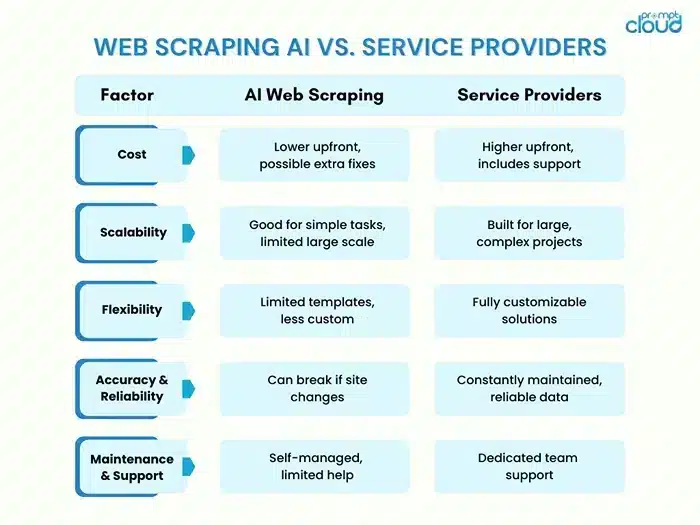
AI Web Scraping Tools vs. Managed Services: Head-to-Head Comparison
The table below covers the eight dimensions that matter most when enterprise teams are making this decision. Neither column is universally better. The right answer depends on where your operation sits across each row.
| Dimension | AI Web Scraping Tools | Managed Web Scraping Services |
| Setup time | Hours to days via low-code or no-code interfaces | Days to weeks for scoped custom pipeline build |
| Entry cost | $0-$333/month for most platforms; enterprise tiers custom | $2,500-$10,000+/month at enterprise scale |
| Scalability | Handles predictable, lower-complexity sites well; degrades at volume | Built for high-volume, multi-domain pipelines from day one |
| Anti-bot handling | Top tools manage CAPTCHAs and JS rendering; weaker ones fail silently | Handled continuously by dedicated team; proxy rotation maintained |
| Data accuracy | Strong on stable pages; can drift when site structure changes | QA layer built in; human validation catches schema drift |
| Maintenance burden | Your team fixes breakages; 80% of engineering time is maintenance | Provider monitors, detects, and repairs without your involvement |
| Compliance support | Dependent on tool vendor policies; limited audit documentation | Providers supply audit logs, compliance docs, and data access agreements |
| Best fit | In-house tech teams, lower complexity, validated use cases | Enterprise pipelines, regulated industries, low tolerance for downtime |
One dimension the table cannot fully capture is risk profile. With AI tools, your team absorbs the risk of breakage, accuracy drift, and compliance exposure. With a managed service, that risk transfers to the provider, who is contractually accountable for delivery quality and uptime. For enterprises where data failures have direct business consequences, ranging from mispriced products to flawed market analysis, that risk transfer is often the single most important dimension in the comparison. It is also why the scraping as a service model has become the default choice for data-critical operations: predictable cost, predictable quality, and accountability that self-serve tools cannot contractually provide. It also changes how you budget: managed service costs are predictable OPEX; in-house failure costs are unpredictable and often invisible until they surface in a quarterly review.
When AI Web Scraping Tools Are the Right Choice
Managed services are not the right answer for every enterprise. There are clear scenarios where AI tools make more economic and operational sense, and recommending managed infrastructure in those situations would create unnecessary cost and complexity.
For teams requiring reliable, production-grade extraction, data for AI and machine learning provides clean, structured web data without the infrastructure overhead.
Your data needs are well-defined and repetitive
If you are pulling product listings from a fixed set of stable e-commerce sites, monitoring job postings from the same ten boards weekly, or tracking publicly available pricing data from sources with consistent layouts, a well-configured AI scraping tool can handle this reliably. The key qualifier is stability. When source behaviour is predictable and change infrequent, the maintenance burden stays low and the tool’s economics hold. AI scraping tools also integrate well into broader workflow automation platforms, making them practical for teams already using tools like Zapier, n8n, or similar automation layers.
You have a technically capable internal team
AI scraping tools have a much shallower learning curve than custom scraper development, but they still require someone who can configure extraction schemas, monitor output quality, and troubleshoot when results drift. If your data team includes engineers or technically fluent analysts who can own this function without it crowding out higher-value work, the in-house route is viable at lower volumes. The critical caveat is bandwidth: if those same people are also responsible for analytics, reporting, and strategy, a scraping maintenance burden can quietly displace the work that matters more.
You are testing a use case before committing
Using an AI scraping tool to validate whether a data source is worth investing in is entirely sensible. Most enterprise-grade managed services require a scoping commitment before work begins. Running a pilot with a no-code or low-code AI tool first gives you the evidence to justify that commitment internally, define the schema requirements clearly, and reduce the risk of a managed engagement that does not deliver what you actually need. Several platforms offer free tiers or pay-as-you-go credits well-suited to this kind of structured evaluation.
Your volume stays below the complexity threshold
For most business teams, $50 to $200 per month covers scraping needs under 100,000 pages per month from relatively accessible sources. At that scale, a managed service contract is difficult to justify on pure economics. The tipping point for most enterprises arrives when they need consistent data across dozens of domains simultaneously, with different structures, anti-bot environments, delivery formats, and refresh cadences. Below that threshold, AI tools are the appropriate and cost-effective starting point.
When Managed Web Scraping Services Are the Better Choice
The managed service conversation becomes necessary when the cost and consequence of data failure exceeds the cost of the service. These are the enterprise conditions where that threshold is consistently crossed.
Your data feeds directly into business decisions
If scraped data flows into pricing engines, competitive intelligence dashboards, financial models, or machine learning training pipelines, a 5% error rate is not acceptable. One enterprise running a three-month pilot comparing a traditional scraping platform against direct LLM extraction for pricing data found the LLM approach sometimes reported prices 20% off the actual value, because it could not reliably distinguish prices inclusive of VAT from prices exclusive of it. When decisions are downstream of the data, accuracy is not a nice-to-have. The restaurant industry case makes this concrete: operators using scraped pricing and menu data to drive competitive positioning cannot absorb extraction errors at scale.
Your sources are complex, protected, or change frequently
Sites with JavaScript-heavy rendering, login walls, session-based navigation, CAPTCHAs, and aggressive bot detection create extraction failures that compound quickly at volume. A 2025 F5 Advanced Persistent Bots report found that over 50% of all website and API traffic is now automated, which has pushed site owners to deploy increasingly sophisticated protections. Managing those defences continuously requires dedicated infrastructure and expertise that most internal teams cannot sustain alongside other product and analytics priorities.
Your team cannot absorb the maintenance overhead
Even when an AI scraping tool works well at setup, it requires ongoing attention. Sites update layouts without notice. Anti-bot rules tighten. Extraction schemas drift when source platforms change their data models. These failures are often silent at first: the scraper continues running but starts returning incomplete, shifted, or inaccurate data. By the time the problem surfaces in a dashboard, the data window may already be compromised. If your data team is already at capacity, the maintenance overhead of running multiple scrapers in production is a real and recurring cost.
You operate in a compliance-sensitive environment
The regulatory environment around web data collection has tightened materially since 2024. Europe’s AI Act, GDPR guidance from CNIL, and the US FTC’s evolving data access framework are creating requirements for auditable, documented, and transparent data collection practices. Managed service providers are building compliance documentation into their standard delivery. For enterprises in financial services, healthcare, legal technology, or any sector where data provenance is subject to audit, working with a provider that can supply documented collection practices is a meaningful risk reduction.
You are scaling across multiple sources simultaneously
Scraping two sites is a tooling problem. Scraping 50 sites reliably, across different geographies, with different delivery cadences and format requirements, is an infrastructure problem. Enterprises attempting to scale AI tools across many parallel sources face a coordination and monitoring challenge that grows faster than the number of sources. Each new source adds its own set of anti-bot characteristics, layout quirks, and failure modes. The most common enterprise web scraping mistakes almost all trace back to underestimating this scaling complexity and applying single-source tooling logic to multi-source operations.
Evaluating Managed Solutions?
See how data for AI and machine learning compares across accuracy, scale, compliance, and total cost of ownership.
Why Enterprises Choose PromptCloud for Managed Web Scraping
PromptCloud is a fully managed scraping as a service platform built specifically for enterprises that treat data as infrastructure, not a side function. The distinction is important: PromptCloud does not offer a tool your team configures and maintains. It delivers a complete data pipeline, from source identification and extraction to cleaning, structuring, and scheduled delivery, with a dedicated team managing every layer of the operation.
Businesses across e-commerce, market intelligence, financial services, retail, and HR technology use PromptCloud to power pricing models, competitive intelligence platforms, job market analytics, and AI training datasets. The common thread across clients is not industry. It is the need for data that is accurate, fresh, and dependable without pulling engineering resources away from the work those teams were hired to do.
PromptCloud is particularly well-suited to enterprises that have already tried the DIY path and hit its ceiling. Most clients started elsewhere. Some built in-house scrapers that became full-time maintenance projects. Others used AI tools that worked at lower volumes and then degraded as complexity and source count increased. A few tried to manage large-scale scraping with freelance contractors and found consistency and quality unpredictable. The inflection point across all of these cases was consistent: when the data operation needed to be as reliable as any other piece of production infrastructure, a fully managed approach became the only viable path.
What sets PromptCloud apart from both DIY AI tools and generic managed services:
- Enterprise-grade scale from day one: PromptCloud handles millions of pages across dozens of sources simultaneously, with the infrastructure to maintain delivery SLAs across complex, high-protection targets.
- Built-in data quality assurance: Every pipeline includes automated schema validation and human QA review. Data is cleaned, structured, and validated before it reaches the client.
- Dedicated project teams: Each engagement is managed by a team that understands the specific sources, schema requirements, and delivery needs. There is no shared support queue or generic ticket system.
- Flexible format and delivery: Output is delivered in the format your downstream systems require, whether that is JSON, CSV, cloud storage, or direct API integration, on the cadence your operation demands.
- Compliance-aware operation: PromptCloud’s extraction practices are built around responsible data collection, including robots.txt compliance, rate-controlled crawling, and documentation support for clients in regulated environments.
If your data needs have reached the point where reliability, scale, and accuracy are non-negotiable, the next step is a direct conversation about what a managed solution would look like for your specific sources and delivery requirements.
Ready to evaluate? Compare data for AI and machine learning options →
Tired of AI scrapers that cap out when complexity kicks in?
• No contracts. • No credit card required. • No scrapers to babysit.
Frequently Asked Questions
What is the difference between AI web scraping tools and managed web scraping services?
AI web scraping tools are software platforms that use machine learning to help users extract data from websites with low-code or no-code setup, while managed web scraping services are fully outsourced data operations where a provider builds, runs, and maintains the entire extraction pipeline on the client’s behalf. The core difference is ownership: with tools, your team owns setup, maintenance, and quality control; with a managed service, the provider does. For enterprises, the distinction matters most when data volume, source complexity, or business criticality crosses the threshold where in-house maintenance becomes a higher risk than the cost of outsourcing.
Which is better for enterprises: AI scraping tools or a managed web scraping service?
Neither is universally better; the right choice depends on your scale, technical capacity, and how much downtime or inaccuracy your downstream operation can tolerate. AI scraping tools are well-suited to enterprises with capable in-house teams, predictable sources, and volumes below approximately 100,000 pages per month. Managed web scraping services are the better choice when data feeds critical decisions, sources are complex or frequently updated, compliance documentation is required, or when the internal team cannot absorb ongoing maintenance without displacing higher-value work.
How much does enterprise web scraping cost in 2026?
Enterprise web scraping costs range from $50 to $200 per month for self-serve AI tools at moderate volumes, to $10,000 to $100,000 or more annually for fully managed services, depending on source complexity, volume, and delivery requirements. However, total cost of ownership for in-house operations typically runs $80,000 to $150,000 annually when engineering salaries, proxy infrastructure, cloud hosting, CAPTCHA-solving services, and ongoing maintenance time are fully accounted for. For enterprises where those hidden costs exceed the cost of a managed contract, outsourcing becomes the economically rational choice.
Can AI web scraping tools handle JavaScript-heavy websites?
Most modern AI scraping tools include some level of JavaScript rendering support, but performance varies significantly by tool and target site. Tools like Browse AI, Diffbot, and Firecrawl handle many JavaScript-rendered pages reliably. However, sites with session-based navigation, complex single-page application architectures, aggressive anti-bot systems, or login walls remain difficult for self-serve AI tools to handle consistently at production scale. Managed web scraping services maintain dedicated browser infrastructure and continuously updated anti-bot countermeasures specifically designed for these environments.
What is AI data scraping and how does it work?
AI data scraping is the use of machine learning models, including large language models and computer vision systems, to identify and extract structured information from websites without relying on brittle, hard-coded HTML selectors. Instead of specifying exactly where data sits in a page’s code, an AI scraper learns what the data looks like semantically. When a site changes its layout, the model adapts rather than failing immediately. In practice, most enterprise AI scraping tools combine semantic understanding with deterministic extraction code, using AI for adaptability and structured logic for speed and consistency at scale.
How do I choose a web scraping service provider for enterprise data collection?
When evaluating a web scraping service provider for enterprise use, prioritise these criteria: demonstrated success rate on your specific target site types, human QA and data validation processes, maintenance model and SLA when sources break, compliance documentation capabilities for your industry, output format flexibility, and pricing transparency. Always ask for a structured pilot on representative samples of your actual sources before committing to a full contract. Providers that resist a scoped pilot are a meaningful risk signal. PromptCloud structures every new engagement with a scoping and testing phase before full production delivery begins.
What are the risks of relying on AI scraping tools for enterprise data pipelines?
The main risks of relying on AI scraping tools for enterprise data pipelines are silent accuracy degradation when target sites change structure, insufficient anti-bot handling for protected or authentication-gated sources, hidden total cost of ownership from proxy and maintenance expenses, and limited compliance documentation for regulated industries. A WebLists research study found that AI extraction agents achieved only 31% recall on structured data tasks from complex interactive websites. For operations where inaccurate data creates downstream business risk, including pricing models, financial analysis, and ML training, these accuracy gaps require careful evaluation before choosing a tool-first approach.
How does a managed web scraping service handle website changes and breakages?
A managed web scraping service handles website changes through continuous monitoring that detects when extraction output deviates from expected schema, volume, or quality thresholds. When a breakage is detected, the provider’s engineering team diagnoses the root cause, whether a layout change, anti-bot update, or structural shift, and repairs the extraction logic before the issue affects data delivery. The client typically receives notification of the incident and resolution without needing to take any action. This contrasts with self-serve AI tools, where breakage detection and repair are the client’s responsibility and are often discovered only when downstream dashboards or models start showing anomalous results.
Is web scraping legal for enterprise use in 2026?
Scraping publicly accessible data is generally permitted in most jurisdictions as of 2026, but the legal landscape is becoming more complex. Europe’s AI Act, GDPR enforcement guidance from CNIL, and the US FTC’s evolving data access framework are creating requirements for transparent, auditable, and purpose-limited data collection. Scraping data behind authentication walls or in violation of a platform’s published terms of service carries distinct legal exposure that varies by jurisdiction. Enterprises building large-scale data collection operations, particularly in regulated industries, should involve legal counsel in the design phase. Managed service providers with compliance-aware practices and documented collection policies can significantly reduce legal risk in this environment.
What industries use managed web scraping services most?
The industries with the highest adoption of managed web scraping services in 2026 are e-commerce and retail for competitor pricing and product intelligence, financial services and investment management for alternative data and market signal monitoring, travel and hospitality for fare tracking and availability aggregation, real estate for property listing and market demand analysis, HR technology and workforce analytics for job market intelligence, and AI and machine learning companies collecting training datasets at scale. The 2026 State of Web Scraping report confirms that 70% of generative AI models are now trained primarily on scraped web data, making managed web scraping infrastructure a direct input to AI product development across virtually every industry vertical.