



What Is a Data Scraping Service?
Enterprises outsourcing data collection to India are no longer making a cost decision. They are making a capability decision. The question has shifted from whether India offers competitive rates, which it does, to whether Indian managed extraction providers can deliver the accuracy, scale, compliance posture, and long-term support that enterprise data pipelines actually require.
The answer, increasingly, is yes. According to Mordor Intelligence, the web scraping software market was valued at $1.03 billion in 2025 and is projected to reach $2 billion by 2030. India accounts for a meaningful share of that growth, with a large and technically sophisticated talent pool that has moved well beyond basic HTML parsing into AI-assisted extraction, enterprise data pipelines, and compliance-aware collection. Indian providers are now competing on quality and specialisation, not just price.
This guide covers what to look for when selecting a managed provider in India, how self-serve tools compare to fully managed services on the dimensions that matter at enterprise scale, what reliable delivery actually looks like in practice, and which providers are worth evaluating. It is written for teams that need a managed extraction pipeline to work as reliably as any other piece of production infrastructure, not as an occasional convenience.
A data scraping service is a managed or semi-managed offering where a provider extracts structured data from websites and online sources on a client’s behalf. Unlike a self-serve scraping tool that your team configures and operates, a data scraping service takes responsibility for the pipeline: building the extractors, managing proxy infrastructure, handling anti-bot systems, validating the output, and delivering clean data in the format and at the cadence the client requires.
The scope of what a managed extraction provider delivers varies. At the lower end, some providers offer on-demand scraping where a client submits a URL list and receives a one-time data dump. At the enterprise end, providers like PromptCloud build continuously maintained pipelines that deliver fresh, schema-validated data on a daily or hourly schedule, with dedicated engineers monitoring and repairing extractors when target sites change.
The distinction between a managed provider and a scraping tool matters practically because it determines who absorbs the maintenance burden. With a tool, your team owns breakage detection, proxy management, anti-bot adaptation, and quality assurance. With a fully managed provider, those responsibilities transfer to the provider. For enterprise teams whose primary work is analysis and decision-making rather than infrastructure management, that transfer has direct and measurable value.
Tired of scraping pipelines that need more maintenance than the insights they produce?
• No contracts. • No credit card required. • No scrapers to babysit.
Why India Has Become a Leading Hub for Data Scraping Services
India’s position as a top destination for managed data extraction is built on a specific set of structural advantages that go beyond cost. Understanding what those advantages are, and where they have limits, is important for enterprises making a sourcing decision.
Technical depth across the full data stack
India produces a large volume of computer science graduates annually, and the country’s technology services industry has matured over two decades to cover the full spectrum of data engineering: web scraping, ETL pipelines, machine learning, business intelligence, and cloud infrastructure. Indian providers increasingly operate at the engineering level of global peers, not as lower-cost copies of them.
Specialisation in high-complexity extraction
The leading Indian providers in this space have built genuine expertise in the most technically challenging aspects of extraction: JavaScript-heavy single-page applications, authenticated scraping at scale, continuous pipeline maintenance against sites with active bot defences, and multi-source aggregation with schema normalisation. These capabilities require years of accumulated operational experience, which the top Indian providers now have.
Time zone leverage for 24-hour operations
For clients based in North America and Europe, India’s time zone creates a natural follow-the-sun support model. Critical breakages that occur during business hours in London or New York are being repaired by Indian engineering teams during their working day, without requiring a client-side engineer to stay up or come in early. For data pipelines where freshness and uptime are contractual requirements, this operational overlap matters. The practical implication is that a data extraction failure that surfaces at 9pm Pacific time can be identified, diagnosed, and repaired by an Indian team at the start of their morning shift, with the repaired delivery arriving before the client’s data team begins their own working day. This follow-the-sun model is one of the operational advantages that distinguishes a well-run Indian managed scraping operation from a smaller provider with no round-the-clock capacity.
Cost efficiency without compromising quality
The top Indian providers deliver enterprise-grade extraction at rates that are materially lower than equivalent US or European providers, not because the quality is lower but because the underlying cost structure differs. Engineering salaries, infrastructure costs, and operational overhead are all lower in India. This allows Indian providers to offer competitive pricing on complex, managed engagements that would be economically prohibitive at US or EU rates.
Regulatory and compliance awareness
The leading Indian providers serving global enterprise clients have built compliance frameworks that address GDPR, CCPA, India’s DPDP Act, and the terms-of-service considerations that apply across different jurisdictions and source types. This is not universal across all Indian providers, which is why compliance due diligence remains a critical part of the evaluation process. But the top-tier providers have invested in this capability as a prerequisite for serving regulated-industry clients.
How to Evaluate a Data Scraping Service Provider: 8 Criteria
The difference between a managed provider that works reliably for years and one that underdelivers within six months almost always comes down to how rigorously the evaluation was conducted upfront. Teams that rush this phase, often under pressure to begin data collection quickly, consistently report that the problems they encounter at month six were visible during the evaluation if they had looked. A structured evaluation against these eight criteria, applied during a scoped pilot phase before any full contract is signed, is the most reliable way to separate providers that can genuinely meet your requirements from those that perform well on simple demonstration sources but struggle on your actual production targets. These are the eight criteria that matter most.
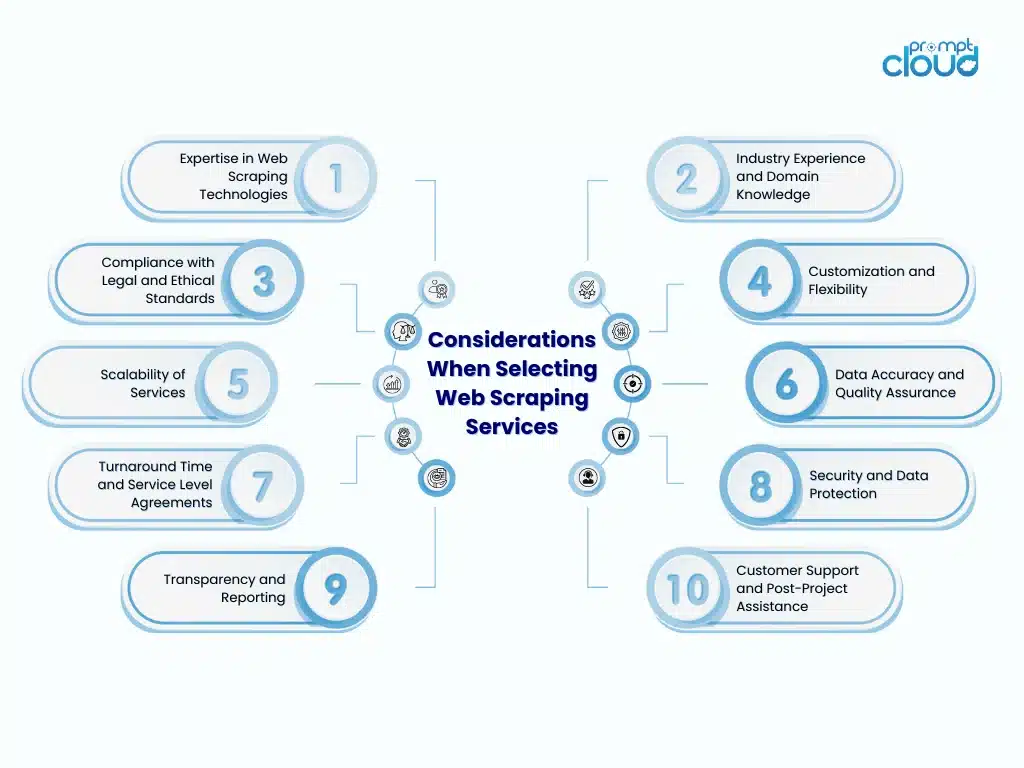
- Technical capability on your specific sources: Ask the provider to demonstrate extraction from sites representative of your actual target list, not just from easy, well-known examples. Anti-bot handling, JavaScript rendering, and login-gated extraction need to be tested on your real sources before any contract is signed.
- Data quality and QA processes: Ask specifically what happens between extraction and delivery. Does the provider run automated schema validation? Is there human review of output? How are anomalies and volume drops detected? A provider that cannot clearly describe its QA layer is likely delivering unchecked raw output.
- Maintenance model and SLA clarity: When a target site changes its layout or deploys new anti-bot systems, what is the provider’s detection and repair process? What is the maximum time between failure detection and restored delivery? These commitments should be in writing, not just verbal assurances.
- Compliance documentation: The provider should be able to supply documentation covering robots.txt compliance, rate-limiting practices, data access agreements, and, for personal data, the legal basis under which collection occurs. Enterprises in financial services, healthcare, and AI development will face compliance questions from their own legal teams. The provider needs to support those answers.
- Output format and delivery flexibility: Your downstream systems have specific format, schema, and delivery cadence requirements. The provider should be able to meet them: JSON, CSV, cloud storage, direct API, or whatever your pipeline requires. Providers that can only deliver in fixed formats create integration overhead.
- Transparency and reporting: You should be able to see delivery logs, volume counts, source health status, and error reports without having to ask. A provider that operates as a black box creates problems when something goes wrong and you need to diagnose it.
- Pilot policy: Any credible managed provider should be willing to run a structured pilot on a representative sample of your actual sources before you commit to a full contract. A provider that resists a scoped pilot is a risk signal. The pilot reveals real-world performance on your specific sources, not just benchmarks on generic test cases.
- Account management and support: Enterprise data pipelines are long-term commitments. The provider should offer a dedicated point of contact who understands your sources, schema, and downstream systems. Shared support queues and generic ticket systems are not appropriate for production-grade pipelines where delivery failures have business consequences.
Self-Serve Scraping Tool vs Managed Data Scraping Service
Before engaging a managed provider, many teams first evaluate whether a self-serve tool can meet their needs. The table below maps the two approaches across the dimensions that determine total cost of ownership and operational risk at enterprise scale.
| Dimension | Self-Serve Scraping Tool | Managed Data Scraping Service |
| Setup | Hours to days; your team configures and runs the tool | Provider handles scoping, build, and setup on your behalf |
| Maintenance | Your engineers fix breakages when sites update or add bot defences | Provider monitors, detects failures, and repairs without client involvement |
| Data quality | Accuracy depends on tool capability and site complexity; QA is your team’s job | Automated schema validation plus human QA on every delivery |
| Anti-bot handling | Varies widely; top tools handle Cloudflare and JS rendering; weaker ones fail silently | Managed through dedicated residential proxy infrastructure and continuously updated countermeasures |
| Compliance | Limited to what the tool vendor documents; no audit trail provided | Provider supplies access logs, compliance records, and data governance documentation |
| Scalability | Handles moderate volumes on stable sources; performance degrades across many concurrent complex targets | Built for high-volume, multi-domain pipelines with defined delivery SLAs from day one |
| Cost model | Fixed subscription plus proxy, hosting, and engineering maintenance costs | Volume or usage-based; all infrastructure, QA, and delivery included in the contract |
| Best for | Technical teams, contained use cases, lower volumes | Enterprise teams, regulated industries, operations where data quality is business-critical |
The self-serve vs managed decision follows a consistent pattern across enterprise teams. Below roughly 20 target sources at moderate volume, a well-run self-serve tool is the more cost-effective option. Above that threshold, especially for operations where data quality directly affects business decisions and downstream system reliability, a fully managed provider typically delivers better value when total cost is calculated. For pricing intelligence use cases specifically, a managed service offers the accuracy and freshness guarantees that pricing engines require to make reliable adjustments.
What to Expect from a Reliable Data Scraping Service
Understanding what good delivery looks like in practice helps distinguish providers who can genuinely meet enterprise requirements from those who are competent at smaller-scale or less complex work.
Structured onboarding and source qualification
Every robust engagement begins with a scoping phase that qualifies your target sources before extraction begins. This includes testing anti-bot complexity, confirming JavaScript rendering requirements, defining the output schema, agreeing on delivery cadence, and identifying any compliance considerations specific to your sources. Providers that skip this phase and move straight to extraction often deliver misaligned schemas or incomplete data on the first delivery.
Schema-first extraction design
The output schema should be defined before any extractor is built, not derived from whatever the scraper happens to collect. A schema-first approach means the extractor is purpose-built to produce the specific fields, types, and relationships your downstream systems expect. This prevents the most common post-delivery problem: receiving data that is technically complete but structurally incompatible with the systems it is supposed to feed. In practice, a schema-first process requires the provider to understand your downstream system requirements, not just your source list. The provider needs to know whether prices should be delivered as integers or decimals, whether dates should follow ISO 8601 or another format, whether product identifiers should match your internal catalogue codes, and how null values should be handled when a field is absent from the source page. Providers that skip this scoping conversation build extractors that technically work but require significant client-side transformation before the data can be used.
Proactive failure detection
Sites change without warning. Anti-bot systems update. Page structures shift. A reliable provider detects these changes through monitoring that flags delivery anomalies, volume drops, schema drift, and extractor errors before they reach the client. The client learns about site changes after they have been addressed, not through empty fields in their dashboards.
Consistent delivery with version control
Each data delivery should come with a record of the sources covered, the volume extracted, the timestamp of extraction, and any schema changes from the previous delivery. This documentation is not just useful for auditing: it is essential for diagnosing issues in downstream systems when something goes wrong. Providers that deliver files without context make troubleshooting far harder than it needs to be.
Top Data Scraping Service Providers Based in India
Several Indian providers have built the technical depth, operational maturity, and compliance awareness to serve enterprise clients reliably at scale. These are the providers most consistently appearing in enterprise evaluations in 2026. The descriptions below are based on publicly available information and are intended to help shortlist candidates for further evaluation, not to replace a structured pilot assessment against your specific sources.
PromptCloud
PromptCloud is a fully managed data scraping service headquartered in Bengaluru, India. It provides end-to-end extraction pipelines with dedicated project teams, automated QA, human validation, and compliance-aware collection. PromptCloud serves enterprise clients across e-commerce, financial services, HR technology, real estate, and AI development, delivering pricing intelligence, market research, job market, and AI training datasets at scale. It is among the few Indian providers with documented compliance frameworks covering GDPR and CCPA alongside India’s DPDP Act.
Datahut
Datahut is an India-based managed extraction provider known for structured data delivery to e-commerce, real estate, and travel clients. The company offers on-demand and scheduled scraping with data delivered in CSV and JSON formats. It is better suited to mid-scale use cases than to complex, high-volume enterprise pipelines.
X-Byte Enterprise Crawling
X-Byte is a managed extraction company with operations across India and the US, specialising in high-volume custom scraping for e-commerce, travel, healthcare, and real estate. The company processes thousands of pages per second and offers pre-built scraper APIs for major platforms. It is a strong choice for teams that need high-volume throughput on known source types.
AIMLEAP Outsource Bigdata
AIMLEAP is an ISO 9001:2015 and ISO 27001:2013 certified Indian provider with capabilities spanning extraction, data labelling, and AI-augmented processing. The certification is relevant for enterprise clients with formal vendor security requirements.
Evaluating cloud scraping APIs alongside managed providers
Not all scraping decisions require a fully managed provider. Teams evaluating cloud-based scraping APIs as part of a self-managed pipeline should compare options carefully. Independent assessments of Scrape.do alternatives and ScrapingBee alternatives provide structured comparisons of what each API delivers on anti-bot handling, JavaScript rendering, pricing, and reliability, which are the dimensions that most often determine whether a self-serve approach remains viable as target complexity increases.
How PromptCloud Operates as an Enterprise Data Scraping Service
PromptCloud is built around a single operating principle: the client defines what data they need and when, and PromptCloud handles everything between that specification and the delivered dataset. There is no infrastructure to manage, no proxy pool to configure, no extractor to maintain, and no QA queue to monitor. The client receives clean, validated data on schedule.
Every PromptCloud engagement begins with a scoping phase that qualifies target sources, defines the output schema to the client’s exact specifications, and establishes the delivery cadence. Extractors are built to that schema, not adapted from generic templates. When a target site changes its structure or deploys new anti-bot defences, PromptCloud’s engineering team detects the change and repairs the extractor before the next scheduled delivery. The client does not learn about site changes from missing data.
PromptCloud’s quality assurance layer covers two stages. Automated schema validation checks every delivery for field completeness, type consistency, volume within expected bounds, and structural integrity. Human QA review, applied on top of automated validation, catches the failures that automated checks miss: shifted currency formats, truncated product names, schema drift from incremental source changes. Both stages run before data reaches the client. For enterprise clients in regulated industries, PromptCloud provides delivery documentation covering the sources scraped, extraction timestamps, volume delivered, and schema version, giving internal compliance and legal teams the audit trail they need without requiring additional instrumentation from the client’s side.
For enterprises evaluating managed web scraping services as an alternative to in-house scraping operations or self-serve tools, PromptCloud offers a structured pilot on representative source samples before any full contract is agreed. This pilot covers the client’s actual sources, not generic test cases, and produces a real delivery that demonstrates schema quality and completeness against the client’s specific downstream requirements.
Choosing a Data Scraping Service in India: The Decision That Determines Your Data Quality
The right managed extraction provider does not just collect data. It defines the quality, freshness, and reliability of every downstream decision that depends on that data. Choosing the wrong provider, or choosing a self-serve tool for a use case that requires managed infrastructure, is a decision whose cost compounds quietly over months before it becomes visible in corrupted dashboards or unreliable pricing models.
India offers a genuine concentration of extraction expertise at enterprise level. The evaluation criteria in this guide, applied rigorously during a scoped pilot phase, will separate providers that can meet your actual requirements from those that can only handle simpler workloads. The pilot is not optional: it is the only reliable way to assess performance on your specific sources before you are already dependent on the delivery.
If your operation has reached the point where data collection needs to function as infrastructure rather than a side project, the next step is a conversation about your specific sources, schema requirements, and delivery expectations. PromptCloud has run that conversation across dozens of enterprise engagements and can give you a clear picture of what a production-grade data pipeline would look like for your use case.
Explore as a starting point if competitive pricing data is your primary use case.
Tired of scraping pipelines that need more maintenance than the insights they produce?
• No contracts. • No credit card required. • No scrapers to babysit.
Frequently Asked Questions
What is a data scraping service?
A data scraping service is a managed or semi-managed offering where a provider extracts structured data from websites on a client’s behalf and delivers it in a usable format. Unlike a self-serve scraping tool your team configures and maintains, a data scraping service transfers the operational responsibility for pipeline setup, proxy management, anti-bot handling, quality assurance, and delivery to the provider. The client defines what data they need, and the provider handles everything involved in acquiring and delivering it.
Why do enterprises choose data scraping services in India?
Enterprises choose data scraping services in India for a combination of technical depth, cost efficiency, and operational scale that is difficult to match elsewhere. Indian providers have developed genuine expertise in complex extraction challenges including JavaScript rendering, AI-assisted scraping, continuous pipeline maintenance, and compliance-aware collection. The cost structure in India allows enterprise-grade data scraping services to be delivered at rates materially below equivalent US or European providers, without a corresponding reduction in quality at the top-tier level.
How much does a data scraping service cost in India?
Costs vary significantly by provider type and project scope. On-demand data scraping services for simple, one-time extractions from a handful of sources can start at a few hundred dollars. Enterprise managed data scraping service contracts range from $10,000 to $100,000 or more annually, depending on source count, extraction complexity, volume, delivery frequency, and QA requirements. When total cost of ownership is compared to building and maintaining an in-house scraping operation, which costs $259,000 to $476,000 per year according to industry analysis, managed services are often more cost-effective above a certain complexity threshold.
What is the difference between a data scraping service and a web scraping tool?
A web scraping tool is software your team configures, operates, and maintains. You own the extraction logic, the proxy management, the anti-bot adaptation, and the quality assurance. A data scraping service transfers these responsibilities to a provider. The provider builds the extractors, manages the infrastructure, monitors delivery health, and repairs failures before they affect the output. For teams whose primary work is analysis rather than data engineering, a data scraping service eliminates a significant and compounding operational burden.
What should I look for when choosing a data scraping service provider?
The eight most important evaluation criteria for a data scraping service provider are: demonstrated technical capability on your specific target sites, a clearly defined QA process covering both automated validation and human review, a maintenance model with explicit SLAs for breakage detection and repair, compliance documentation for the jurisdictions and data types involved, output format flexibility matching your downstream systems, transparent reporting and delivery logs, a structured pilot policy that covers your real sources, and a dedicated account management model rather than a shared support queue.
Is data scraping legal in India?
Scraping publicly accessible data is generally legal in India and in most jurisdictions globally. The HiQ Labs v. LinkedIn ruling established in the United States that scraping publicly available data does not violate computer access laws. In India, data scraping of publicly accessible content does not contravene the Information Technology Act. However, India’s Digital Personal Data Protection Act introduces obligations around the collection and processing of personal data. GDPR applies to any scraping of data about EU residents regardless of where the scraper operates. Reliable data scraping service providers in India maintain compliance frameworks covering these regulations and can supply documentation for enterprise clients with legal audit requirements.
How do I evaluate a data scraping service before committing to a contract?
The most reliable evaluation method is a structured pilot on a representative sample of your actual target sources. Submit a pilot brief that covers three to five of your most complex target sources, your required output schema, and one full delivery cycle. Evaluate the output against your schema specification for completeness, accuracy, and format consistency. Ask the provider to document how they detected and handled any issues during the pilot. A provider that delivers a clean, schema-consistent pilot from complex sources is demonstrating real capability. A provider that resists a scoped pilot or delivers inconsistent output during the pilot will not improve at full contract scale.
What industries use data scraping services most in India?
The industries with the highest adoption of data scraping services from Indian providers in 2026 are e-commerce and retail for competitor pricing and product intelligence, financial services for alternative data and market signal monitoring, travel and hospitality for fare and availability aggregation, real estate for property listing and market data, HR technology and staffing for job market and workforce intelligence, and AI and machine learning companies building training datasets at scale. Indian providers have built particular depth in e-commerce and travel data scraping, where the high source count, frequent site changes, and anti-bot complexity match the capabilities of the leading Indian teams.
How long does it take for a data scraping service to start delivering?
Timeline from initial brief to first production delivery depends on source complexity and provider process. For straightforward sources with stable structures and no significant anti-bot protection, a data scraping service can begin delivering within one to two weeks. For complex sources requiring custom rendering logic, authenticated access, or specialised anti-bot handling, the scoping and build phase typically takes two to four weeks before the first validated delivery. Enterprise managed service providers including PromptCloud structure their onboarding to complete a scoped pilot within the first two weeks, with full production delivery beginning after the pilot schema is confirmed.
What data formats do data scraping services deliver?
Reliable data scraping service providers deliver output in the format your downstream systems require. Common delivery formats include JSON, CSV, XML, Parquet, and direct integration with cloud storage services including AWS S3, Google Cloud Storage, and Dropbox. API delivery is available from most enterprise-tier providers. Providers that can only deliver in a single fixed format create integration overhead on the client side that is worth factoring into the evaluation. PromptCloud configures output format, schema, and delivery destination as part of the initial scoping process for every engagement.