




**TL;DR**
Web scraping often fails not in data collection but in hidden schema breaks and field mismatches. With scraping QA automation, teams use large language models and observability tooling to detect structural drift, validate fields, and catch silent errors shifting from manual firefighting to proactive assurance.
In this article you’ll discover:
- Why schema drift is the silent killer of scraping pipelines
- How LLM-driven QA frameworks validate scraped data automatically
- Real world practices for observability, alerting and remediation
- How this fits into enterprise scraping operations and reduces risk
Takeaways:
- Schema and field testing matter as much as proxies or selectors.
- LLM and observability stack replace much of manual QA work.
- Automation doesn’t remove humans, it shifts them into oversight.
Ever launched a scraper only to find weeks later that the dataset looked “fine” but the missing fields grew silently. The website layout changed, a field got renamed, a page variant slipped through — and your downstream reports started showing blanks or defaults. This isn’t a bug in data capture. It’s a failure in schema compliance and data quality assurance. Traditional scrapers rarely break loudly. They degrade slowly.
That’s where scraping QA automation comes in. Instead of relying on manually defined tests, you build systems that observe collected data, compare it against expected schemas, detect drift, and trigger remediation. With help from LLMs and observability platforms, you move from reacting to breaks to preventing them.
In this article we’ll explore:
- The hidden cost of schema drift and silent errors in scraping.
- How LLMs and automated validation frameworks change QA in scraping.
- Workflow architecture for automated scraping observability.
- Use cases and tool chains for enterprise-scale QA.
- Best practices, metrics and next steps for building resilient pipelines.
Let’s dive into how QA automation shifts scraping from an art to an engineered discipline.
The Cost of Schema Breaks and Why Observability Matters
Every web scraping pipeline starts strong and ends messy. The problem isn’t data extraction; it’s data evolution. Websites change quietly. A field gets renamed, a new variant appears, or pagination logic shifts. The scraper still runs, but what it captures drifts from what your schema expects.
That silent drift is what kills quality.
When you’re dealing with hundreds of sources, schema mismatches multiply. A few missing fields might seem minor until they skew dashboards, break joins, or mislead downstream AI models. By the time someone notices, the data has already been consumed and your insights are off.
Want to see what scraping QA automation looks like in practice?
The Real Cost of “Looks Fine” Data
- Hidden Nulls and Silent Type Errors
You won’t always get errors. Sometimes the scraper writes empty strings where prices should be numbers. Downstream systems accept it, but analytics silently degrade. - Broken Relationships
Missing identifiers or renamed keys break joins between datasets. The pipeline runs fine, but the results no longer match the business logic. - Model Drift in AI Pipelines
If scraped data feeds AI training, schema mismatches can cause model confusion. Fields that once held clean attributes now mix free text or outdated values. - Cost of Manual Detection
Manual QA teams rely on sampling or periodic validation scripts. By the time a break is found, it’s already replicated across thousands of records.
Why Observability Changes the Game
Observability flips QA from inspection to detection. Instead of relying on people to review samples, you instrument the data pipeline itself. It watches for anomalies in field count changes, missing headers, skewed distributions and raises alerts in real time.
A robust scraping observability layer tracks:
- Schema versioning and field frequency
- Distribution patterns for numeric and categorical values
- Field-level null rates and type inference drift
- Unexpected surges or drops in row counts
With those signals, your system doesn’t just catch errors; it learns what “normal” looks like.
This approach mirrors the data assurance practices used in machine learning observability. According to Databricks, modern data pipelines now include drift detection not just for models but for upstream data. The same logic applies here: schema drift is model drift, only one step earlier.
When scraping observability works right, every pipeline becomes self-reporting. Instead of debugging weeks of output, you investigate a single alert before data reaches production.
How LLMs Automate Schema Validation and Field Testing
Manual data validation has always been a weak spot in web scraping. Even the best regex or field mapping logic can’t keep up with how fast websites evolve. Every new layout introduces subtle structural shifts that standard validators miss.
Large language models (LLMs) are changing that equation. Instead of relying on hard-coded rules, they analyze scraped output as humans would compare field names, formats, and semantic intent across runs. They can detect whether “productCost,” “price,” or “amountUSD” refer to the same concept, even when the structure changes.
How It Works in Practice
- Schema Understanding Through Context
LLMs read both historical schemas and recent scraped samples. They learn what each field represents in plain language — “this column usually holds product names,” or “this one contains ratings.” When the next scrape looks different, the model flags inconsistencies automatically. - Automated Field Validation
A validation agent can check each field’s type and consistency. For instance, if the “discount” column suddenly contains text instead of numbers, it raises an alert. LLMs can even estimate expected ranges, catching impossible values like “150% discount.” - Drift Detection Over Time
By embedding previous schema states into vector representations, the system can measure drift quantitatively. If field embeddings shift significantly, it’s a sign that something changed structurally or semantically. - Natural-Language Reporting
Instead of unreadable logs, QA agents generate plain summaries:
- “Field ‘product_name’ dropped from 12k to 0 non-null values.”
- “Column ‘rating_score’ changed from float to string.”
- “New field ‘user_feedback’ detected — not in schema v4.”
This closes the loop between machine detection and human understanding.
Why It Matters
LLMs don’t just validate data; they interpret intent. Traditional schema validation breaks the moment naming conventions shift. LLM-based validation adapts dynamically, catching breaks that regex never will.
It’s the difference between verifying syntax and understanding semantics.
This kind of reasoning-driven QA is already being adopted in enterprise data engineering. In how to use vector databases for AI models, we discussed how embeddings help models “understand” context. The same principle applies here: schema embeddings give the QA system memory and comparison capability across scraping runs.
When combined with version control and observability, LLM-powered validation becomes a permanent guardrail not a one-time test.
Architecture of an Automated Scraping QA System
Scraping QA automation is a system, not a script. Think sensors, memory, and decision making wrapped around your crawlers. The goal is simple. Detects schema drift early, validates fields continuously, and route fixes before bad data lands in production.
The high level flow
- Ingest scraped batches or streams into a staging zone
- Run schema inference and compare against the latest approved contract
- Validate fields with LLM checks and rule based tests
- Score data quality and trigger alerts when thresholds are breached
- Auto remediate if safe, or open a ticket with a natural language report
- Promote only validated data to downstream stores and models
Core components and responsibilities
| Layer | What it contains | Responsibility | Notes |
| Ingestion and staging | Queues, object storage, change logs | Land raw scrapes with full lineage | Keep originals for replay and audits |
| Schema service | Contracts, versions, embeddings of past schemas | Detect drift and map new fields | Learns equivalence such as price versus amount |
| Validation engine | LLM validators, rule checks, type checks | Field level and row level QA | Catches null spikes and impossible values |
| Observability | Metrics store, dashboards, anomaly detection | Track freshness, volume, distribution | Drives alerts based on learned normals |
| Remediation | Auto fix rules, backfill jobs, ticketing | Retry, patch, or escalate | Writes human readable reports for owners |
| Promotion | Warehouse, lakehouse, feature store | Publish only passing datasets | Attach QA badges and version tags |
Metrics and alert thresholds to watch
| Metric | What it signals | Typical threshold example | Action when breached |
| Null rate per field | Missing values or selector break | More than five percent increase versus last week | Raise alert and open canary rerun |
| Type consistency | Unexpected strings in numeric fields | More than one percent type mismatch in a batch | Quarantine batch and trigger LLM review |
| Distribution drift | Price or rating skew outside normal band | Population shift score above set limit | Compare against prior schema and re infer selectors |
| Row count volatility | Crawl completeness issue | More than thirty percent drop versus rolling median | Retry crawl with alternate path and proxies |
| New field detection | Layout change or feature launch | Any new column not in schema vX | Propose contract update and route to owner |
| Freshness lag | Stale feeds or blocked paths | Delay exceeds agreed SLA window | Escalate to operations and rotate routes |
Putting the pieces together
The validation engine does not work alone. It leans on a schema service that remembers yesterday and last quarter. It scales through observability that understands normal volumes and healthy distributions. When something shifts, the remediation layer either fixes it automatically or files a crisp ticket with the full story and the evidence.
A practical example helps. Imagine a retail feed where price suddenly becomes a string with a currency symbol. The LLM validator flags the type flip, the schema service confirms that previous versions stored a float, and remediation strips symbols, retypes safely, and backfills the last hour. Only then does promotion publish the clean table downstream.
If you are designing this from scratch, begin with your contract-first approach. Define the fields that matter, their types, and acceptable ranges. Then add learned checks above the rules. LLM-based validators catch intent-level changes that rules miss, such as reviews that quietly move from star ratings to text-only “thumbs up.”
For teams still assembling reliable sources, this architecture pairs well with a disciplined intake process such as the approach in how to source AI datasets. It keeps inputs structured before they hit the QA engine.
Real-World Workflow: How Automated QA Fits into Enterprise Scraping Operations
Automation is only valuable if it fits the way real teams work. In most enterprise scraping setups, QA has to plug into three moving parts at once: crawling, delivery, and analytics. The challenge isn’t detection, it’s coordination.
When done right, QA automation acts like a silent partner that verifies every stage, from raw extraction to dashboard-ready data.
1. Integration with Crawlers
Every scraper feed should register with the QA engine as soon as it starts producing data. The engine reads the schema, tracks row counts, and begins collecting baseline distributions. Once those baselines are set, the system can detect even the smallest shift in structure or value patterns.
For example, when a site like Costco changes its product layout, the crawler still runs, but the field positions differ. Automated validation catches that early by comparing to prior versions. It’s the same principle that drives operational efficiency in how to scrape Costco product data.
2. Delivery and Staging
After extraction, data lands in a staging environment where the validation engine performs schema checks, field testing, and consistency scoring. Passing batches get tagged “clean,” while questionable ones move to a quarantine bucket. The observability dashboard highlights these changes instantly, giving engineers and analysts the option to override or retrain.
This process reduces manual triage time by more than half and ensures that every feed entering your warehouse carries a QA signature.
3. Feedback to Analytics and Monitoring
Once data is consumed downstream, analytics tools can send feedback signals upstream. For example, if product category counts or sentiment scores deviate from expected ratios, an observability agent can trace the drift back to its source feed.
That feedback loop creates a continuous learning cycle, scraper, QA, analytics, back to scraper.
Enterprises using this closed loop report better pipeline uptime, cleaner joins, and faster recovery from layout changes. It’s a data-quality framework that behaves less like a watchdog and more like a nervous system.
Metrics, Alerts, and Human Oversight in Automated QA
Automation doesn’t eliminate humans. It elevates them. The goal of scraping QA automation is not to replace analysts but to let them focus on pattern recognition, not spreadsheet inspection. To do that effectively, your QA system must communicate clearly through metrics, alerts, and escalation logic that humans can interpret at a glance.
The Metrics That Matter
Every QA engine generates dozens of stats. Only a few truly matter:
| Metric | What It Shows | Why It Matters |
| Schema Stability Score | How much the current schema diverges from the last approved version | Quantifies drift; lower scores mean higher risk |
| Field Validity Rate | Percentage of fields passing type and value checks | Core measure of scraper health |
| Data Consistency Index | How stable distributions remain between runs | Detects subtle layout or content changes |
| Error Recurrence Rate | Frequency of similar schema errors reappearing | Identifies persistent crawl logic flaws |
| Remediation SLA Compliance | How quickly flagged batches are reviewed or fixed | Keeps human feedback loop accountable |
These metrics feed the observability dashboard. A visual heat map or trend chart tells your team when something starts slipping before the damage spreads.
Smart Alerts, Not Noise
Alerting is where most QA automation fails. Too many alerts cause fatigue; too few leave you blind.
Modern systems use LLM summarization to group related alerts and explain them in plain language:
“Three product feeds dropped ‘price_per_unit’ in the last 24 hours. Detected drift severity: medium. Potential cause: HTML layout update.”
This contextual alerting saves hours of guesswork. You don’t just know that something broke and you know why it probably happened. Some setups extend this to Slack or email summaries where QA agents post a short diagnostic message, complete with suggested fixes.
Keeping Humans in the Loop
Automation handles detection. Humans handle judgment.bFor high-stakes data sources like pricing, finance, healthcare, or compliance feeds, the final review still sits with a data steward. They verify the system’s suggestions, approve schema updates, or override false positives.
Think of it as air traffic control for data: the system tracks every flight, but humans authorize landing and takeoff.
This balance ensures accountability and auditability. When a schema drift alert triggers, you can trace who reviewed it, what decision they made, and how it was resolved. That transparency is what converts automation into trust.
The Future of QA Automation in Scraping – From Monitoring to Self-Healing Pipelines
Right now, scraping QA automation is about detection and alerting. You catch schema drift, validate fields, and notify teams before damage spreads. The next phase will go beyond monitoring self-healing pipelines and systems that don’t just report what went wrong, but correct it automatically.
Imagine a crawler that knows when a site’s HTML changes, re-infers its selectors, regenerates its schema, validates the output, and resumes operation without human input. That’s where we’re headed.
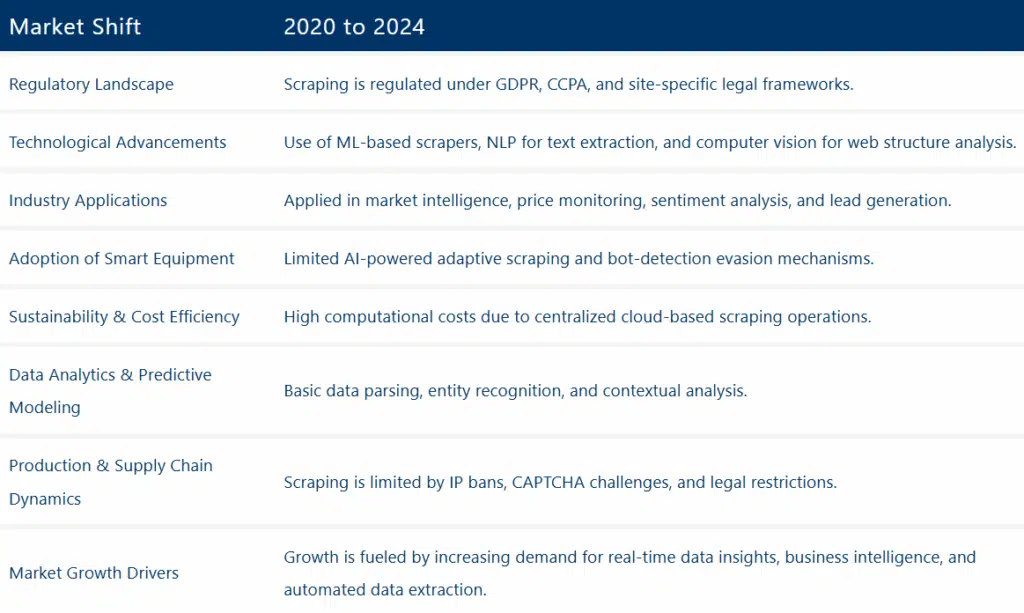
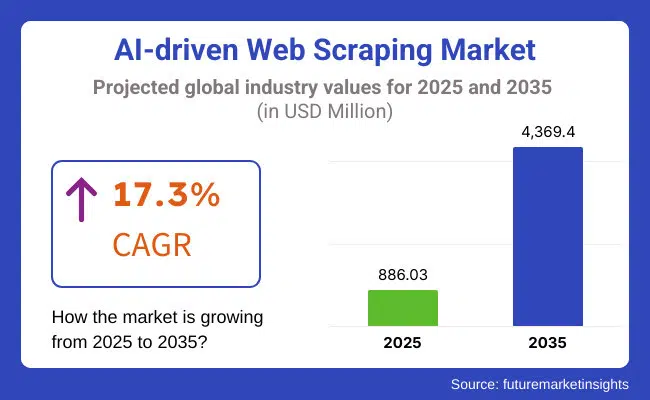
Shifts in the AI-Driven Web Scraping Market from 2020 to 2024.
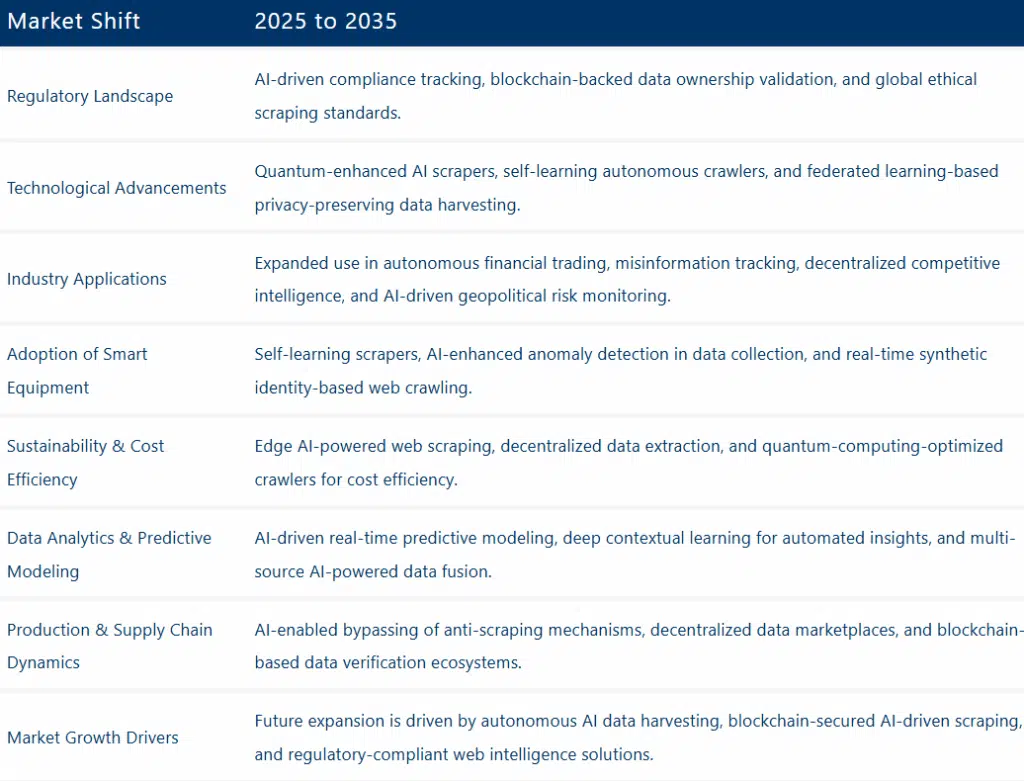
Shifts in the AI-Driven Web Scraping Market: Future Trends 2025 to 2035.
What’s Driving the Shift
- LLM-Driven Reasoning Loops
QA agents will soon analyze error logs and propose fixes in real time. Instead of waiting for a developer to patch selectors, the model can rewrite the extraction logic based on previous schema versions. - Adaptive Schema Learning
Continuous schema embeddings will allow systems to recognize equivalent fields across sites and time. “Cost,” “Price,” or “AmountUSD” become one normalized attribute, updated automatically when new variants appear. - Feedback-Aware Validation
Future validation agents will learn from each decision made by human reviewers. Over time, the system will develop an internal playbook of approved fixes and deploy them proactively. - Integrated Observability Stacks
QA metrics, anomaly detection, and schema tracking will merge into a single layer of observability. Instead of maintaining separate dashboards, scraping pipelines will surface unified health indicators across sources.
What This Means for Enterprises
For enterprise data teams, the future is about autonomy with accountability. Manual schema checks, spreadsheet audits, and reactive debugging will give way to a continuously learning infrastructure that manages itself. Scraping pipelines will evolve into closed-loop systems that detect, diagnose, correct, and verify; all before humans even log in.
That’s not science fiction. It’s the logical outcome of everything happening in scraping QA today.
As seen in agentic AI vs generative AI web scraping, the rise of agent-based scraping already hints at this direction. When validation and automation combine, the pipeline stops being fragile and starts becoming adaptive.
Want to see what scraping QA automation looks like in practice?
FAQs
1. What is scraping QA automation?
Scraping QA automation is the use of AI models and observability tools to validate scraped data in real time. It monitors schema changes, field consistency, and data integrity automatically, reducing the need for manual inspection.
2. How does automation detect schema drift?
Automated QA systems store previous schema versions and compare them with new outputs. When fields disappear, change type, or appear unexpectedly, the system flags a potential drift and triggers validation checks or remediation actions.
3. How are LLMs used in scraping QA?
Large language models interpret schema intent rather than raw field names. They understand that “price,” “amount,” and “cost” might represent the same concept, which allows them to identify meaningful structural changes that rule-based validators miss.
4. What’s the difference between QA automation and scraping observability?
QA automation performs validation, while observability provides visibility. QA ensures accuracy; observability ensures awareness. Together, they create a self-monitoring system that detects issues, explains them, and supports continuous improvement.
5. Can automated QA fix schema breaks on its own?
In advanced setups, yes. Self-healing pipelines can re-infer selectors, regenerate schemas, and resume scraping automatically. Most enterprises still keep human review in the loop to approve final schema updates.
6. What metrics define good scraping QA performance?
Key indicators include schema stability, field validity rate, data consistency index, error recurrence rate, and remediation SLA compliance. These metrics quantify how healthy and reliable your scraping pipelines are over time.
7. Is AI-based QA suitable for all types of scraped data?
Yes, but its impact scales with data complexity. For simple HTML pages, traditional tests may suffice. For multi-structured or frequently changing sources like eCommerce, travel, or news sites, LLM-powered validation saves immense manual effort.
8. How does PromptCloud handle QA automation for enterprise clients?
PromptCloud integrates observability, schema drift detection, and AI validation directly into managed pipelines. Each dataset is versioned, tested, and quality-checked before delivery to ensure compliance and consistency across feeds.