


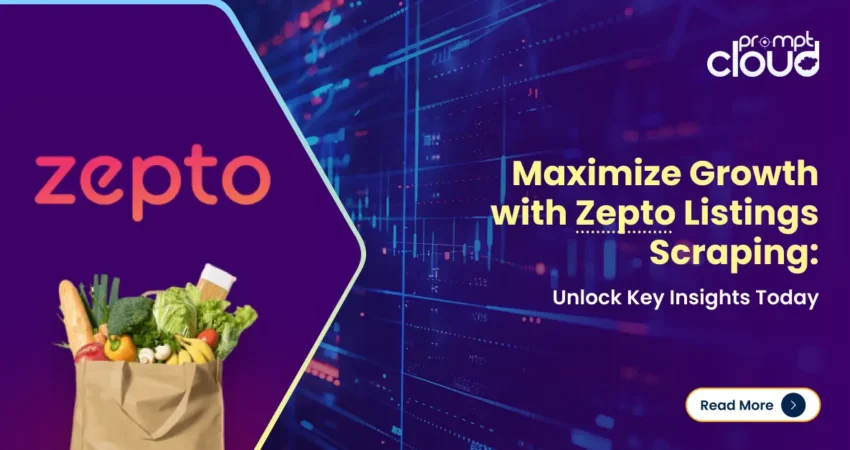

Scraping Zepto Listings: A Practical Guide to Pricing Intelligence in Quick Commerce
Zepto does not give brands a dashboard. There is no API telling a competitor what your prices were at 11 pm on a Tuesday, or which SKUs quietly went out of stock after a flash sale. If you want that intelligence, you have to go and get it.
That is exactly what a growing number of consumer goods brands, pricing analysts, and market research teams are doing , scraping Zepto’s publicly available product listings to extract structured data on prices, availability, categories, and product positioning.
This guide covers what Zepto listing data actually contains, how companies are putting it to work, and what a real scraping pipeline looks like in practice. It also covers the part most articles skip: where scraping setups break down in production, and how to build something that holds up over time.
If you are evaluating whether scraping Zepto makes sense for your team, or looking to replace a brittle in-house setup. This is where to start.
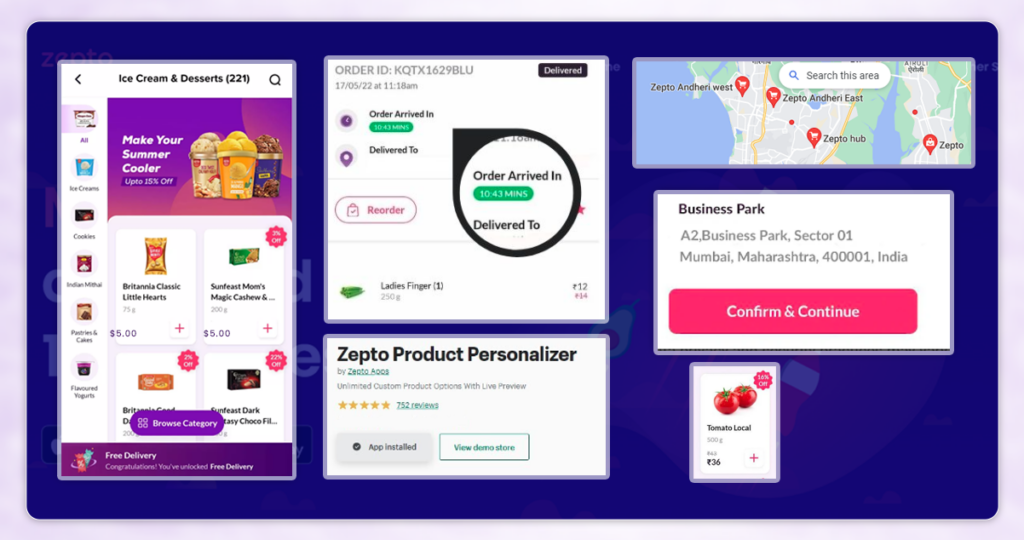
Source: Food Data Scrape
Why Zepto Data Matters More Than Most Brands Realise
Quick commerce in India is not a niche anymore. According to a 2025 report by Redseer Strategy Consultants, the quick commerce market in India is expected to reach $5.5 billion by 2025, with Zepto, Blinkit, and Swiggy Instamart controlling the lion’s share. Zepto alone operates across more than 25 cities and processes millions of orders per month.
For brands listed on Zepto, that scale creates a real data problem. Prices on quick commerce platforms shift multiple times a day. Competitors run limited-time promotions. New SKUs appear without announcement. Category rankings shuffle based on availability and conversion signals. None of this is visible in a seller dashboard.
The brands winning on quick commerce right now are not the ones with the biggest budgets. They are the ones treating Zepto as a live data source and acting on what they see faster than their competitors do.
What makes Zepto particularly interesting as a data target is that it operates on a dark store model. Unlike traditional e-commerce platforms where third-party sellers manage their own listings independently, Zepto controls inventory centrally. That means pricing and availability data on Zepto reflects real supply chain decisions , it is a cleaner signal than most marketplaces.
Stop losing ground on Zepto while competitor prices shift and promotions run without warning.
• No contracts. • No credit card required. • No scraping infrastructure to maintain.
Quick commerce platforms update pricing and availability data continuously, often 8–12 times per day for high-demand categories. Manual monitoring of even 200 SKUs is operationally impossible without automation.
What You Can Actually Extract from Zepto Listings
Before designing a scraping setup, it helps to be specific about what data is available and what you will actually do with it. Zepto’s publicly accessible listings contain several distinct data types, each with different analytical applications.
Pricing Data
The most requested data type. Zepto listings show both the current selling price and the MRP (Maximum Retail Price), which means you can calculate the effective discount percentage at any point in time. Track this across multiple SKUs over weeks and a clear picture emerges: who is discounting, when, and by how much.
Availability and Stock Status
Products on Zepto show as available or out of stock. Tracking availability gaps for competitor SKUs can reveal supply chain pressure , a competitor that is regularly out of stock is losing sales you could be capturing. It also helps with your own demand forecasting.
Category and Search Rankings
Where a product appears in a category listing or search result is not random. Scraping ranking positions over time shows which brands are gaining visibility and which are losing it , and correlating that with price or promotion changes reveals what actually moves the needle.
Product Metadata
Product names, descriptions, images, weight per unit, and pack sizes are all accessible. Brands use this for competitive benchmarking , are competitors changing pack sizes to maintain a low price point? Is a new entrant using a product description strategy that is out-ranking established SKUs?
Ratings and Review Counts
Where visible on the platform, aggregated ratings and review volume tell you about relative consumer trust across SKUs. A product with a lower price but significantly more reviews is going to convert differently than one priced higher with fewer reviews.
Four Ways Brands Are Using Zepto Data Right Now
The data is only useful if it maps to a decision someone actually has to make. Here are four concrete use cases that justify a Zepto scraping programme:
1. Dynamic Pricing Decisions
A beverage brand we worked with was losing weekend sales to a competitor that had started discounting by 12 percent every Friday afternoon. Without price monitoring, the brand had no visibility into this pattern. With a scraping feed pulling hourly data, the pricing team could now respond within the same day , not the same week.
This is the core value of Zepto price monitoring: compressing the time between a market move and your response to it.
2. New Product Launch Benchmarking
Before launching a new SKU on Zepto, brands use competitor listing data to calibrate: what price range does this category support, how are existing products described, and what pack sizes dominate. Going in blind means guessing. Going in with two weeks of scraped data means entering with evidence.
3. Assortment and Gap Analysis
Which product categories are underpopulated on Zepto in your region? Which SKU types are consistently out of stock across multiple brands , signalling demand that no one is reliably serving? Assortment analysis at scale requires structured data. You cannot manually audit 40 categories across 10 competitor brands. Scraped data makes it tractable.
4. Promotional Calendar Mapping
Zepto runs platform-wide promotions tied to events like IPL season, festive periods, and regional holidays. Brands that scrape consistently can reverse-engineer the promotional calendar: when discounts deepen, how long they last, and which categories get the biggest push. That intelligence feeds directly into budget planning and campaign timing.
How to Set Up a Zepto Listings Scraping Pipeline
There is a meaningful gap between scraping a few product pages manually and running a production-grade Zepto data pipeline. Here is what a robust setup actually involves.
Step 1: Define Your Data Requirements First
Start with the decision, not the data. What are you trying to monitor, and how often does that decision get made? If you are tracking competitor pricing for a weekly category review, daily scraping is sufficient. If you are running dynamic pricing that changes intra-day, you need hourly or near-real-time feeds.
Scope your SKU list carefully. Scraping 500 competitor products is manageable. Scraping 50,000 is a different infrastructure challenge entirely. Start narrow, prove value, then expand.
Step 2: Handle Dynamic Rendering
Zepto, like most modern quick commerce platforms, is a JavaScript-heavy single-page application. Basic HTTP requests will not return the product data , you need a scraper capable of executing JavaScript and waiting for the DOM to render before extracting content.
This is one of the first points where many DIY setups fail. Tools like Puppeteer or Playwright can handle this, but they require careful configuration for headless environments and add significant overhead compared to static HTML scrapers.
A detailed breakdown of why simple scrapers break on platforms like Zepto is covered in Why Web Scrapers Fail in Production. Worth reading before you commit to a build.
Step 3: Manage IP Rotation and Request Throttling
Platforms like Zepto have bot detection in place. Sending too many requests from a single IP address will get you blocked quickly. A production scraping setup needs rotating proxy infrastructure , ideally residential proxies, not datacenter IPs , with rate limiting logic that mimics human browsing patterns.
Getting this right is not trivial. Many teams underestimate the time required. According to The State of Web Scraping 2026 report, IP-related blocking and JavaScript rendering are the two leading causes of data pipeline failure , accounting for over 60 percent of production outages in scraping programmes that were built without enterprise infrastructure.
Step 4: Structuring and Cleaning the Output
Raw scraped data from Zepto comes back messy. Product names have inconsistent formatting. Prices include currency symbols that need stripping. Availability flags are sometimes text, sometimes Boolean, sometimes absent. A pipeline that delivers clean, structured output , in JSON, CSV, or directly into a data warehouse , requires a transformation layer between raw extraction and storage.
If you are dealing with downstream data quality issues in an existing pipeline, the guide on 10 challenges in turning web data into insights maps the full range of issues that typically emerge, from schema drift to missing values.
Step 5: Build for Resilience, Not Just Launch Day
Zepto updates its site structure periodically. When it does, scrapers that relied on specific CSS selectors or XPath expressions break silently , they keep running but stop returning accurate data. A production pipeline needs monitoring: data freshness checks, schema validation on incoming records, and alerting when extraction quality drops.
This is the step that most in-house builds skip until something goes wrong. By then, there is usually a backlog of bad data that has already fed decisions.
Build vs. Buy: The Honest Trade-Off
The question every data team eventually asks: do we build this in-house or do we buy a managed solution?
Building in-house gives you control and, in theory, lower ongoing costs. But the upfront investment is consistently underestimated. Beyond the initial scraper build, you are also taking on proxy infrastructure, maintenance as the target site changes, monitoring, and the engineering time to support it.
A realistic breakdown of this trade-off, including which scenarios that favour each approach , is covered in Web Scraping: Build vs. Buy.
In our experience, the calculation shifts strongly toward managed solutions when three conditions are true: the target platform changes frequently, the data is needed reliably rather than occasionally, and the team using the data is not the team building the infrastructure. That describes most quick commerce intelligence use cases precisely.
If you have already tried a DIY approach and hit walls, the post on DIY web scraping challenges in 2026 covers the specific failure modes that are most common in quick commerce contexts , and which ones are solvable without rebuilding from scratch.
| Factor | Build In-House | Managed Solution |
|---|---|---|
| Setup time | 4–12 weeks (engineering) | Days to first data |
| Ongoing maintenance | High: site changes break scrapers | Managed by provider |
| IP / proxy infrastructure | Must build or license separately | Included |
| Data quality assurance | Manual QA process needed | Schema validation built-in |
| Best for | Stable targets, technical team | Dynamic targets, frequent need |
What a Managed Zepto Scraping Setup Actually Delivers
A managed data pipeline for Zepto, handled by a provider like PromptCloud , takes a different form than a self-hosted scraper. The deliverable is not code. It is a structured, maintained data feed that arrives on schedule in the format your team already uses.
In practice, that means: configuring the SKU list and data fields you need, agreeing on delivery format (CSV, JSON, or direct API), setting the extraction frequency, and receiving clean output without managing the infrastructure layer at all.
For teams that need Zepto data as an input into a wider analytics stack, including pricing models, inventory dashboards, and competitive intelligence reports. This is usually the faster path to value. The scraping problem is solved once. The analytics problem is where the team’s attention belongs.
Successful Zepto price monitoring requires clean, structured data delivered consistently at the right frequency. This is the foundation of modern ecommerce industry web data.
PromptCloud delivers structured Zepto data feeds in CSV, JSON, or via API, with schema validation and freshness monitoring included. If you want to see what the output looks like for your specific category, reach out at sales@promptcloud.com.
The Bigger Picture: Zepto as a Market Intelligence Layer
The brands using Zepto data most effectively are not just monitoring their own listings. They are using Zepto as a real-time index of consumer demand across a fast-moving market.
Which categories are growing fastest? Which price points are generating the most visibility? Which competitor SKUs are gaining traction , and is it because of pricing, availability, or product positioning? These are not questions you can answer by logging into your seller account. They require structured data at scale across the entire platform.
Quick commerce is moving fast enough that a two-week lag in competitive intelligence is genuinely expensive. The gap between knowing what is happening on Zepto today versus finding out next month shows up in sales. The brands treating Zepto data like a live feed , not an afterthought , are the ones growing share in the categories where the market is still being defined.
If you are serious about your quick commerce strategy in 2025 and beyond, Zepto listings scraping is not a technical project. It is a business intelligence decision.
Zepto is one of the richest publicly available data sources in Indian quick commerce , and most brands are leaving that data untouched.
Whether you are benchmarking prices before a product launch, tracking competitor availability gaps, or building a real-time pricing model, the value is in the consistency and quality of the data feed , not just the one-off extraction.
The infrastructure challenges are real: dynamic rendering, IP management, schema drift, and data cleaning are not trivial. But they are solvable , either by building the right in-house setup or by working with a managed provider that has already solved them.
If you’re building quick commerce intelligence infrastructure, explore how ecommerce industry web data handles listing extraction, price tracking, and schema maintenance at scale.
Stop losing ground on Zepto while competitor prices shift and promotions run without warning.
• No contracts. • No credit card required. • No scraping infrastructure to maintain.
Frequently Asked Questions
Is scraping Zepto legal?
Scraping publicly available data including product listings, prices, and availability , is generally considered lawful in most jurisdictions, as these data points are accessible to any user visiting the platform. That said, legal standards vary by country and terms of service language differs across platforms. PromptCloud operates within established ethical and legal guidelines and can advise on compliant approaches for your specific use case.
How frequently can Zepto data be scraped?
Extraction frequency depends on your use case. For price monitoring where decisions are made daily, a once-daily scrape is often sufficient. For dynamic pricing applications or promotional calendar tracking, hourly extraction is more appropriate. A managed provider like PromptCloud can configure the right cadence based on your requirements.
What data fields are available in Zepto listings?
Standard fields include product name, SKU identifier, current selling price, MRP, discount percentage, availability status, category, subcategory, product weight or pack size, and , where displayed , customer ratings and review count. Custom fields can sometimes be captured depending on page structure.
Will a scraper break if Zepto updates its site?
Any scraper built on specific selectors will break if the underlying page structure changes. This is one of the core maintenance challenges with in-house builds. Managed scraping providers handle site change monitoring and selector updates as part of the service , so your data feed continues uninterrupted.
How does Zepto scraping compare to scraping Blinkit or Swiggy Instamart?
The technical approach is similar across quick commerce platforms. The main differences are in how each platform renders product data, the rate limiting and bot detection in place, and page structure for categories and search results. PromptCloud supports data extraction across all major quick commerce platforms if a multi-platform view is needed.
How do I scrape Zepto product listings?
Scraping Zepto product listings requires a JavaScript-capable scraper since Zepto is a single-page application — basic HTTP requests will not return product data. Tools like Puppeteer or Playwright can handle the rendering layer. From there, you need to identify the data fields you want (price, availability, category, MRP), set up a structured extraction logic, and pipe the output into a cleaning layer before storage. For production use, you also need rotating proxy infrastructure to avoid IP-based blocking and a monitoring layer to catch when Zepto’s page structure changes and breaks your selectors. Most teams start with a focused SKU list — 50 to 200 products — before scaling.
What is the best way to monitor Zepto prices?
The most reliable approach is an automated scraping pipeline that pulls price and MRP data at a set frequency — daily for strategic reviews, hourly for dynamic pricing decisions. The key is not just capturing the current price but logging it over time so you can identify patterns: when competitors discount, by how much, and for how long. A flat CSV export reviewed manually once a week will tell you something. A timestamped data feed flowing into a dashboard will tell you everything. The difference is in how actionable the insight is when a competitor makes a move at 9pm on a Friday.
Can I scrape Zepto data without getting blocked?
Yes, but it requires the right infrastructure. Zepto uses bot detection that flags repeated requests from the same IP address, unusually fast request intervals, and headless browser fingerprints. To scrape reliably without interruption you need residential proxy rotation, randomised request timing that mimics human browsing behaviour, and a headless browser setup configured to avoid common detection signals like predictable user-agent strings. Datacenter proxies are faster but get blocked more often on quick commerce platforms specifically. The teams that get blocked consistently are usually those who built a scraper that worked fine in testing but never accounted for production-scale request volume.
How is Zepto different from Blinkit and Swiggy Instamart for data scraping?
The core difference is in how each platform handles inventory. Zepto operates on a fully centralised dark store model, which means pricing and availability data reflects direct operational decisions rather than third-party seller behaviour. Blinkit has a hybrid model with some third-party seller influence on listings, and Swiggy Instamart works across a mix of dark stores and partner stores depending on the city. For scraping purposes, Zepto tends to produce cleaner and more consistent pricing signals. The page rendering approach is similar across all three, but schema structures differ — a scraper built for one platform will not work on another without modification.