




Web Scraping at Scale Requires Regional Intelligence
Web scraping at scale is not just about higher crawl volume. It’s about surviving geography, language, infrastructure variability, and jurisdiction-specific rules.
Most teams assume scaling web scraping means adding more servers, rotating more proxies, or increasing parallelization. That works inside one region. It breaks the moment you cross borders.
Because global web data collection introduces new variables:
- Geo-blocking and region-specific IP filtering
- Language and encoding variance
- Localization-driven layout changes
- Data localization laws
- Multi-country anti-bot detection systems
Scaling web scraping globally is not linear expansion. It is distributed orchestration.
Let’s start with the first breaking point.
Get structured, QA-verified datasets delivered with SLAs and human-in-the-loop validation.

Trusted by global data teams across retail, travel, and financial intelligence operating in 40+ countries.
“Our biggest global failures weren’t technical — they were regional inconsistencies. Standardized geo-aware collection changed that.”
Head of Data Engineering
International Marketplace
PromptCloud currently operates scraping infrastructure across 40+ countries, each with dedicated proxy pools, localization parsing layers, and region-specific monitoring dashboards. Over 65% of enterprise web data requests now involve multi-country collection requirements.
Challenge 1: Geo-Blocking and Regional IP Filtering in Web Scraping
At global scale, the first thing you learn is simple: the same URL is not one truth.
Websites gate content by country in ways that don’t look like “blocking” until you compare outputs side-by-side. Sometimes you get a hard wall (403, CAPTCHA, country restriction). More often you get softer controls: throttling, forced login, limited pagination, or a “lite” page version that looks valid but is missing key fields.
This gets ugly fast when your dataset assumes consistency.
A product page might show a different price, different currency formatting, different availability logic, or different shipping promises purely based on IP location. If you scrape globally without locking region identity per session, you end up stitching together records that never existed for any real user.
This is especially common in ecommerce and marketplace sources where “price” and “stock” are location-dependent. If your pipeline is collecting product attributes across markets, you need region-aware capture and region tagging, not just more throughput. The practical patterns and extraction pitfalls are covered well in this guide on extracting product information from ecommerce sites.
What global teams do differently
- Bind IP + locale + headers + session into a single “region identity” instead of rotating proxies randomly.
- Tag every record with country, language, currency, and access path so downstream consumers don’t mix variants.
- Monitor “soft blocking” via coverage checks (e.g., attribute counts, missing nested sections) not just HTTP status codes.
Challenge 2: Localization and Language Parsing Failures
Once you move beyond one country, HTML is not the only thing that changes. Semantics change.
Field labels shift. Units switch. Decimal separators flip. Date formats invert. Category taxonomies fragment. Even identical page templates embed region-specific business logic.
- A parser trained on “$1,299.99” will break silently on “1.299,99 €”.
- A stock indicator like “In Stock” won’t match “Disponível” or “Auf Lager”.
- A date parser expecting MM/DD/YYYY will misread DD/MM/YYYY without throwing an obvious error.
This is where web scraping at scale stops being structural and becomes linguistic.
Localization issues don’t usually crash crawlers. They degrade data quality. You still get output. It just becomes inconsistent across countries.
Now imagine applying that to alternate data use cases across markets. Financial signals, regulatory disclosures, product taxonomies, and corporate announcements vary significantly by jurisdiction. Without normalization layers, cross-country comparisons become misleading. The normalization burden becomes clear when working with global signals such as those discussed in this overview of alternate data sources for hedge funds.
What breaks at global scale
- Currency stored as string instead of numeric float
- Units mixed between metric and imperial
- Category trees diverging across language versions
- Structured fields embedded in translated labels
- Encoding mismatches (UTF-8 vs region-specific encodings)
Scaling web scraping globally requires a localization layer:
- Language detection per page
- Region-aware parsing rules
- Unit and currency normalization pipelines
- Schema abstraction above raw labels
Without that layer, data pipeline scalability collapses under silent inconsistency.
Many of these global failures compound issues first seen in core scraping systems. See our breakdown of foundational web scraping challenges in 2026.
Challenge 3: Global Proxy Rotation Strategies That Break at Scale
Proxy rotation strategies that work in one country often collapse in another.
At a small scale, rotating IPs solves basic IP blocking. At global scale, it becomes far more nuanced. Different regions assign different risk weights to data center IPs. Some markets aggressively fingerprint residential traffic. Others flag ASN clustering patterns. In certain countries, even session timing patterns matter more than IP diversity.
Scaling web scraping globally means proxy rotation is no longer a technical toggle. It becomes geo-sensitive orchestration.
For example, scraping travel marketplaces across countries requires maintaining local browsing behavior per geography. If you rotate a US IP into a German property search and then immediately switch to a Singapore IP for the same listing path, you trigger anomaly detection patterns. This is especially visible in hospitality data collection contexts like scraping Airbnb data for travel industry players, where availability, pricing, and tax logic vary per region.
Where global proxy strategies break
- Uniform rotation intervals across countries
- Shared proxy pools reused across high-risk regions
- No ASN diversity in sensitive markets
- Ignoring mobile vs desktop IP behavior differences
- Centralized routing without local exit nodes
At global scale, proxy strategy must account for:
- Region-specific IP reputation scoring
- Residential vs data center mix tuning
- Session persistence per geography
- Country-level rate thresholds
- Behavioral pacing aligned to local user norms
Scaling web scraping internationally is not about rotating faster. It is about rotating intelligently per region.
Challenge 4: Regional Anti-Bot Detection Systems
Anti-bot systems are not globally uniform.
The same website may deploy different detection stacks in different regions. In North America, behavioral anomaly scoring may dominate. In parts of Europe, stricter fingerprinting and cookie validation may apply. In certain Asian markets, dynamic JavaScript challenges are more aggressive.
Web scraping at scale means you are not fighting one detection system. You are navigating multiple regional configurations.
This becomes more complex when scraping extends beyond text into multimedia. Image-heavy platforms, marketplaces, and search engines often layer bot mitigation differently for media endpoints. When teams move into large-scale image harvesting or visual dataset creation, they quickly encounter fingerprint-based gating mechanisms. The operational nuances are visible in workflows like scraping images for image search engines, where request signatures matter as much as IP diversity.
Regional anti-bot variance shows up as:
- Different JavaScript rendering paths by geography
- Session cookie validation tied to IP region
- Device fingerprint challenges triggered only in specific countries
- CAPTCHA frequency increases tied to region-level anomaly spikes
- Local CDN behavior altering response payloads
The problem is not detection alone. It is inconsistent.
A distributed crawling architecture may perform perfectly in one market while failing silently in another. Status codes look normal. Payloads are returned. But embedded data blocks are missing, partially rendered, or rate-limited.
Global web data collection requires:
- Region-specific monitoring dashboards
- Detection fingerprint comparison across geographies
- Payload completeness validation per country
- Canary crawls to test layout integrity
Scaling web scraping globally is not about bypassing anti-bot systems once. It is about adapting continuously across markets.
Challenge 5: Data Localization Laws and Cross-Border Compliance
Once you scrape globally, storage stops being neutral.
Certain countries require specific categories of data to remain within national borders. Others restrict cross-border transfers unless contractual safeguards are in place. Even when content is publicly accessible, the moment it contains personal data or regulated commercial information, jurisdiction matters.
Web scraping at scale intersects directly with data localization laws.
A pipeline that collects multi-country data and centralizes it in one cloud region may unintentionally violate regional transfer rules. This becomes especially relevant in sectors like ecommerce and travel, where scraped datasets can include user-generated content, host profiles, pricing tied to individuals, or regional tax disclosures.
The challenge is architectural.
Most scraping infrastructure is built for efficiency:
- Centralized storage
- Unified processing clusters
- Global aggregation pipelines
But multi-country scraping introduces legal geography.
Where teams run into trouble:
- No tagging of record origin by country
- No separation of storage buckets by jurisdiction
- Cross-region replication enabled by default
- No data classification layer to identify personal or regulated content
- Inability to isolate or delete country-specific records
Scaling web scraping globally means integrating compliance into infrastructure routing.
That includes:
- Region-aware data tagging at ingestion
- Jurisdiction-based storage policies
- Transfer logging between regions
- Clear mapping of source country vs processing country
Web scraping at scale is no longer just distributed crawling. It is distributed governance.
Experiencing These Challenges?
Get structured, QA-verified datasets delivered with SLAs and human-in-the-loop validation.
Challenge 6: Infrastructure Routing and Global Latency Variability
When you scale from one region to ten, network physics starts to matter.
Cross-continent routing increases latency. DNS resolution behaves differently by geography. CDNs serve variant content based on edge location. Some regions experience packet loss spikes or intermittent throttling that look like site instability but are actually routing issues.
Web scraping at scale amplifies these small inconsistencies.
Timeout thresholds that work in one country cause premature failures in another. Retry logic tuned for low-latency regions overloads slower markets. Distributed crawling nodes may compete for shared upstream bandwidth, creating synchronized slowdowns.
The result isn’t obvious crashes. It’s partial extraction. Incomplete payloads. Missing nested attributes. Pagination that fails on page three instead of page one.
What breaks at global infrastructure scale
- Fixed timeout values across all regions
- Centralized crawl scheduling without regional load balancing
- No latency-based adaptive retry logic
- Overlapping crawl windows across continents
- Lack of payload completeness validation
Scaling web scraping globally requires routing intelligence:
- Regional edge nodes close to target markets
- Adaptive timeout configuration per geography
- Traffic shaping aligned to local network conditions
- Payload size monitoring per region
- Geo-level health dashboards
Data pipeline scalability is not only about processing capacity. It is about network resilience across continents.
Challenge 7: IP Blocking Escalation in Multi-Country Scraping
At a small scale, IP blocking feels tactical. Rotate IPs. Slow down requests. Retry intelligently. At global scale, blocking becomes systemic.
When you operate distributed crawling across multiple countries simultaneously, your traffic footprint compounds. Even if each region stays within acceptable thresholds individually, aggregate behavior can trigger detection patterns.
Anti-bot detection systems correlate signals across:
- ASN clusters
- IP reputation history
- Request fingerprint similarity
- Session reuse across regions
- Behavioral timing patterns
If your global scraping infrastructure uses shared proxy pools across countries, blocking in one region can contaminate reputation elsewhere. A surge in one geography increases scrutiny in another.
This is where scaling web scraping shifts from parallelization to coordination.
Common global-scale failures
- Launching synchronized crawls across markets
- Using identical request headers globally
- Reusing proxy subnets across continents
- Ignoring regional peak traffic windows
- Scaling volume without staggered scheduling
Web scraping at scale requires traffic choreography.
That includes:
- Region-aware scheduling windows
- Independent proxy pools per geography
- Header and fingerprint diversification
- Volume ramp-up strategies instead of instant scaling
- Reputation monitoring across markets
IP blocking at global scale is not a local issue. It is a networked one.
Challenge 8: Geo-Targeted Content in Global Web Data Collection
One of the most underestimated risks in web scraping at scale is data contamination across regions.
Websites increasingly serve geo-targeted content:
- Different pricing tiers
- Tax-inclusive vs tax-exclusive formats
- Localized shipping policies
- Region-specific product bundles
- Currency-dependent discount logic
If your pipeline aggregates these without tagging and separation, you end up with hybrid records that don’t reflect any real market condition.
For example:
A product scraped in the US may show base pricing without VAT. The same SKU scraped in Germany may include VAT and region-specific compliance labels. If those attributes merge into a single canonical record, downstream analytics become misleading.
This problem multiplies in global web data collection. At scale, small regional differences become structural data errors.
Where it breaks
- Canonical SKU mapping without country dimension
- Currency conversion applied before region tagging
- Shared category IDs across markets
- Unified availability flags ignoring jurisdiction
- No locale metadata stored with each record
Scaling web scraping globally requires treating region as a primary key.
Every record should include:
- Country
- Language
- Currency
- Access region
- Timestamp
Without that separation, data pipeline scalability collapses under logical inconsistency. Global scraping is not just distributed crawling. It is distributed context management.
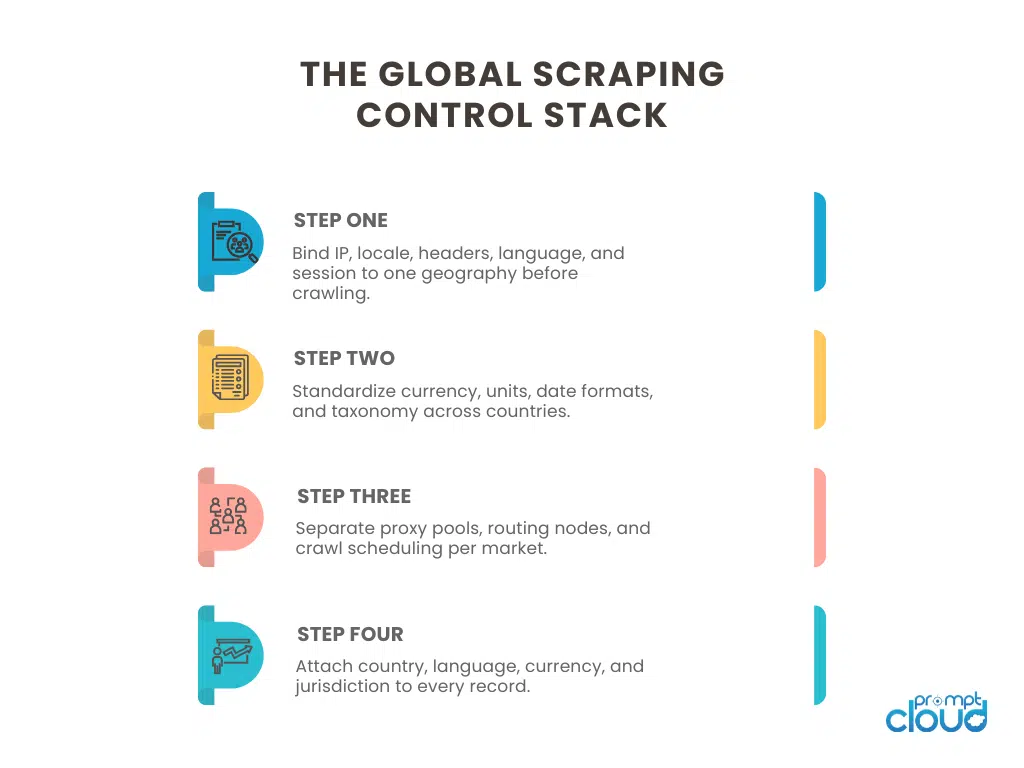
Figure 1: The four structural controls required to stabilize web scraping at scale across multiple countries.
Challenge 9: Cross-Country Data Normalization and Taxonomy Mapping
At global scale, normalization stops being formatting work and becomes structural reconciliation.
Different countries publish the same type of data differently. Ratings use different scales. Units switch between metric and imperial. Category taxonomies diverge. Corporate identifiers vary. Disclosure frequency changes.
A 5-star rating in one market may sit on a 10-point scale elsewhere. A product size listed in inches in one country appears in centimeters in another. A regulatory filing published quarterly in one jurisdiction may appear annually in another.
Without normalization, cross-country comparisons become misleading.
Where global datasets fail
- Assuming identical taxonomies across countries
- Treating numeric scales as equivalent without mapping
- Merging corporate identifiers across jurisdictions without reconciliation
- Ignoring regulatory disclosure frequency differences
- Aggregating signals without adjusting for structural reporting gaps
Data pipeline scalability across markets depends on a translation layer:
- Taxonomy mapping
- Unit normalization
- Scale harmonization
- Identifier reconciliation
- Reporting cadence alignment
Without this, global alternate datasets become apples-to-oranges comparisons. Scaling web scraping internationally is not about collecting more signals. It is about making them comparable.
Challenge 10: Operational Scalability in Global Scraping Infrastructure
At some point, the challenge stops being regional. It becomes organizational. Web scraping at scale stresses not just servers, but processes. When you expand into multiple countries, your infrastructure becomes:
- Multi-region
- Multi-language
- Multi-proxy
- Multi-compliance
- Multi-routing
If ownership remains centralized and undocumented, complexity compounds. What breaks first is observability. Logs are fragmented. Regional failures look isolated. No one has a single view of:
- Crawl health per country
- Payload completeness by region
- IP reputation trends
- Localization error rates
- Geo-specific detection spikes
Operational debt accumulates quietly. Scaling web scraping globally requires more than distributed crawling. It requires distributed accountability.
Common operational breakdowns
- No region-level health dashboards
- Shared error queues across markets
- No escalation routing by geography
- Schema changes rolled out globally without region testing
- No rollback isolation per country
Scraping infrastructure that works domestically can fail internationally simply because coordination mechanisms are missing. At global scale, architecture must include:
- Region-specific monitoring
- Canary crawls per geography
- Independent deployment pipelines
- Regional SLA tracking
- Isolated rollback capability
Web scraping at scale is not a traffic problem. It is an orchestration problem.
Global Web Scraping Risk Map
| # | Challenge | What Breaks at Global Scale | Hidden Impact |
| 1 | Geo-blocking & access controls | Region-specific content mismatch | Distorted datasets that mix incompatible variants |
| 2 | Language & localization variance | Parsing failures and unit inconsistencies | Silent data corruption across markets |
| 3 | Proxy rotation instability | IP reputation contamination across regions | Systemic blocking instead of local throttling |
| 4 | Regional anti-bot sensitivity | Payload suppression without hard errors | Incomplete extraction masked as success |
| 5 | Data localization laws | Cross-border storage violations | Regulatory exposure and forced re-architecture |
| 6 | Infrastructure routing & latency | Timeout variability and partial payloads | Uneven crawl coverage by geography |
| 7 | Escalated IP blocking at volume | Detection triggered by synchronized global activity | Reputation decay across markets |
| 8 | Geo-targeted content inconsistencies | Region data merged without tagging | Analytical inaccuracy and pricing errors |
| 9 | Alternate data normalization gaps | Incomparable taxonomies and rating scales | Misleading cross-country comparisons |
| 10 | Operational scaling failures | Lack of regional observability and rollback isolation | Compounding technical debt and instability |
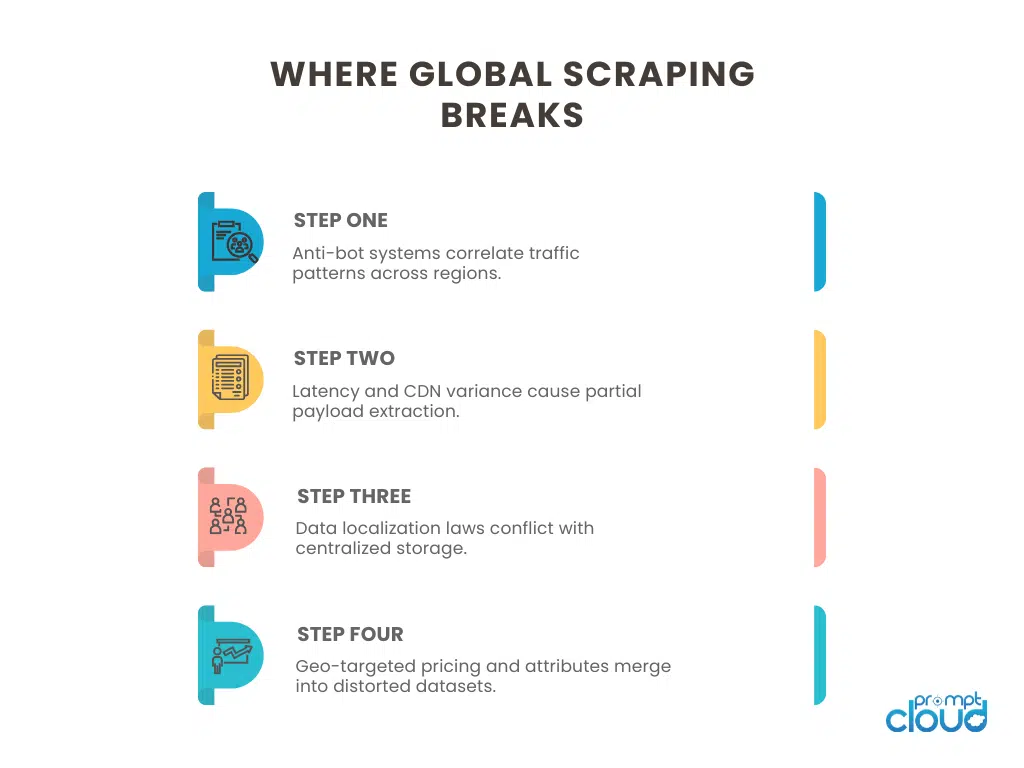
Figure 2: The four systemic failure points that emerge when scaling web scraping globally without region-aware orchestration.
When Web Scraping at Scale Stops Being Engineering
Most teams believe scaling web scraping is a capacity question.
Most teams assume scaling means adding more servers, expanding proxy pools, and increasing parallelism. That logic works inside one region. It collapses globally.
That logic works inside one region. It collapses globally. Because web scraping at scale is not about volume. It is about variance. Every new country introduces new detection systems. New network conditions. New compliance environments. New localization logic. New content structures. New infrastructure bottlenecks. Scaling web scraping globally multiplies unknowns, not just requests. The mistake many teams make is assuming that scaling web scraping is linear expansion. In reality, it is exponential coordination.
What changes at global scale?
At global scale, five dimensions change simultaneously.
- Identity — your crawler must behave like a regional user, not a global machine.
- Context — every record must carry geography, language, and currency before aggregation.
- Orchestration — distributed crawling must be staggered and isolated per region.
- Normalization — signals must be harmonized before comparison.
- Governance — infrastructure must respect jurisdiction-specific storage and routing rules.
At a small scale, errors are visible. At global scale, errors are statistical. You do not see a crash. You see drift.
- Coverage slowly drops in one country.
- Payloads shrink in another.
- Fields start appearing null only in certain markets.
- Currency mismatches creep into analytics dashboards.
- IP blocking increases gradually across regions.
By the time you notice, your dataset has already diverged from reality. Web scraping at scale demands a shift in mindset.
- From crawling pages to managing ecosystems.
- From collecting data to preserving context.
- From parallelizing requests to orchestrating geography.
- From scraping infrastructure to global data infrastructure.
The teams that succeed globally treat the region as a first-class dimension. They build:
- Region-tagged records
- Geo-aware proxy pools
- Localization parsing layers
- Jurisdiction-aware storage policies
- Independent monitoring dashboards per country
What separates successful teams is operational clarity. They design for region variance, data integrity, and predictable delivery instead of patching failures market by market. This is why enterprise Data-as-a-Service for web data requires standardized outputs, geo-aware collection, and dependable delivery. Organizations reaching this realization often evaluate whether to keep scaling DIY global scraping or shift to managed feeds with defined expectations.
Get structured, QA-verified datasets delivered with SLAs and human-in-the-loop validation.
FAQs
1. What makes web scraping at scale different from regular scraping?
Web scraping at scale introduces geographic variance. Content, detection systems, compliance rules, and infrastructure behavior differ by country. Scaling web scraping is less about volume and more about managing regional complexity.
2. Why does geo-blocking increase at global scale?
Because traffic patterns become correlated across markets. Detection systems monitor IP reputation, ASN clustering, and behavioral timing across regions, not just within one country.
3. How should teams handle geo-targeted content?
Every record must include country, language, currency, and region metadata. Without that tagging, datasets merge incompatible variants and corrupt downstream analytics.
4. What is the biggest risk in multi-country scraping?
Silent inconsistency. Localization parsing errors, unit mismatches, and payload suppression often do not trigger hard failures but degrade data reliability.
5. How can teams make global scraping infrastructure more resilient?
Use region-aware routing, staggered scheduling, localized proxy pools, per-country monitoring dashboards, and normalization layers before aggregation.