



Why trend analysis sits at the center of sportswear marketing
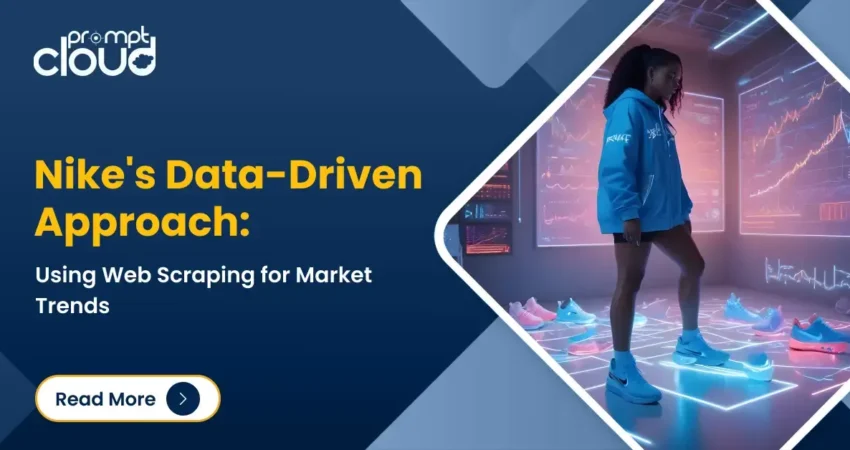
Nike did not become the world’s most valuable apparel brand by guessing what people want to wear. It got there by watching, listening, and measuring. Every sneaker drop, every price adjustment, every campaign is shaped by signals the brand picks up long before a product hits a shelf.
A lot of that signal comes from the open web. Competitor catalogues, marketplace listings, social chatter, review sites, fashion forums, resale platforms, and search trends form a constant stream of data about what shoppers care about right now. Reading that stream at the scale Nike operates is not a job for a few analysts with browser tabs open. It is a job for web scraping.
This piece breaks down how Nike uses web-sourced data to inform its marketing strategy, and how smaller brands can run the same playbook without a $51 billion revenue line behind them.
Why trend analysis sits at the center of sportswear marketing
Sportswear moves faster than most retail categories. A shoe silhouette can go viral on TikTok on Monday and be sold out across resale platforms by Thursday. A collaboration announcement can reshape the demand curve for an entire sub-category overnight. And athleisure, which was once a quiet sub-segment, now competes with luxury apparel for consumer wallet share.
In a market like that, the brands that win are the ones that spot demand shifts before they show up in quarterly sales data. Waiting for point-of-sale numbers is waiting too long. Web scraping gives marketing teams a faster input: the conversations, searches, prices, and listings happening across the open web in close to real time.
For Nike, that input feeds everything from product development briefs to the way individual email campaigns are segmented. It is also the reason the brand can move inventory, pricing, and messaging in lockstep rather than as separate workflows.
Stop reacting to market shifts after they show up in your sales data.
• No contracts. • No credit card required. • No scraping infrastructure to maintain.
Five ways Nike uses web data in its marketing strategy
Nike does not publish its data stack, but the company’s public moves, acquisitions, and earnings commentary make the pattern clear. Here are the five most visible use cases, each paired with how any brand can replicate the approach.
1. Competitive pricing and assortment intelligence
Before Nike sets the price on a new running shoe, its team already knows what Adidas, On, Hoka, and New Balance are charging for comparable models, what the median resale price is on StockX, and which retailers are discounting last season’s stock. That picture is built by pulling structured data from dozens of sources on a rolling schedule.
The value is not just in matching prices. It is in spotting gaps. If no competitor is charging under a certain threshold in the trail running category, that is a whitespace. If every competitor’s new drop is priced 10 to 15 percent higher than last year’s equivalent, that is permission to raise prices without standing out.
Replicate it: start with a narrow list of five to ten direct competitors. Scrape their product catalogue pages weekly. Capture SKU, title, category, price, availability, and promotional flags. Feed this into a simple dashboard your merchandising and marketing teams both see.
2. Trend detection from social and search
Nike’s design calendar is set years in advance, but its marketing calendar flexes in weeks. When a colorway starts trending on sneaker Twitter, or a specific training style gains traction on Reddit fitness subs, the brand’s marketing team can push adjacent products to the top of homepage merchandising, reroute paid media spend, and seed product at the right athletes within days.
The signal sources are diverse: hashtag frequency on Instagram and TikTok, thread velocity on Reddit, search-volume shifts on Google, product-page scroll depth on its own site, and wishlist saves on SNKRS, its sneaker app. What unifies them is that most are observable from the outside with the right scraping pipeline.
Athleisure is the textbook example. Nike did not invent the category, but by reading the data early it expanded its athleisure line while competitors were still running focus groups. The result was a multi-billion-dollar segment that the brand now leads.
Replicate it: pick the three online venues where your buyers actually talk. For a supplement brand, that might be Reddit, Amazon reviews, and TikTok. For a B2B SaaS brand, G2, LinkedIn, and industry Slack communities. Scrape them for keyword frequency, sentiment, and product mentions. You do not need every platform. You need the right three.
Successful sportswear trend analysis requires continuous, structured pricing and product data from competitor catalogues, marketplaces, and resale platforms. This is the foundation of modern pricing intelligence.
3. Voice-of-customer analysis at scale
Nike’s reviews are not just a reputation layer. They are a feedback pipeline into R&D. When a new running shoe launches, scraping aggregated review data from retailers, specialty sites, and forums within the first 30 days tells the team what is landing and what needs to be fixed in the next iteration.
In one widely referenced case inside the industry, early feedback on a new Nike silhouette praised comfort but flagged durability issues in the outsole. Because the feedback was captured quickly through aggregated web data rather than a delayed customer-service summary, the next production run corrected the problem before it damaged the line’s reputation.
Replicate it: set up a rolling review scraping and sentiment pipeline on your top 20 SKUs across every retailer that sells them. Tag comments by theme (fit, durability, value, service). Share a weekly digest with product and marketing together. The companies that do this outperform the ones that treat reviews as a customer-service problem.
4. Demand forecasting and inventory alignment
Nike’s 2018 acquisition of Celect, a predictive analytics company, was a public signal of how seriously the brand takes demand forecasting. The premise is simple: the better you can predict what each regional market will buy next season, the less you overproduce, the less you discount, and the healthier your margins.
Web scraping feeds this model with inputs that first-party sales data cannot provide on its own. Resale market velocity signals unmet demand. Competitor stockouts signal category heat. Search trends by geography signal where demand is arriving before it shows up in brick-and-mortar traffic.
Marketing benefits directly. When inventory forecasts are accurate, campaigns can be built around products the brand actually has in stock, in the right regions, at the right time. Nothing kills ROAS faster than driving traffic to a sold-out SKU.
Replicate it: layer web-sourced demand signals (resale prices, competitor availability, regional search volume) on top of your own sales data. Even a lightweight version of this, refreshed weekly, will make your campaign planning sharper.
5. Personalization and segmentation that actually converts
Nike’s Consumer Direct Acceleration strategy, announced in 2020, was built on a thesis that the brand’s first-party relationships, through Nike.com, the Nike App, SNKRS, and Run Club, were the most valuable asset it had. That thesis plays out in how narrowly the brand segments its marketing.
A marathon runner in Chicago and a CrossFit athlete in Miami do not see the same homepage. They do not get the same emails. They do not even get the same retargeting creative. And the signals that power that segmentation are not only first-party. Public data about races, gyms, event attendance, athlete mentions, and community content feeds the persona model.
Replicate it: the most underrated personalization input for most brands is public event and community data. Scraping local race calendars, gym directories, or industry event listings, and mapping them to customer ZIP codes, gives you segments that no competitor can replicate because no competitor has bothered to build them.
What Nike’s playbook gets right that most brands miss
The specific tactics above matter, but the underlying discipline matters more. Three things set Nike’s approach apart from brands that collect data but do not act on it.
First, the data is continuous. Nike does not run a quarterly competitor audit. The catalogue data, pricing data, and sentiment data are on rolling pipelines that refresh on a cadence matching how fast the category moves. For apparel, that is weekly at minimum.
Second, the data crosses team lines. Merchandising, marketing, design, and supply chain work off the same feeds. This sounds obvious. In most companies it is not happening. Marketing runs one dashboard, merchandising runs another, and product runs a third, and the three disagree on what is true.
Third, the data informs decisions, not dashboards. The point is not to have more charts. The point is that when someone asks “should we reprice this style?” or “is it time to launch the fall campaign?” the answer is already visible in the data, not buried under five tabs of analysis.
A smaller brand will not match Nike’s analytics headcount. But it can absolutely match the discipline.
Where to start if you are not Nike
The mistake most mid-market brands make is trying to build a Nike-scale data program in year one. It fails, budget gets cut, and the initiative stalls. The better path is narrower and faster.
Pick one use case from the five above. Competitive pricing is the most common starting point because the ROI is easy to measure and the data sources are finite. Build a weekly pipeline for that one use case. Prove value in one quarter. Then expand.
This is also the stage where a managed scraping partner pays for itself. Building in-house means hiring engineers, fighting anti-bot systems, maintaining parsers every time a site’s HTML changes, and handling compliance. A managed web scraping service takes all of that off the marketing team’s plate and delivers clean, structured data into a dashboard or warehouse of your choice.
For a broader view of how the data-extraction landscape is evolving heading into 2026, including where AI-ready data and LLM pipelines are reshaping retail analytics, the State of Web Scraping 2026 report is a useful companion to this piece.
The takeaway
Nike’s dominance is not a marketing-campaign story. It is a data story with great marketing wrapped around it. The brand spots trends early because it measures early. It prices accurately because it watches competitors continuously. It personalizes at scale because it treats public web data as a strategic asset, not a nice-to-have.
None of that requires Nike’s budget. It requires picking the right signals, collecting them reliably, and routing them to the people who make decisions. That is a solvable problem. If it is one you want help solving, PromptCloud’s team can scope a pipeline tailored to your category and use case.
If you’re building competitive intelligence infrastructure, explore how pricing intelligence handles multi-retailer tracking, SKU matching, and pricing signal delivery across thousands of products at scale.
External reference used: Nike Investor Relations(FY24 revenue and Consumer Direct Acceleration strategy context)
Stop losing ground to competitors who see pricing and trend signals before you do.
• No contracts. • No credit card required. • No scraping infrastructure to maintain.
FAQs
What is Nike’s data-driven marketing strategy?
Nike’s data-driven marketing strategy is built on continuous signal collection from first-party channels (Nike.com, SNKRS, Nike Run Club) and public web sources (competitor sites, social platforms, review sites, resale markets). This data feeds pricing, product development, inventory planning, and personalized marketing, letting Nike respond to demand shifts in days rather than quarters.
How does Nike use web scraping for market research?
Nike uses web scraping to monitor competitor pricing and assortments, detect emerging product trends on social and search platforms, aggregate customer reviews at scale, and feed regional demand forecasts with signals like resale velocity and competitor stockouts. The common thread is converting unstructured public content into structured data that marketing and merchandising teams can act on.
Can smaller brands replicate Nike’s data strategy without Nike’s budget?
Yes. The discipline transfers even if the scale does not. The most effective starting point is one narrow use case, usually competitive price monitoring, run on a weekly pipeline. Managed web scraping services handle the engineering and anti-bot complexity, which lets mid-market teams get value in a quarter rather than a year.
What data sources matter most for sportswear trend analysis?
Competitor catalogue and pricing pages, resale platforms like StockX, sneaker communities on Reddit and Twitter/X, TikTok and Instagram hashtag data, Google search trends by region, and aggregated review platforms. For most brands, picking three high-signal sources beats trying to monitor everything.
Is web scraping for competitive intelligence legal?
Scraping publicly available web data is broadly permitted in most jurisdictions, with important caveats around personal data, copyright, and individual site terms of service. Working with an established provider that follows robots.txt, respects rate limits, and handles compliance reduces legal and reputational risk significantly. PromptCloud operates within ethical data-collection frameworks as a standard practice.