
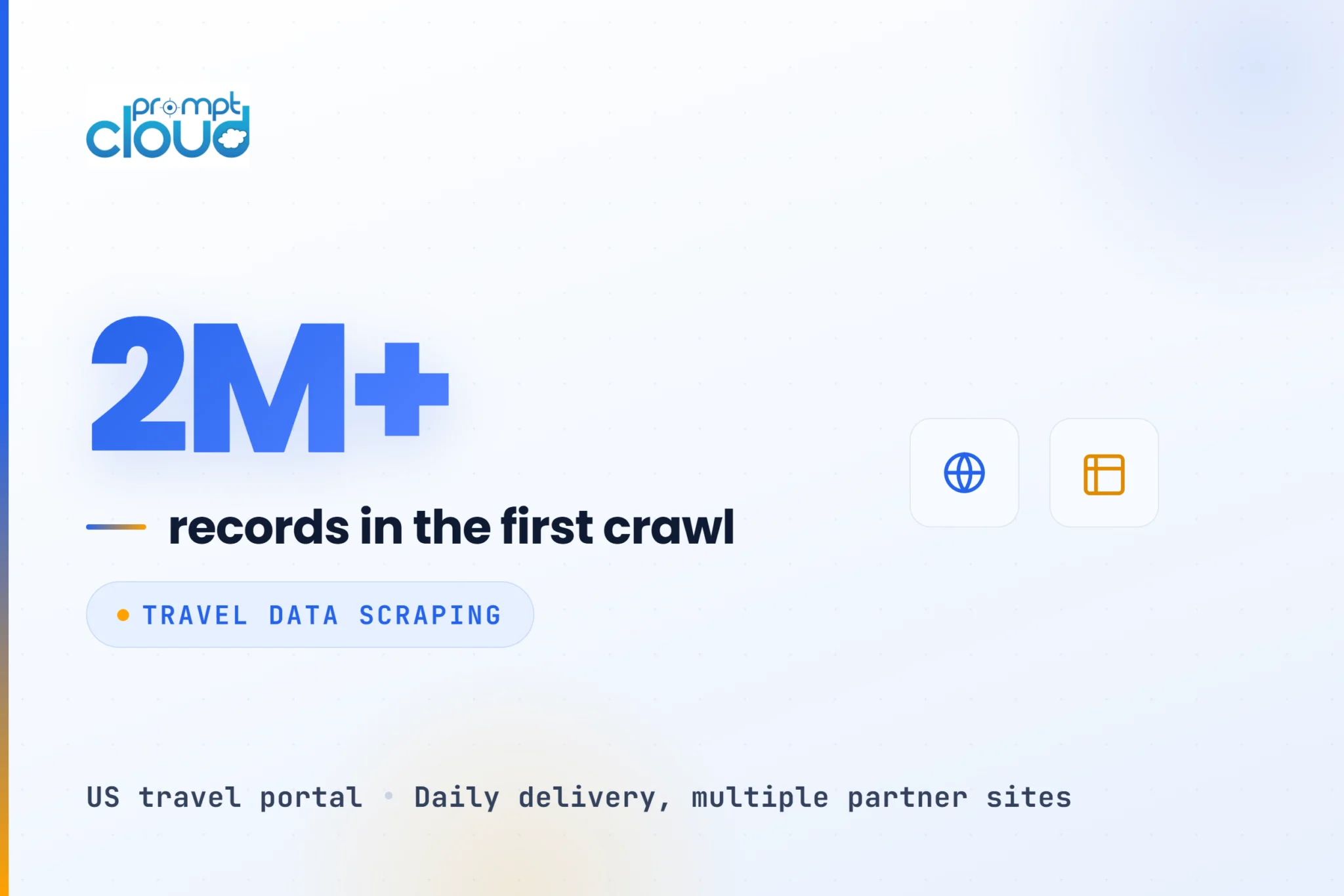
A popular US travel portal needed travel data scraping across multiple partner sites, delivered daily, to keep its own listings database fresh without adding a data team.
Client Overview
A popular travel portal in the United States built its business on showing travelers a wide set of listings pulled together from multiple partner sites, but keeping that listings database current meant constantly pulling fresh data from sources that were never going to standardize their formats for anyone’s convenience. The portal’s own team needed to spend its time on marketing and promotion, not on chasing down and cleaning data from a growing list of partner sources.
What the portal actually wanted was a data layer sitting underneath its existing setup, one that delivered continuous, noise free feeds so the listings database stayed current without pulling the team’s attention away from growing the business. Travel data scraping at the scale this portal needed meant treating data collection as its own dedicated function, not a side task squeezed in between other priorities.
Client Requirements
The portal’s brief to PromptCloud was straightforward in scope but demanding in cadence:
- A defined list of partner sites and data points to crawl, provided by the portal’s own team
- Fresh data delivered every day, not on a weekly or ad-hoc basis
- Delivery in CSV format, uploaded directly to the portal’s S3 servers
- Noise free listings data the team could load straight into its database
- Ongoing monitoring so the crawl kept working as source sites changed
Challenges
Every partner site structured its listings differently, which meant a single generic crawler was never going to hold up across the full source list. Travel data scraping across sites that were never designed to be scraped consistently meant building extraction logic tuned to each source, not a one size fits all approach applied everywhere and hoped to work.
Daily delivery raised the stakes further. A crawl that broke on a Tuesday and stayed broken until someone noticed meant a day of stale listings sitting on the portal’s own site, which is a worse outcome for a listings business than simply having less data. The setup had to be reliable enough that a broken source site got caught and fixed before it ever reached the portal’s database.
Solutions
PromptCloud built this around its site crawling service, since the portal’s partner list spanned sites with different structures, all feeding into one consistent daily delivery.
Crawlers Tuned to Each Partner Site
Rather than one crawler stretched across every source, PromptCloud built extraction logic specific to each partner site on the portal’s list, since travel data scraping across differently structured sources rarely holds up with a single generic template. The portal supplied the source list and the data points it needed, so the crawl setup was built around what the listings database actually required, not a generic travel data template applied without regard for the portal’s own schema.
Daily Delivery Without the Team Lifting a Finger
Once live, the crawl ran every day, delivering fresh CSV files to the portal’s S3 servers without any manual step in between. The initial setup took only a few days, and the first crawl alone delivered around 2 million records, giving the portal an immediate, substantial base of listings rather than a slow trickle that would have taken weeks to build up to something usable.
Monitoring That Catches Problems Before the Team Does
Source sites change layouts without warning, and a crawler tuned to yesterday’s version of a page can quietly start missing data. PromptCloud set up monitoring across the full partner list so changes were caught and fixed before a gap reached the portal’s database. For teams weighing whether to build and maintain this kind of monitoring internally, PromptCloud’s DIY web scraping cost report breaks down what that upkeep tends to cost over time.
Handling Volume Without Slowing Down
Travel data scraping at a daily cadence across a growing partner list produces a lot of data fast, and the underlying tech stack was built to handle that volume without the delivery schedule slipping. Large data volumes moved through the pipeline the same way small ones did, on time, in the same format, which is what let the portal keep adding partner sources without renegotiating the setup each time.
Travel Portal Data Feed, Before and After PromptCloud
| Area | Before | After |
| Listings freshness | Inconsistent, dependent on manual updates | Fresh data delivered daily |
| Partner site handling | One-size crawler risked breaking on new formats | Extraction logic built per source site |
| Team focus | Time split between data upkeep and marketing | Team free to focus on marketing and promotion |
| Site monitoring | Reactive, after something broke | Proactive, issues caught before reaching the database |
Benefits to the Client
The portal’s listings database grew fast, about 2 million records landed in the very first crawl alone, giving the team an immediate base to build on rather than a slow ramp up. All the complex technical work of extraction sat with PromptCloud, which meant the portal’s own team never had to divert attention from marketing and promotion to keep the data flowing.
Initial setup took only a few days before data started arriving consistently, and ongoing monitoring meant the crawl kept working as source sites changed without the portal’s team needing to notice or intervene. Handling that volume never slowed delivery down, the daily cadence held regardless of how much the partner list grew.
Travel Data Scraping That Keeps a Listings Database Honest
A travel portal built on other people’s listings is only as good as how current those listings are. Travel data scraping that runs once and gets left alone will drift out of date the first time a partner site changes its layout, and a listings business cannot afford a database quietly going stale.
What made this work was treating daily freshness as a requirement from the start, not a nice to have, and building monitoring in alongside the extraction itself. That is what turned a list of differently structured partner sites into one dependable feed the portal’s team never had to think about.